
On January 11, 2026, Google and Shopify released the Universal Commerce Protocol (UCP). While most commerce platforms build one-off integrations with ChatGPT, Gemini, and whatever AI agent launches next week, UCP standardized the entire game.
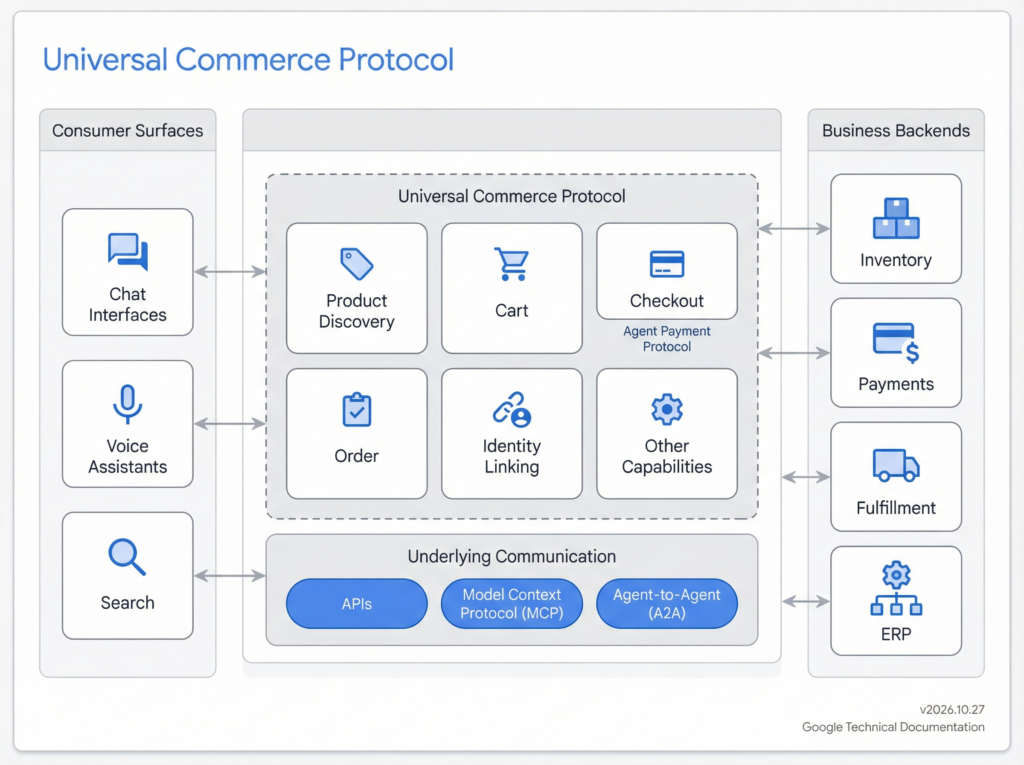
The two companies that process billions of transactions took everything they learned about commerce infrastructure and distilled it into an open protocol. Not a proprietary API. Not a closed platform. An open standard that any merchant, any agent, and any payment processor can plug into.
If you run a Shopify, WooCommerce, or custom e-commerce stack, you need to understand this. Agentic commerce is about to eat traditional e-commerce.
The Problem UCP Solves
Right now, if you want your products discoverable in AI chat interfaces, you face a nightmare:
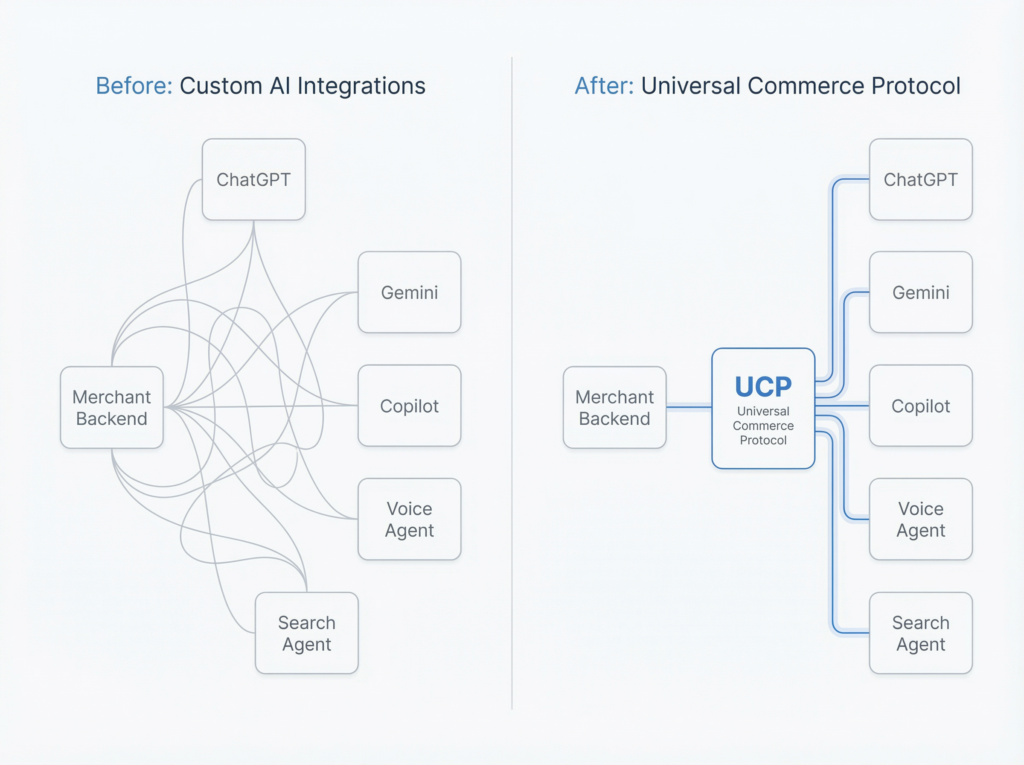
ChatGPT requires a custom integration. Google Gemini needs its own setup. Microsoft Copilot demands yet another API. Every new AI platform means rebuilding everything from scratch.
The math is brutal: 10 AI platforms × custom integration work × ongoing maintenance = your engineering team burning cycles on integrations instead of building features.
UCP flips this model. Instead of building custom integrations for every AI surface, merchants implement UCP once and become available across every agent that supports the protocol. It’s the difference between building a website for Internet Explorer, then Firefox, then Chrome, then Safari versus just writing standard HTML that works everywhere.
How UCP Works (The Technical Breakdown)
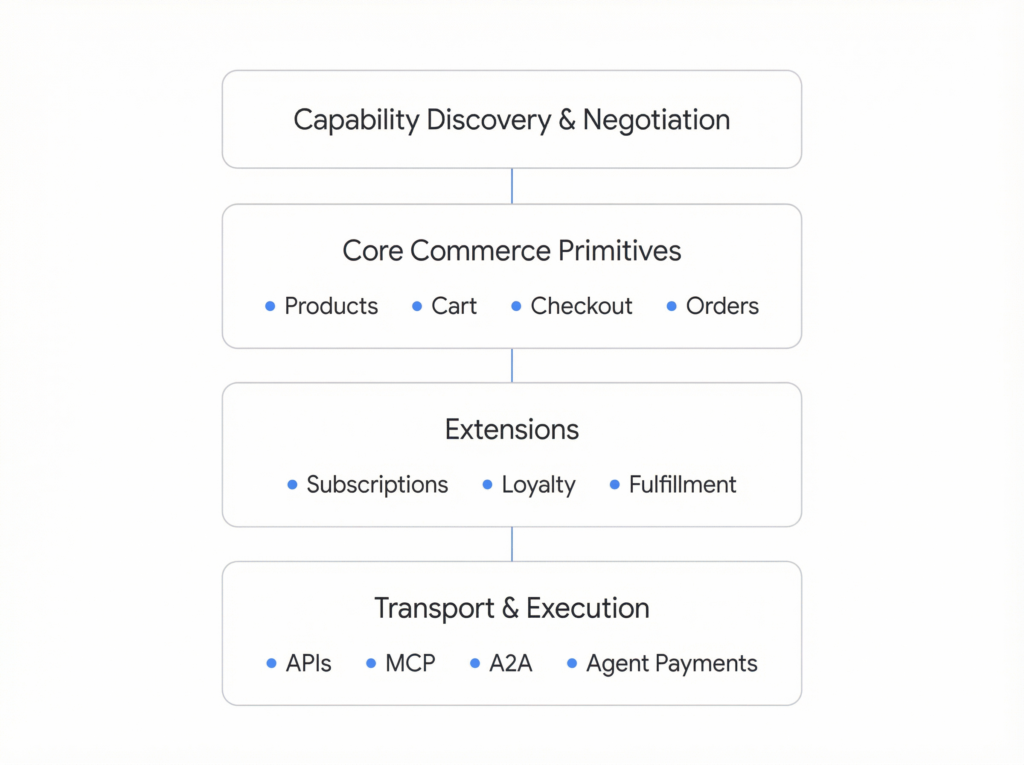
UCP isn’t a payments API with some shopping cart logic bolted on. It’s a layered architecture designed to handle the complexity of modern commerce.
Discovery and Negotiation
Every UCP-enabled merchant exposes a .well-known/ucp endpoint that advertises their capabilities. An AI agent hits this endpoint and knows what this merchant supports: Can they handle subscriptions? Do they support loyalty programs? What payment methods do they accept? Can they do scheduled delivery? Do they offer bundling or discounts?
The agent compares this against its own capabilities, negotiates what it can handle, and proceeds only with the features both sides support. No integration meetings. No six-month roadmap discussions. Dynamic, real-time capability matching.
Core Shopping Primitives
UCP defines the universal building blocks every transaction needs: checkout sessions with proper state management, line items with flexible pricing structures, order status and fulfillment tracking, and dynamic pricing based on cart contents, user location, or loyalty status.
These aren’t rigid schemas. They’re extensible foundations that merchants build on.
Extensions for Everything Else
UCP gets smart here. Instead of defining every possible commerce workflow in the core protocol, it provides an extension system. Need to handle complex fulfillment rules? Add the fulfillment extension. Subscriptions? There’s an extension. Custom loyalty program logic? Build your own extension.
The core protocol stays stable while extensions version independently. Merchants only implement what they need, and new capabilities can emerge without breaking existing integrations.
Transport Flexibility
UCP doesn’t force you into a single integration pattern. It supports REST APIs for traditional HTTP integrations, Model Context Protocol (MCP) for LLM-native tool calling, Agent-to-Agent (A2A) for direct agent communication, and Agent Payments Protocol (AP2) for autonomous transactions with cryptographic proof.
Whether you’re building a traditional API integration or a cutting-edge agentic workflow, UCP has you covered.
Why Payment Negotiation Changes Everything
Most commerce protocols treat payments as an afterthought. UCP inverts this completely with dynamic payment handler negotiation.
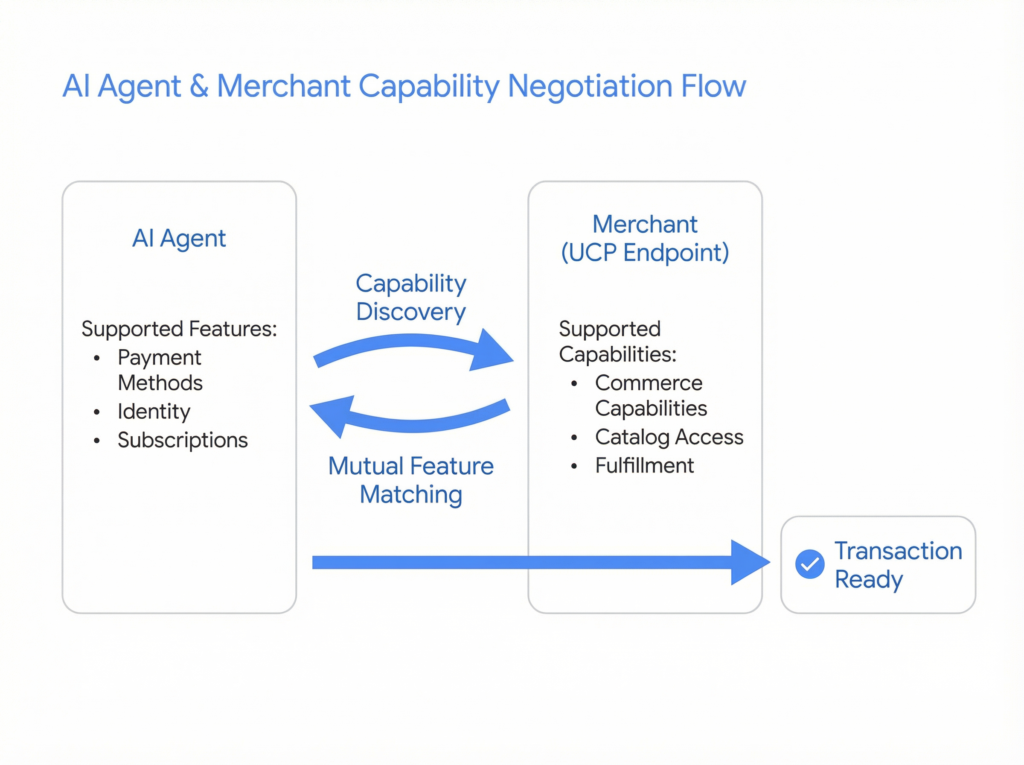
Here’s how it works: the agent profile declares what payment credentials it can provide (Shop Pay, Google Pay, credit cards). The merchant responds with available handlers for this specific cart based on cart contents, buyer location, transaction amount, merchant’s PSP relationships, and fraud rules.
If both the agent and merchant support Shop Pay and Google Pay, the buyer chooses. Change any variable (cart size, buyer region, product type) and the available handlers might shift. This is two-sided, dynamic negotiation for every transaction.
The Embedded Checkout Problem (Finally Solved)
One of the hardest problems in agentic commerce: what happens when the AI can’t complete the transaction autonomously? Maybe the customer needs to select a delivery window. Maybe they need to verify their address. Maybe there’s a business-critical checkout customization that requires human interaction.
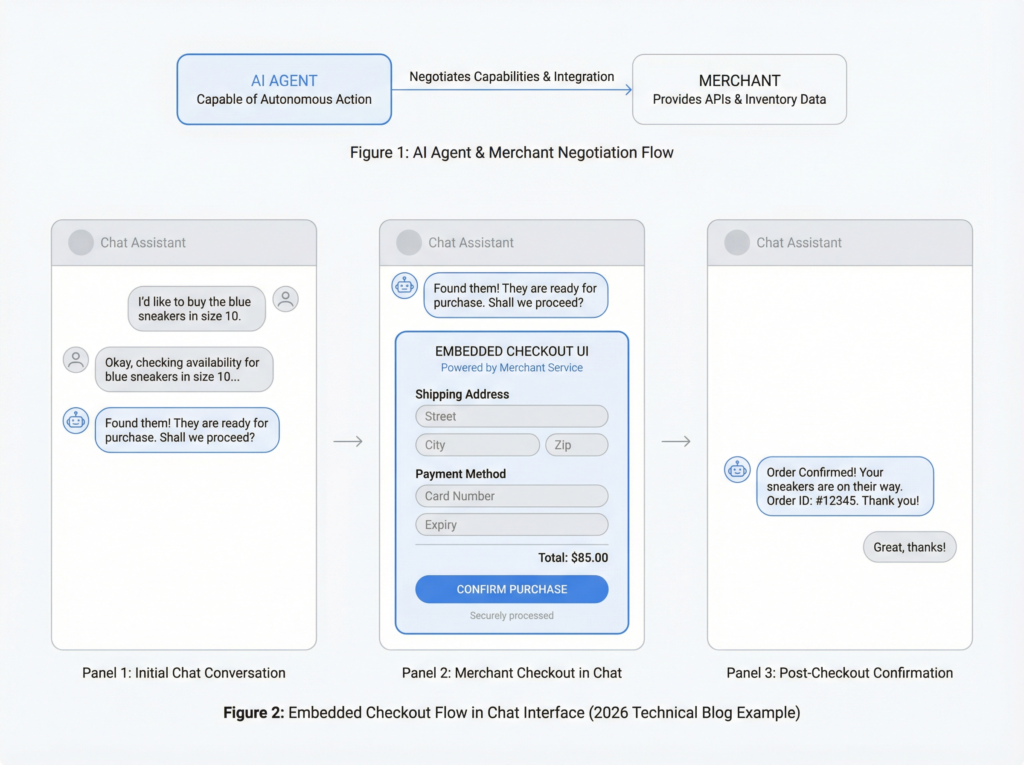
Most protocols fail at this point or redirect the user completely out of the conversational experience. UCP solves this with Embedded Commerce Protocol (ECP), which enables agents to render a merchant’s checkout UI within the chat interface.
Customers stay in the conversation. Merchants keep their business-critical extensions. Payment and address selection still work. The UI maintains the agent’s branding for a unified experience.
It’s the graceful handoff that agentic commerce needs to work in production.
❓ UCP enables AI checkout. It does not guarantee AI discovery.
Whether an agent recommends your brand depends on how AI models understand, rank, and trust your store.
The ShopOS Brand Audit shows how ChatGPT, Gemini, and Perplexity see your brand today, highlights visibility gaps, and flags UCP issues that block agent-led purchases.
Who’s Using This?
The adoption list reads like a who’s who of commerce.
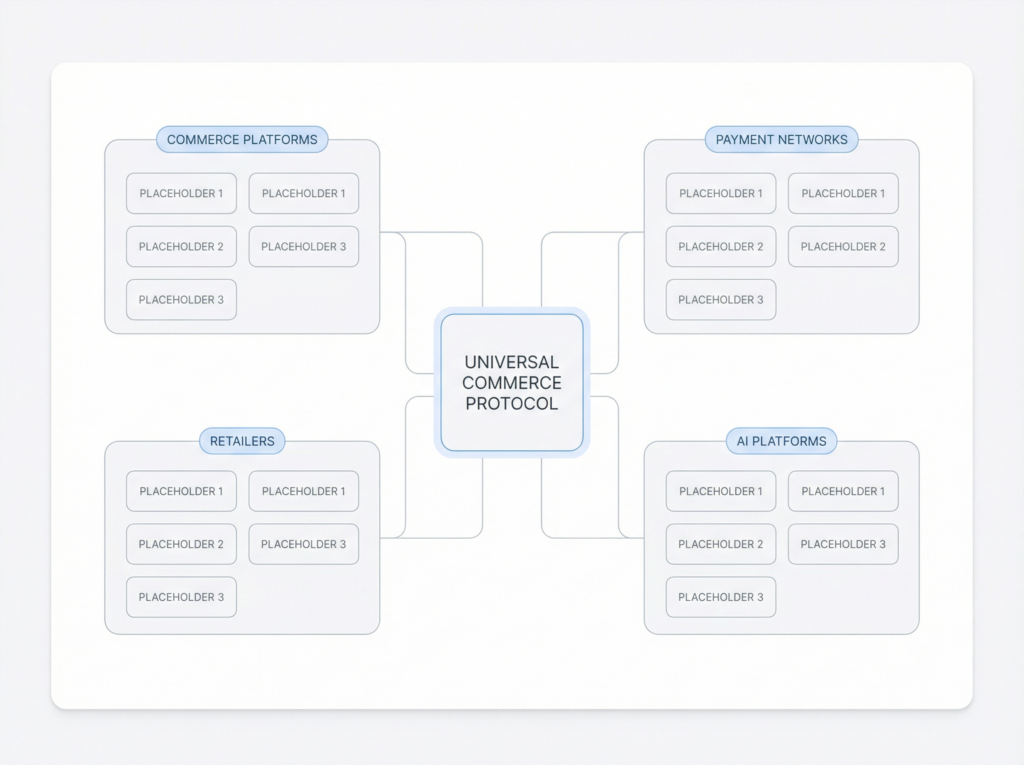
Co-developers: Shopify, Google, Etsy, Wayfair, Target, Walmart
Endorsed by 20+ platforms including: Adyen, American Express, Best Buy, Flipkart, Macy’s, Mastercard, Stripe, The Home Depot, Visa, Zalando
Shopify merchants like Monos, Gymshark, and Everlane are selling directly in Google AI Mode and Gemini. Brands like Keen and Pura Vida are using Copilot Checkout.
“At Monos, we’re excited about agentic shopping because it enables us to meet customers where they already are,” said Victor Tam, CEO and Co-Founder. “It’s a new way for our story and product details to show up at the exact moment someone is asking real questions with real intent.”
What This Means for Your Commerce Stack
If you run a modern e-commerce brand, here’s what you need to understand:
Agentic commerce isn’t a future trend. It’s rolling out now. Google Gemini and AI Mode shopping launched in January 2026. Microsoft Copilot Checkout is live. ChatGPT shopping has been available for months. Millions of people are discovering and buying products through AI conversations.
The integration burden is gone. Implement UCP once and you’re available across every agent that supports the protocol. Your engineering team can focus on your product instead of maintaining a dozen custom integrations.
You stay in control. Unlike platform-locked solutions, UCP lets you remain the merchant of record. You keep your customer relationships, your data, your checkout customizations, and your brand experience. You’re not handing over your entire business to an AI platform. You’re making yourself discoverable.
The SEO game is changing. Traditional keyword optimization is giving way to something new: being the best answer to a conversational query with accurate product data, real-time inventory, and seamless fulfillment. The brands that nail this early will dominate discovery.
How ShopOS Fits Into the Agentic Commerce Stack
UCP handles the standardized checkout layer-the universal language that lets any merchant talk to any agent. But modern e-commerce needs more than checkout flows: product imagery that converts in conversational contexts, content generation at scale for 30-day pipelines, brand memory systems that maintain creative consistency, and automated workflows that adapt to each platform’s requirements.
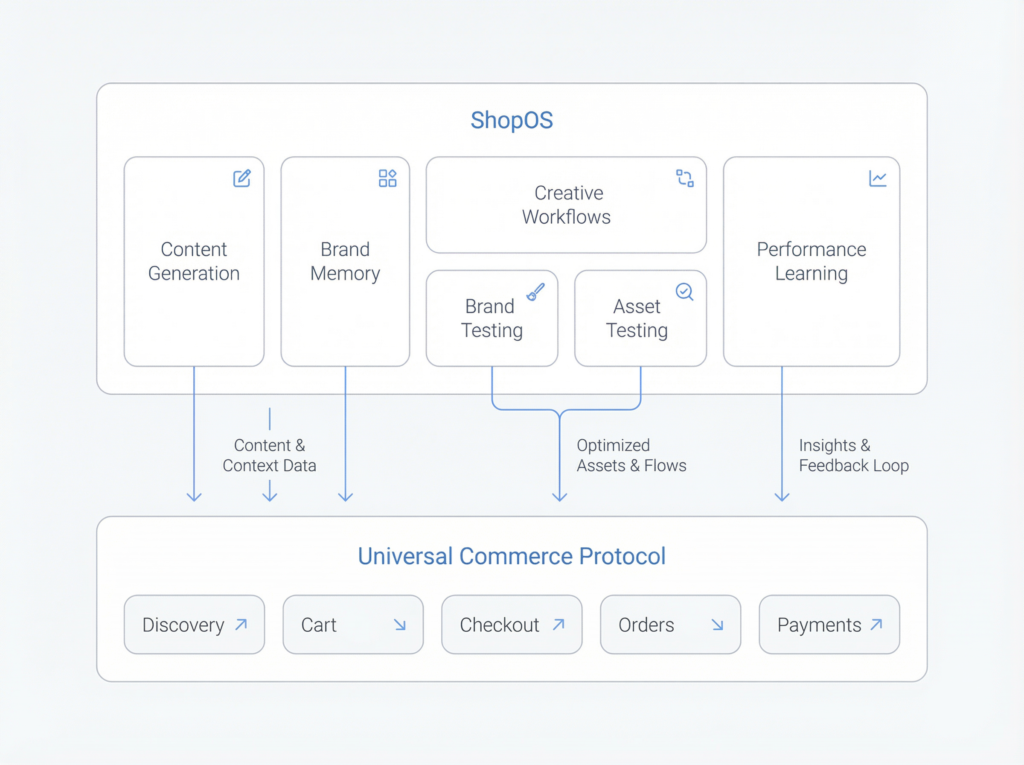
ShopOS operates at that layer-the AI-powered operating system that generates the assets, content, and creative workflows that feed into agentic storefronts. UCP ensures your checkout works everywhere. ShopOS ensures you have something worth checking out.
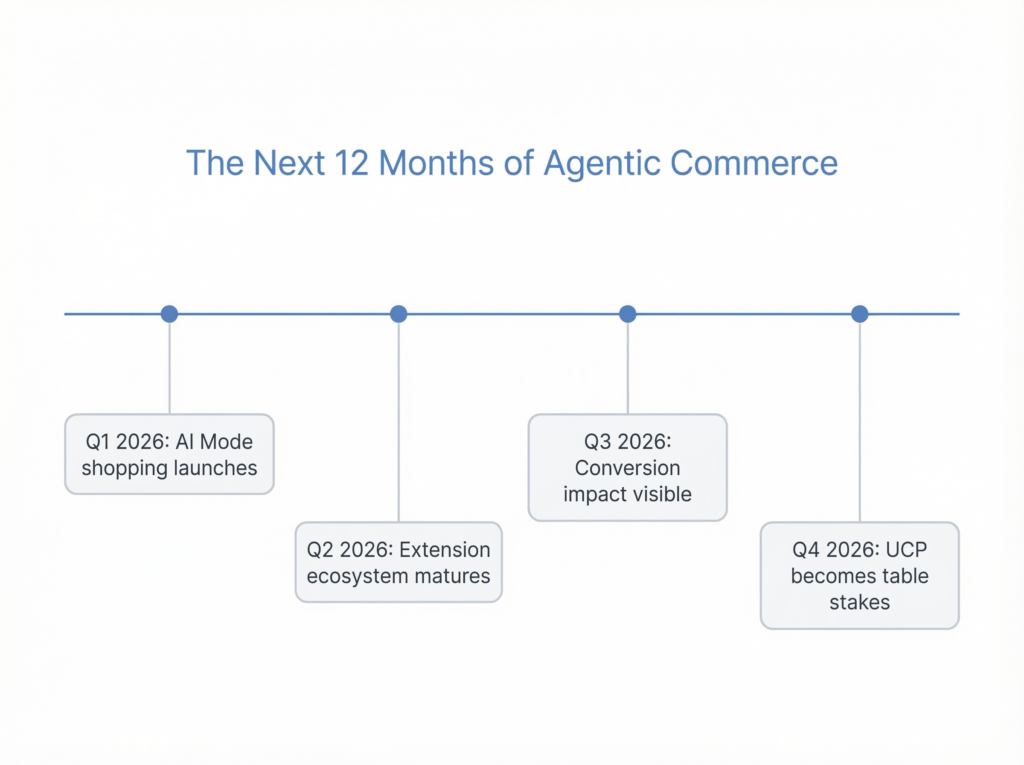
The Next 12 Months
Here’s what’s coming based on the current rollout:
Q1 2026: Google AI Mode and Gemini shopping go fully live for UCP merchants. Microsoft Copilot Checkout becomes widely available.
Q2 2026: More AI platforms adopt UCP. Expect announcements from Meta, Apple, and regional players. The extension ecosystem matures with specialized capabilities for subscriptions, complex fulfillment, and loyalty programs.
Q3 2026: Agentic commerce starts showing up in platform metrics. Early adopters report measurable discovery and conversion gains. Traditional SEO teams start pivoting to conversational optimization.
Q4 2026: UCP becomes table stakes. Not having it implemented means you’re invisible to millions of high-intent shoppers discovering products through AI conversations.
The Bottom Line
The Universal Commerce Protocol isn’t just another API spec. It’s the TCP/IP of commerce-a fundamental protocol that makes the entire ecosystem interoperable.
Shopify’s Harley Finkelstein framed it perfectly: this levels the playing field. Instead of advertising dominance or SEO gaming, discovery becomes merit-based. The AI recommends what fits the customer’s needs based on product data, availability, and genuine suitability.
The brands that understand this shift-that optimize for conversational discovery, that implement UCP early, that build systems to generate the content and assets agentic commerce needs-those brands will own the next decade.
The protocol is open. The spec is public at ucp.dev. The major platforms are rolling out support now.
The first step is not implementation.
It is understanding how AI systems already see your brand.
Run the ShopOS Brand Audit to assess your GEO visibility and UCP readiness.
Sources: