

 ChatGPT
 Perplexity
 Claude
 Gemini
 Grok
Grok
AI Merchandising. AI can optimize a Shopify store faster than any team can manually review it.
It can sort products, recommend bundles, personalize journeys, generate offer ideas, support customer service, and automate parts of merchandising. For ecommerce teams under pressure to move faster, this is not a future advantage. It is already becoming the operating baseline.
But optimization is not the same as judgment.
That is the sharper question behind AI-native ecommerce: not what AI can do, but what smart brands should still refuse to hand over completely.
At AI-Native E-Commerce · Edition 01, powered by Meta, ShopOS, and Crafeed at One BKC, Mumbai, the room was designed around operators who are not discussing AI from a distance. The event page describes it as a working morning where founders and teams compare how they use AI across creative, discovery, performance, retention, merchandising, growth, and operations.
That context matters.
The founders and operators at Edition 01 represent the judgment layer behind brands that have scaled in very different categories. An apparel founder knows when a product pairing feels premium or off-brand. A workwear founder knows when comfort, function, and real-world use matter more than clicks. A personal care founder knows when recommendation needs education first. A purpose-led commerce founder knows when demand needs cultural sensitivity before becoming a campaign.
AI can make ecommerce faster.
But smart brands still keep four decisions in human hands:
- Edge-case decisions
- Brand-risk decisions
- Taste and aesthetic decisions
- Customer escalation handling
That is the real human layer in AI-native ecommerce.
What Is AI Merchandising?
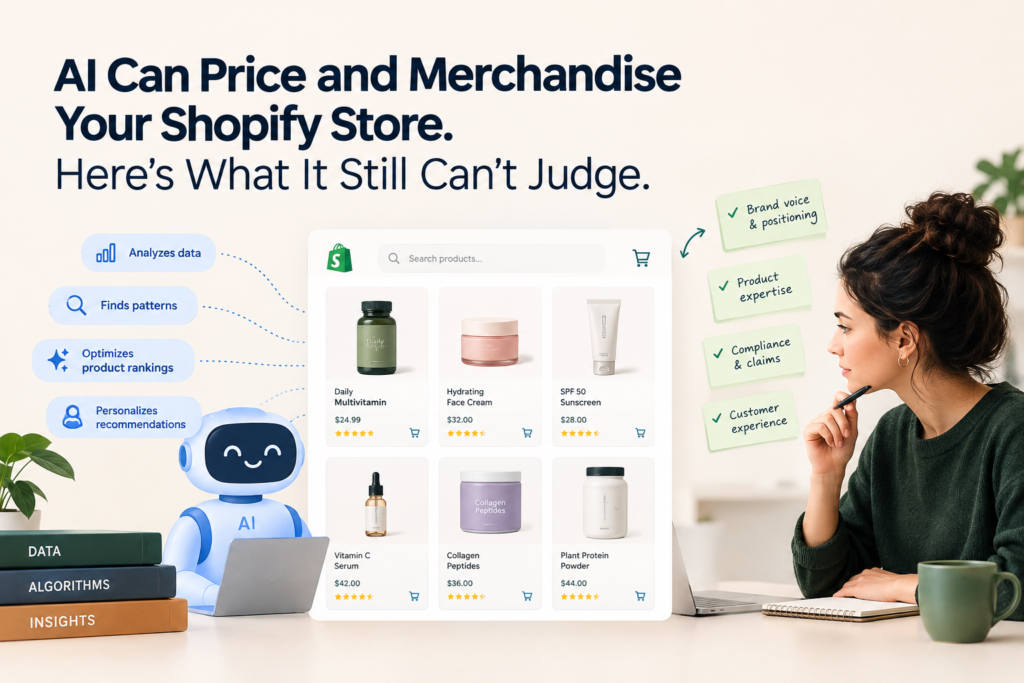
AI merchandising is the use of AI and machine learning to optimize product discovery and presentation across an ecommerce store. It can influence product rankings in search, category-page ordering, product recommendations, bundles, promotions, and personalized shopping experiences.
AI merchandising systems can analyze signals such as product performance, customer searches, clicks, purchase history, inventory levels, seasonality, and browsing behavior. They then use those signals to identify patterns and adjust what shoppers see. Shopify
For example, if shoppers who search for a particular skincare concern frequently purchase a specific moisturizer afterward, an AI merchandising system may learn that relationship and surface the moisturizer more prominently to similar shoppers.
The important distinction is that AI can optimize based on patterns, but humans still provide the context for what those patterns mean for the brand.
| AI merchandising task | What AI can do | Where humans matter |
|---|---|---|
| Product ranking | Identify products likely to perform | Decide whether the ranking fits the strategy |
| Recommendations | Suggest complementary products | Check whether the pairing makes sense |
| Search | Personalize results based on intent | Define important brand/product rules |
| Promotions | Identify opportunities from sales data | Protect margins and brand positioning |
| Inventory | Surface products based on availability | Consider launches and strategic products |
| Product content | Generate or optimize copy | Verify accuracy and brand voice |
In case of Supplement
Imagine a supplement store with 500 products. AI can analyze searches, purchases, repeat orders, product combinations, and inventory to identify patterns.
If customers searching for “daily magnesium” frequently purchase a specific magnesium glycinate product, AI could surface that product more prominently for similar shopping journeys.
But the merchandising team still needs to verify what the product actually contains, who it is intended for, serving information, allergens, certifications, and permitted product claims before allowing AI-generated recommendations or copy to go live.
In supplements, this human review is particularly important because a recommendation that looks commercially logical may require additional product or compliance context.
In case of Beauty Ecommerce
Beauty ecommerce is another strong use case for AI merchandising because shoppers often navigate products through attributes such as skin type, hair type, ingredients, finish, shade, concern, and routine.
AI can use these attributes alongside browsing and purchase behavior to improve search rankings and product recommendations. For example, a shopper looking for a lightweight moisturizer may be shown products associated with similar browsing and purchase patterns.
However, human judgment remains important when recommendations depend on nuanced product attributes. Ingredient accuracy, product suitability, brand positioning, and the way a beauty product is described all need to be reviewed. Research on beauty recommendation systems also highlights the importance of accurate ingredient and product-attribute extraction for explainable recommendations.
1. Edge-Case Decisions: When the Pattern Is Right, but the Situation Is Not Simple
AI product recommendations work well when the pattern is obvious.
If customers often buy two products together, AI can suggest the pairing. If a product is selling fast, AI merchandising can push it higher. If an item is low on stock, Shopify automation can reduce its visibility. These are useful decisions because they follow clean signals.
But ecommerce is full of messy exceptions.
A product may sell well but create high exchanges. A hero item may be low on stock but still central to a launch. A premium product may not convert quickly but may still protect brand perception. A bundle may look logical in the data but feel wrong in the customer journey.
That is where AI should not decide alone.
A brand like Knya shows why edge cases need human judgment. When products are made for healthcare professionals, decisions are not only about clicks or conversions. Comfort, fit, fabric, movement, and real-world use matter because the product has to work through long shifts, not just look good on a page.
That category cannot be treated like ordinary fashion merchandising.
AI may know which scrub color gets more clicks. It may know which size sells faster. But it does not automatically understand long-shift comfort, fabric expectations, pocket utility, hospital use, or professional confidence.
The takeaway is simple: AI can flag the edge case, but humans should close it.
2. Brand-Risk Decisions: When Conversion Can Damage Trust
AI is naturally drawn to measurable outcomes.
More clicks. Higher conversion. Faster sell-through. Better response rates. Those numbers matter, but they are not the whole brand.
A discount can clear inventory and still weaken premium perception. A claim can increase ad response and still create trust risk. A campaign can tap into a trend and still feel insensitive. A product recommendation can increase basket size and still make the brand feel pushy.
Brand-risk decisions need people who understand the cost beyond the dashboard.
Phool.co makes this clear. UNESCO has covered Phool’s work around recycling used temple flowers into artisanal organic products, including incense, while also employing women from marginalized communities.
That kind of category carries emotional, cultural, and spiritual context.
AI may see festive demand. It may suggest a worship-led campaign. It may recommend a gifting angle because the search signal is rising. But a human team still has to ask whether the message feels respectful, relevant, and true to the brand.
The same principle applies beyond Phool. Health brands must be careful with claims. Kids’ brands must protect parental trust. Premium brands must be careful with discounting. Personal care brands must avoid exploiting insecurities.
The risk is not that AI will make a random decision.
The risk is that AI will make a logical decision without understanding the brand consequence.
That is why the better question is not, “Can AI do this?”
It is, “Should AI be allowed to decide this without us?”
3. Taste and Aesthetic Decisions: When Performance Data Misses Brand Feel
Taste is not a soft layer. In ecommerce, taste is a commercial asset.
It decides whether a page feels curated or crowded. Whether a product pairing feels premium or forced. Whether a campaign feels confident or loud. Whether a brand feels distinct or interchangeable.
AI can study what performs. It can analyze product images, page layouts, captions, conversion rates, and product combinations. It can suggest what may work next. But it cannot fully own what the brand should feel like.
A brand like The Bear House shows why taste cannot be reduced to performance data. Its brand world is built around clean lines, elevated essentials, premium fabrics, and thoughtful construction. In that kind of category, merchandising is not just about which product converts. It is also about whether the pairing, placement, and visual flow feel right for the brand.
That is not only a product story. It is a taste system.
AI merchandising may suggest pairing two products because customers often view them together. But the founder or brand team still has to decide whether that pairing feels like The Bear House. AI may push the highest-converting product to the top. But the team may know that another product better represents the collection.
This is where over-optimization becomes dangerous.
A brand can become more efficient and less ownable. More consistent and less alive. More data-led and less memorable.
Smart brands will use AI to scale taste, not replace it. They will feed systems with approved references, brand rules, campaign memory, product context, and human feedback.
AI can help repeat the pattern.
Humans still define what good looks like.
4. Customer Escalation Handling: When Speed Is Not the Same as Care
AI customer experience is useful because most ecommerce support is repetitive.
Order status. Return policy. Size guidance. Product availability. Delivery timelines. Basic recommendations. These are areas where AI can reduce workload and improve response time.
But the customer moments that define trust are rarely the easy ones.
A loyal customer with a repeated delivery issue does not need another automated answer. A buyer confused about a product routine may need education, not an upsell. A customer with a product concern may need reassurance. A premium buyer may need confidence before placing a high-value order.
Speed matters, but care matters more when something goes wrong.
A brand like Perfora shows why customer escalation cannot be treated as a simple support workflow. Oral care is personal, habitual, and trust-led. A customer asking about a routine, product suitability, sensitivity, or repeat purchase may not need the fastest recommendation. They may need the right guidance first.
That changes the role of AI product recommendations and AI customer experience.
A system may suggest the next product, the next bundle, or the next response. But the right customer journey may require one more question first. The right move may be education. The right answer may be a handoff.
A system may recommend a whitening product, toothpaste, toothbrush, or value pack. But the right customer journey may require one more question first. The right move may be education. The right answer may be a handoff.
That is why escalation logic matters.
AI can answer, summarize, tag, route, and recommend. But humans should handle repeat complaints, high-value customers, emotional language, safety concerns, refund exceptions, and product dissatisfaction.
A fast answer can close a ticket.
A thoughtful answer can save a customer.
What This Means for AI-Native Ecommerce
AI-native ecommerce does not mean handing more decisions to AI.
It means designing the right relationship between AI systems and human judgment.
AI should handle what is repetitive, signal-heavy, and scalable. It should prepare recommendations, identify patterns, summarize customer issues, and reduce manual work.
Humans should own what is ambiguous, sensitive, emotional, aesthetic, strategic, or reputation-linked.
That is the operating model founders and CXOs should care about.
The brands at AI-Native E-Commerce · Edition 01 are not interesting only because they use AI. Many brands use AI now. They are interesting because they operate in categories where the wrong decision can cost more than a missed automation opportunity.
AI can make the team faster.
Judgment keeps the brand intact.
Where ShopOS Fits In
ShopOS fits into this conversation as a collaborator layer, not a replacement layer.
The value is not that agents can simply produce more actions. The value is that agents can work with brand context, product knowledge, Brand Memory, workflows, and human review paths.
ShopOS describes itself as an AI platform for commerce brands that creates product content, manages assets, and learns what performs in one place. Its site also explains Brand Memory as a way to store brand guidelines, colors, fonts, example images, voice notes, and style references so outputs stay consistent.
That is the right role for AI agents in ecommerce.
They should help teams scale execution without removing the judgment layer that makes the brand worth trusting.
Let AI Move Faster. Keep Judgment Where It Matters.
ShopOS helps ecommerce teams use AI agents for execution while keeping brand context, product knowledge, Brand Memory, and human review connected across workflows.
Scale what AI does best without giving up the decisions that make your brand worth trusting.
Final Takeaway
AI can optimize ecommerce.
It can improve AI merchandising, strengthen AI product recommendations, support Shopify automation, and make AI customer experience faster.
But smart brands still keep four decisions in human hands.
They keep edge cases with people who understand context.
They keep brand-risk decisions with people who protect trust.
They keep taste and aesthetic calls with people who know what the brand should feel like.
They keep customer escalations with people who know when care matters more than speed.
The winning brands will not be the ones that automate everything first.
They will be the ones that know what AI should decide, what AI should suggest, and what humans should never fully give away.