


AI for Ecommerce·Jun 30, 2026
Every ecommerce brand is using AI now. Some use it ...

Every ecommerce brand is using AI now.
Some use it to write product descriptions. Some use it for ad copy. Some use it for customer replies. Some use it to summarize reviews or speed up campaign ideas.
But using AI does not automatically make a brand AI-native.
The real proof is operational.
Has AI changed how the brand plans campaigns? Has it changed how teams create, test, approve, and learn? Has it connected creative, ads, product pages, email, SEO, customer insights, and performance? Has it made the business faster at making better decisions?
That is the real question behind AI-Native E-Commerce · Edition 01, hosted by ShopOS, Meta, and Crafeed.
The room brings together founders, operators, and ecommerce leaders who are not discussing AI as theory. They are discussing where AI is already showing up inside ecommerce workflows.
So the useful question is not, “Which AI tool does a brand use?”
The better question is:
What proves a brand is actually operating as an AI-native ecommerce business?
AI-native ecommerce means AI is built into the daily operating workflows of an ecommerce brand.
It supports how the team plans campaigns, creates assets, updates product pages, runs ads, analyzes performance, and reuses learnings across channels.
In simple terms, an AI-native ecommerce brand does not use AI only to produce more work. It uses AI to improve how work moves through the business.
This is where AI agents for ecommerce become important. A generic AI tool may answer prompts, but AI agents for ecommerce support specific ecommerce functions such as creative, ads, Shopify operations, SEO, GEO, email, customer insights, and growth.
A strong AI ecommerce platform connects these agents around shared brand context, product context, workflow history, and performance learning. That connected layer is what separates AI-native ecommerce from basic ecommerce automation tools.
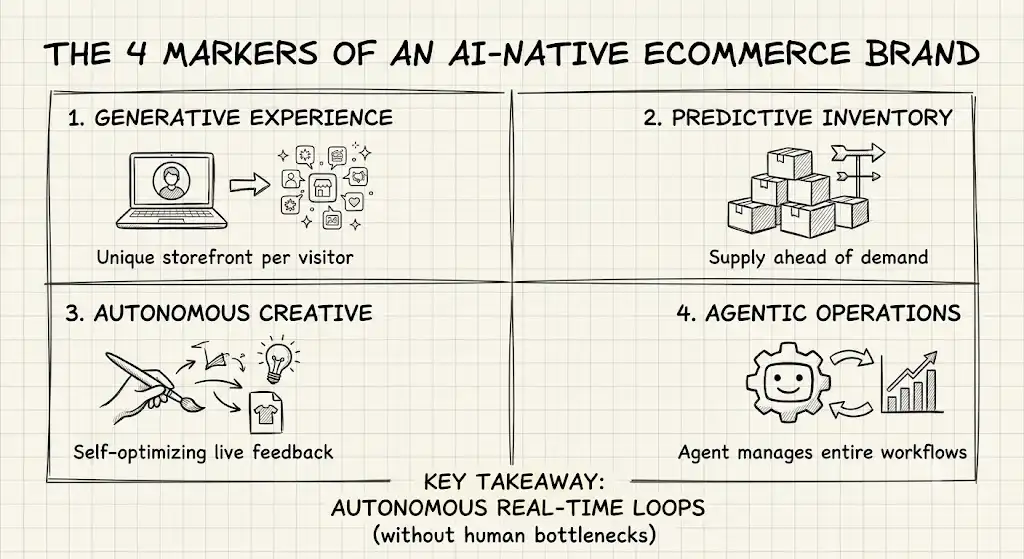
The difference becomes clearer when we look at four operational markers: workflow, memory, decisions, and metrics.
| Marker | What to Check | AI-Native Ecommerce Proof |
| Workflow | Where does AI sit in the process? | AI is part of campaign, store, content, and ad workflows |
| Memory | Does AI remember the brand? | AI works with brand voice, product context, and past learnings |
| Decisions | Does AI only create, or also guide? | AI helps teams decide what to test, update, and reuse |
| Metrics | Does AI change operating speed? | Launch speed, testing cycles, approval time, and learning loops improve |
These four markers create the right lens for Edition 01.
Not who mentions AI the most. Not who has the longest tool list. Not who added AI first.
The real signal is how deeply AI has entered the operating model of the brand.
The first marker is workflow depth.
A product launch is a good example because it shows how many parts of an ecommerce business need to move together. A launch usually needs product positioning, campaign angles, product page copy, ad variants, email messaging, Shopify updates, social content, SEO sections, creative testing, approvals, and performance analysis.
In an AI-native ecommerce setup, AI supports the movement between these steps instead of helping with one isolated task. The product brief should inform the campaign angle. That campaign angle should shape the ad hook, landing page, FAQ, email flow, and retargeting message. Once the campaign goes live, performance data should return to the system so the next test starts with better context.
That is workflow depth.
This is where many ecommerce automation tools stop too early. They may automate one repeated task, but they do not always connect that task to the rest of the brand system.
AI-native ecommerce connects the handoffs. Creative teams should understand what paid media is testing. Paid media should know which product pages need clearer messaging. Email should know which objections are appearing. SEO and GEO should know what buyers are asking before purchase. The store team should know what content needs to be updated before traffic arrives.
AI is not sitting outside the workflow. It is moving with the workflow.
The second marker is memory.
An AI-native ecommerce brand builds a memory layer around the business. That memory includes brand voice, product claims, approved phrases, rejected angles, customer objections, campaign learnings, high-performing hooks, past creative tests, channel patterns, and performance insights.
This matters because ecommerce teams repeat the same context more often than they realize. A new campaign starts, and the same product story has to be explained again. A new agency asks for brand tone. A product page needs updates, but the team has to search through old decks, Slack threads, and performance reports to understand what worked earlier.
Without memory, the brand keeps rebuilding context.
With memory, AI agents for ecommerce can work with what the brand already knows. The first campaign improves the second campaign because the learning is not lost. Customer questions improve future PDPs because the same objections do not need to be rediscovered. Ad performance improves future creative direction because winning hooks, tired claims, and rejected angles stay visible.
This is one of the clearest signs of AI-native ecommerce.
The brand is not starting from zero every time. It is building a learning system.
The third marker is decision support.
In ecommerce, the hard part is not only creating more work. It is deciding what work deserves attention first.
Which product should get more focus this week? Which campaign angle should be tested first? Which product page is missing buyer clarity? Which ad hook is getting tired? Which customer objection needs to be answered before purchase? Which email segment needs a different message? Which creative learning should be reused?
These are operating questions, not only content questions.
AI agents for ecommerce should be judged by how well they prepare context for these decisions. A useful agent can organize campaign learnings, compare product page gaps, surface repeated customer questions, identify weak handoffs between ad and landing page, and suggest the next test based on past performance.
But the final judgment still belongs to the team.
That is the healthier version of AI-native ecommerce. AI prepares the context, humans apply judgment. AI suggests the next workflow, humans approve the direction. AI tracks what happened, humans decide what changes.
The goal is not to remove people from the process. The goal is to make every decision better informed.
The fourth marker is measurement.
If AI is really part of the business, it should show up in operating metrics. The proof may appear in campaign turnaround time, creative testing speed, product page refresh cycles, ad analysis frequency, email campaign velocity, SEO and GEO update cycles, customer insight reuse, approval time, or learning loops after launch.
This is where the difference becomes visible.
For example, if AI helps a team create 100 ad hooks but none of the learnings return to the next campaign, output has increased but the operating system has not improved. If AI helps the team understand which hooks worked, why they worked, where they worked, and what to test next, the brand has changed how it operates.
That is the metric that matters.
Not just more output.
Better operating rhythm.
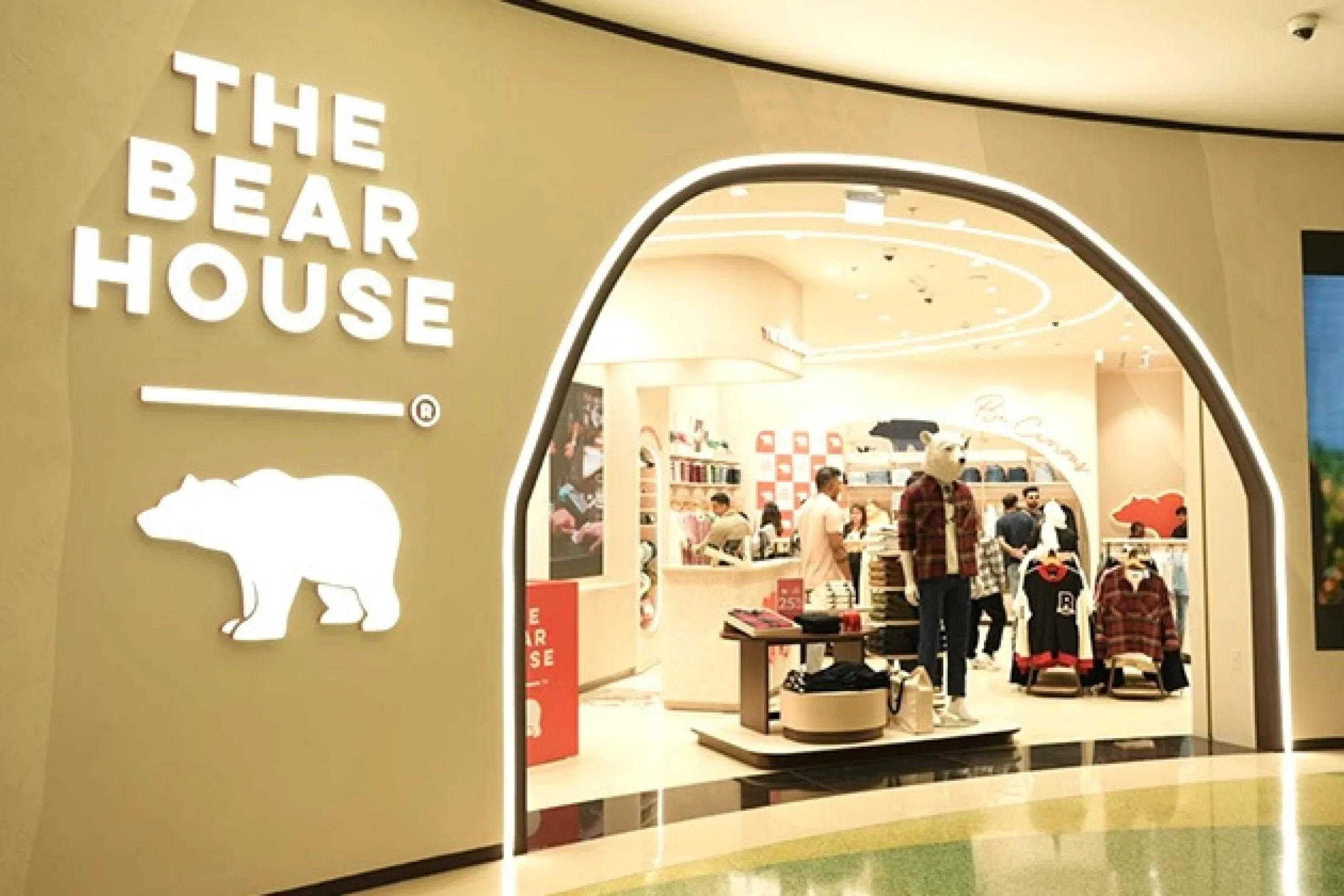
The Bear House is a useful example because its strength is not only marketing. It has an operating story behind it.
Before building the brand, founders Harsh and Tanvi Somaiya spent years manufacturing garments for global labels. The brand also speaks about manufacturing expertise and quality-controlled products as part of its own story.
That detail matters for this article because AI-native ecommerce works best when a brand has operating discipline.
Product quality, fabric decisions, fit consistency, sourcing control, inventory discipline, customer feedback, and channel execution are not surface-level brand activities. They are systems. They shape how the business runs before any campaign reaches the customer.
When a brand has clearer systems, AI has better context to work with. Product data is cleaner. Campaign inputs are sharper. Customer feedback is easier to reuse. Quality signals are not lost between teams.
This is not a claim that The Bear House uses AI across all these workflows. The point is that operational control creates the kind of foundation AI needs.
For Edition 01, this makes The Bear House a stronger lens than a simple speaker mention. It shows why the AI-native ecommerce conversation cannot stay limited to content generation or chatbots. The same lens can also be applied to brands like Perfora, Knya, Phool.co, Campus Activewear, and others in the room. Each brand may show AI-native ecommerce differently, but the useful question remains the same: where is AI changing how the business actually works?
The real question is how AI connects with the operating discipline behind a brand.
AI-Native E-Commerce · Edition 01 should not be judged by broad statements about AI.
The sharper discussion is where AI has changed the way work happens.
For every founder and operator in the room, the useful questions are practical. Has AI changed campaign planning? Has it reduced time between idea and launch? Has it improved creative testing? Has it helped the team update product pages faster? Has it improved how customer insights are reused? Has it connected ads, store, email, and content? Has it changed how the team learns after launch?
These questions give the event a practical framework for evaluating how AI changes ecommerce operations.
An AI-native ecommerce brand should be able to point to specific changes in how work moves through the business. For one brand, that may mean faster campaign turnaround. For another, it may mean better product page updates. For another, it may mean stronger creative testing, cleaner customer insight loops, or better coordination between ads, store, email, and content.
That is what the room should listen for.
Not general excitement around AI, but specific changes in how ecommerce work gets done.
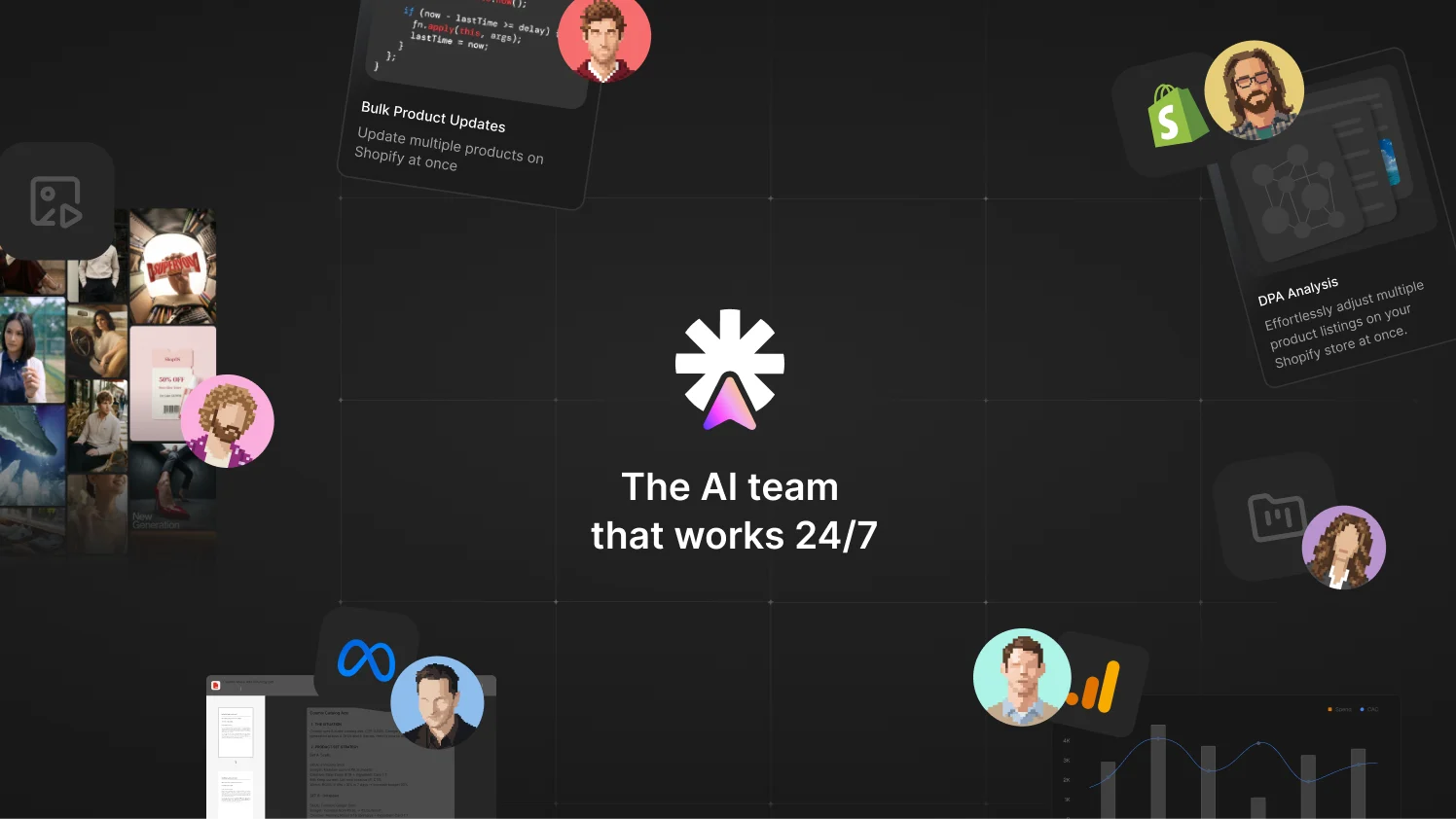
This is where ShopOS fits naturally.
ShopOS is built as an AI ecommerce platform with role-based AI agents for ecommerce teams.
Each agent supports a specific part of ecommerce work.
The stronger point is not that each agent completes one task.
The stronger point is that these agents work around shared brand context.
That is what makes the ShopOS model relevant to AI-native ecommerce. It connects brand memory, workflow execution, human approval, and channel-specific output inside one operating layer.
Basic ecommerce automation tools can help teams move faster.
ShopOS helps ecommerce teams move faster with context.
That distinction matters because AI-native ecommerce is not about adding more disconnected tools. It is about giving teams a better way to run the brand across creative, ads, store, SEO, email, and growth.
The four markers make AI-native ecommerce easier to evaluate.
Workflow shows whether AI is part of the process. Memory shows whether the brand is building on what it already knows. Decision support shows whether AI is helping teams choose better next steps. Operating metrics show whether AI is changing speed, quality, and learning cycles.
That is the standard Edition 01 can set for the market.
Not who has the most AI tools. Not who talks about AI the most. Not who added AI first.
The real question is:
What has changed inside the business because AI entered the workflow?
The brands that can answer that clearly are the ones moving closest to AI-native ecommerce.
Using AI for isolated tasks is easy. Building connected workflows where creative, ads, Shopify, SEO, and growth teams work from the same brand context is where the real advantage begins.
See what AI-native ecommerce looks like with ShopOS. Book a Demo
AI-native ecommerce means AI is built into the daily workflows of an ecommerce brand. It supports planning, creative, ads, Shopify updates, email, SEO, GEO, reporting, and customer insights.
Ecommerce automation tools usually automate repeated tasks. AI-native ecommerce connects workflows, brand memory, customer insights, performance learnings, and human approval across teams.
AI agents for ecommerce are important because each agent supports a specific business function such as creative, ads, Shopify, SEO, email, or growth. When these agents share context, teams can move faster without losing brand consistency.
An AI ecommerce platform should help teams plan, create, approve, update, analyze, and reuse learnings across ecommerce workflows. It should support the full operating cycle, not only generate content.
A brand can check where AI shows up in its daily workflows. If AI improves campaign speed, creative testing, product updates, reporting, approvals, and learning loops, the brand is moving toward AI-native ecommerce.

