

 ChatGPT
 Perplexity
 Claude
 Gemini
 Grok
Grok
We stopped being a software company that employed humans to serve brands. We became a squad company, part human, part AI, fully accountable. Every brand we work with now has a named team of AI agents for ecommerce running 24/7 behind their store. Every person at ShopOS now manages more agents than they manage humans.
We are calling it the ShopOS Squad model. And we are making it the default for every brand we onboard this quarter.
That shift matters because ecommerce brands have outgrown disconnected AI tools. A product copy tool can write a description. A creative tool can generate an asset. A reporting tool can show performance. But brands need more than isolated outputs. They need a system that understands the store, remembers the brand, supports Shopify workflows, improves content, and keeps humans involved where judgment matters. That is the direction ShopOS is moving toward as an AI platform for ecommerce brands.
Here is how it works.
AI Platform for Ecommerce Brands: What is the ShopOS Squad Model?
The ShopOS Squad model is a dedicated AI operating model where every ecommerce or DTC brand gets a named team of AI agents trained on its store, catalog, brand voice, customer segments, workflows, and performance data. Each agent has a clear role, defined scope, and memory. A human Squad Manager oversees the agents, reviews important outputs, handles escalations, and improves Brand Memory over time.
In simple terms, ShopOS works as an AI platform for ecommerce brands by combining AI agents, Brand Memory, Cowork, Spaces, Loops, Refine, Files, and human review into one operating system. The result is an ecommerce AI operating system where agents handle repeatable execution while humans focus on strategic decisions, taste calls, relationship calls, and edge cases.
The Features Powering the ShopOS Squad Model
Every brand that works with ShopOS gets a Squad, a dedicated team of AI agents trained specifically on their store, catalog, brand voice, and operations. Over time, that is what turns ShopOS into more than a collection of AI tools. It starts functioning like an AI platform built for ecommerce brands.
A fashion DTC brand doing ₹3 crore a month might get a Squad of 8. Monica handles creative direction, campaign ideas, product storytelling, and visual direction. Gavin watches ad spend and marketing performance daily, flagging anomalies before the human team even opens their laptop. Russ tracks finance and growth signals. Dinesh handles email and CRM campaigns from brief to final copy. Erlich supports social and content workflows. Richard runs Shopify store management decisions, including product updates, catalog tasks, merchandising changes, and PDP improvements. Big Head supports GEO and SEO visibility, helping the brand structure content for search engines and AI answer engines. Jian-Yang sits inside brand intelligence, constantly updating what the brand understands about itself, including seasonal shifts, SKU performance, and segment behavior.
A larger enterprise brand like Lotto or Celio, with thousands of SKUs and multiple markets, runs a Squad of 16 to 20. They have dedicated agents per market language, per category, and per campaign type. Their agents do not share queues. Each one has a scope.
Every agent in a Squad has three things:
- A name
- A defined scope
- A memory
They know the brand. They remember decisions. They accumulate context over time.
That last part is the real unlock.
Brand Memory AI for Ecommerce: The Context Layer Behind Every Agent
Brand Memory is the foundation of the ShopOS Squad model. Without shared context, even strong AI systems drift away from how ecommerce brands actually operate. That context layer is what helps ShopOS function as a true AI platform for ecommerce brands, not just a collection of disconnected tools. It stores the brand’s voice, tone rules, product context, customer segments, visual preferences, campaign learnings, banned words, audience behavior, and performance signals.
This makes Brand Memory a powerful brand memory AI for ecommerce because every agent works from the same source of truth. When a brand launches a new sub-line, updates seasonal messaging, changes a product positioning angle, or adds a new audience insight, Brand Memory helps the whole Squad absorb that context.
For a DTC brand, this solves a real problem. Most AI tools forget the brand the moment the session ends. ShopOS is designed to remember. That is why the Squad can improve week after week instead of starting from zero every time.
What Brand Memory Stores
- Brand voice and tone rules
- Product positioning
- Audience behavior signals
- Campaign learnings
- Seasonal messaging
- Visual preferences
- Banned words and phrasing
- SKU performance insights
Cowork: The AI Team Workspace for Ecommerce Brands
“Cowork is where that working relationship becomes visible. Instead of forcing teams to manage work across scattered systems and workflows, collaboration happens inside ShopOS itself. That is part of what makes it feel like an AI platform built for ecommerce brands rather than another standalone AI product. Brand teams interact with their Squad through Cowork, the conversational workspace where they can brief agents, review outputs, give feedback, and request revisions.
Cowork works like an AI team workspace for ecommerce brands because it makes AI feel less like a prompt box and more like a working relationship. A brand’s head of marketing at a DTC fashion label does not interact with “the AI.” They interact with Monica for creative direction, Gavin for performance marketing, Russ for finance and growth, Dinesh for email and CRM, Erlich for social and content, Richard for Shopify store work, Big Head for GEO and SEO support, and Jian-Yang for brand intelligence.
When they need a product launch brief, they brief Monica inside Cowork for creative direction, Dinesh for email messaging, Richard for Shopify execution, Big Head for SEO and GEO structure, and Erlich for social content. The agents draft. The team reviews. They send back notes. The agents revise.
The difference: the Squad can turn around a full PDP support suite, including product copy direction, Shopify updates, email angles, SEO metadata, and campaign-ready messaging, in minutes. A freelance copywriter may take 2 days. An in-house team may take half a day per SKU.
What Teams Can Do Inside Cowork
- Brief AI agents directly
- Review and approve outputs
- Request revisions quickly
- Manage campaign workflows
- Coordinate Shopify tasks
- Run cross-functional execution
- Collaborate with multiple agents
- Keep brand context active during work
Spaces: The AI Product Image Generator for Ecommerce Workflows
Most ecommerce teams do not need more one-off outputs. They need repeatable workflows that can run with the right context every time. That is where Spaces helps ShopOS operate as an AI platform for ecommerce brands. Spaces are structured workflows inside ShopOS. They help teams turn repeatable ecommerce tasks into guided AI processes. A Space can support product launches, influencer gifting, end-of-season markdowns, merchandising tasks, campaign content, product imagery, or catalog updates.
This is where ShopOS becomes more than a writing tool. Spaces can support creative workflows as an AI product image generator for ecommerce while also helping agents follow the right brief, format, sequence, and approval path.
In the Squad workflow, 10 AM to 1 PM is often used for deep work such as onboarding a new agent scope, updating Brand Memory with seasonal context, writing a new Space, or building a structured workflow for a new use case like influencer gifting or end-of-season markdowns.
What Spaces Can Automate
- Product launch workflows
- Influencer gifting flows
- End-of-season markdown execution
- Product imagery workflows
- PDP content generation
- Campaign production systems
- Merchandising tasks
- Structured approval paths
Loops: AI Content Optimization for Ecommerce Brands
The real advantage begins when performance starts shaping the next output. Loops is the continuous learning layer inside ShopOS. It helps the system learn from feedback, results, and iteration over time, which is a big part of what makes ShopOS an AI platform for ecommerce brands rather than a one-time generation tool. It helps ShopOS use feedback and performance signals to improve future outputs. Instead of treating content as a one-time deliverable, Loops connects output, review, performance, and iteration.
That makes it useful for AI content optimization for ecommerce because brands can learn which product descriptions, campaign angles, ad creatives, email messages, or SEO structures perform better over time.
For ecommerce teams, this is critical. Content volume alone does not create advantage. Learning content does. The stores that learn faster can adjust faster.
What Loops Improves Over Time
- Product descriptions
- Email campaign messaging
- PDP structures
- Ad creative angles
- SEO metadata
- GEO visibility
- Shopify merchandising patterns
- Audience response signals
Refine: AI Brand Training for Ecommerce Teams
AI becomes more useful when human feedback improves future outputs. Refine is the human feedback and training layer inside ShopOS. It helps teams correct outputs, improve agent behavior, and turn feedback into better future execution across ShopOS, the AI platform for ecommerce brands.
This makes Refine important for AI brand training for ecommerce because brand teams can shape the way agents understand tone, product nuance, campaign sensitivity, visual preference, and approval logic.
The goal is not to remove humans from the system. The goal is to put human judgment where it matters most and let feedback improve the AI over time.
What Refine Helps Improve
- Tone consistency
- Creative direction quality
- Product messaging accuracy
- Approval logic
- Campaign alignment
- Brand-specific output behavior
- Human review workflows
- Agent learning cycles
Files: AI Asset Management for Ecommerce Brands
Files gives brands a place to organize product assets, campaign references, brand guides, example images, creative notes, and source material that agents can use. Without that layer of organized context, ShopOS would behave like isolated AI tools instead of the AI platform for ecommerce brands it is designed to be.
This works as AI asset management for ecommerce brands because it keeps brand knowledge accessible to the Squad. Instead of scattering references across drives, old chats, folders, and decks, Files helps make the brand’s working knowledge usable by AI agents.
For ecommerce brands with fast-moving product cycles, this matters. Agents can only produce strong work when they have strong context.
What Brands Can Organize Inside Files
- Product images
- Campaign references
- Brand guidelines
- Creative inspiration
- Example copy assets
- Merchandising references
- Seasonal campaign notes
- Structured source material for agents
Meet the ShopOS Agents Built for Ecommerce Teams

Monica: The AI Creative Director for Ecommerce Brands
Monica supports creative direction for ecommerce brands. She helps shape campaign ideas, visual direction, product storytelling, and creative angles. As an AI creative director for ecommerce, Monica helps teams move faster while staying aligned with brand context.
Gavin: The AI Performance Marketing Agent Ecommerce Teams Can Use Daily
Gavin focuses on performance marketing. He can monitor campaign signals, flag anomalies, review creative fatigue, and help teams understand what is happening across paid channels.
Inside ShopOS, Gavin functions as an AI performance marketing agent ecommerce teams can use to react faster to ROAS shifts, CAC pressure, and creative fatigue.
Russ: The AI Finance Agent for Ecommerce Brands
Russ supports finance and growth visibility. He helps connect revenue, margin, spend, and growth decisions.
As an AI finance agent for ecommerce brands, Russ helps teams understand the commercial impact behind growth moves, campaign costs, and operational decisions.
Dinesh: The AI Email Marketing Agent Ecommerce Brands Can Brief Like a CRM Teammate
Dinesh supports email and CRM workflows. He helps with campaign copy, customer segments, subject lines, promotional messaging, and lifecycle communication.
Inside ShopOS, Dinesh works as an AI email marketing agent ecommerce brands can use to reduce the weekly scramble around email calendars and CRM execution. Since he works with Brand Memory, he can carry the brand’s tone, product context, and past campaign learnings into every new email draft.
Erlich: The AI Social Media Agent for Ecommerce Brands
Erlich supports social and content workflows. He helps with content ideas, captions, campaign themes, platform-specific messaging, and social calendars.
As an AI social media agent for ecommerce brands, Erlich gives content teams a faster way to move from product context to platform-ready ideas while staying aligned with the brand’s voice.
Richard: The AI Shopify Store Manager for Modern Ecommerce Teams
Richard supports Shopify store management. He can help with store updates, catalog tasks, merchandising changes, product content checks, and operational workflows.
For brands looking for an AI Shopify marketing platform, Richard becomes a key part of the operating model because he connects AI execution to Shopify-related work. As an AI Shopify store manager, he helps ecommerce teams reduce manual workload around store operations.
Big Head: The AI GEO Agent for Ecommerce Brands
Big Head supports SEO, GEO, and AI-search visibility. This matters as more shoppers and buyers discover brands through AI answers, search summaries, recommendation engines, and generative search experiences.
As an AI GEO agent for ecommerce brands, Big Head can support metadata, structured content, FAQs, search-friendly copy, generative engine visibility, and content built for AI answer engines.
Jian-Yang: The AI Brand Intelligence Tool for Ecommerce
Jian-Yang supports brand intelligence. He helps teams understand patterns in audience behavior, product performance, brand positioning, and internal knowledge.
As an AI brand intelligence tool for ecommerce, Jian-Yang helps the brand learn faster. Strong AI systems do not simply produce content. They help brands understand what to repeat, what to retire, and what to improve.
The Squad Manager: The Human Layer That Makes AI Accountable
Even with agents running active workflows, human judgment stays central. That is why every brand Squad inside ShopOS, the AI platform for ecommerce brands, has a Squad Manager who owns the relationship, oversees the agents, and keeps the system aligned with the brand.
The Squad Manager’s job looks very different from a traditional account manager’s role. They are not spending the day writing every brief, producing every asset, or building every campaign deck from scratch. Their role is to direct the Squad, review outputs, escalate sensitive decisions, improve workflows, and keep Brand Memory aligned with the brand.
Here is what a Squad Manager’s day looks like.
8:30 AM. The Squad Manager opens the ShopOS dashboard. Active workflows have been running overnight. Monica has prepared creative direction for the summer drop. Richard has queued product content and Shopify updates. Gavin has flagged a ROAS movement on Meta catalog ads and drafted a preliminary diagnosis around SKU-level creative fatigue. Dinesh has prepared email and CRM campaign drafts. Big Head has generated SEO and GEO recommendations for updated PDPs. Erlich has drafted social content angles. A few items are flagged for human review.
The Squad Manager does not start the day by creating from zero. They start by reviewing. They move through the outputs like an air traffic controller scanning a radar screen. Most flights are fine. A few need rerouting.
By 10 AM, the Squad Manager has approved Monica’s creative direction with edits, sent Richard’s Shopify update plan to the brand’s digital team with context, escalated Gavin’s performance diagnosis to the paid media lead, reviewed Dinesh’s email flow, and resolved smaller review items directly.
Anything requiring a brand-level decision, such as policy calls, positioning changes, or sensitive approvals, goes to the brand team.
10 AM to 1 PM is usually deep work: onboarding a new workflow, updating Brand Memory with seasonal context, building a new Space, or running a weekly review with the brand team.
Afternoon becomes review and iteration. More outputs enter the queue. The cycle repeats.
One Squad Manager can oversee multiple brand Squads because the role shifts from manual production to direction, review, escalation, and improvement.
That is the operating logic behind the ShopOS Squad model.
Before vs After the ShopOS Squad Model
| Traditional Ecommerce Workflow | ShopOS Squad Workflow |
| Teams manually write PDP copy | Agents prepare draft-ready PDP suites |
| Reporting takes hours every Monday | Gavin delivers summarized reporting before the workday starts |
| Shopify updates move through multiple teams | Richard handles structured Shopify workflows |
| Email and CRM campaigns require repetitive coordination | Dinesh drafts lifecycle and campaign flows quickly |
| SEO and GEO updates happen separately | Big Head integrates SEO and GEO recommendations continuously |
| Teams lose context between tools | Brand Memory keeps shared context active across workflows |
How Brands Experience the Squad
For the brand team, the ShopOS Squad feels less like a software subscription and more like having a senior specialist on call for every function, someone who never sleeps, never misses context, and gets smarter about the brand every week. That operating model is a big reason ShopOS is becoming the AI platform for ecommerce brands.
For the brand’s ops lead, the Squad means Gavin is running performance reporting. Every Monday morning, Gavin has already pulled last week’s numbers across all channels, identified the top 3 anomalies, and drafted a plain-English summary with recommended actions. The ops lead reads it, amends it if needed, and sends it to leadership. What used to take 3 hours of pulling reports and writing commentary now takes 20 minutes of review.
Brand teams interact with their Squad through three surfaces:
- Cowork, conversational work with agents
- Spaces, structured workflows where the brief goes in and the agent does the work
- Brand Memory, the living document of what the agents know about the brand
The brand always has visibility into what the agents know. They can update it, correct it, and expand it. Brand Memory is not hidden. It is reviewable and editable by the human team at any time.
When the brand launches a new sub-line, they add it to Memory. All relevant agents in the Squad absorb it.
Agent-to-Human Reviews: The Trust System Behind the Squad
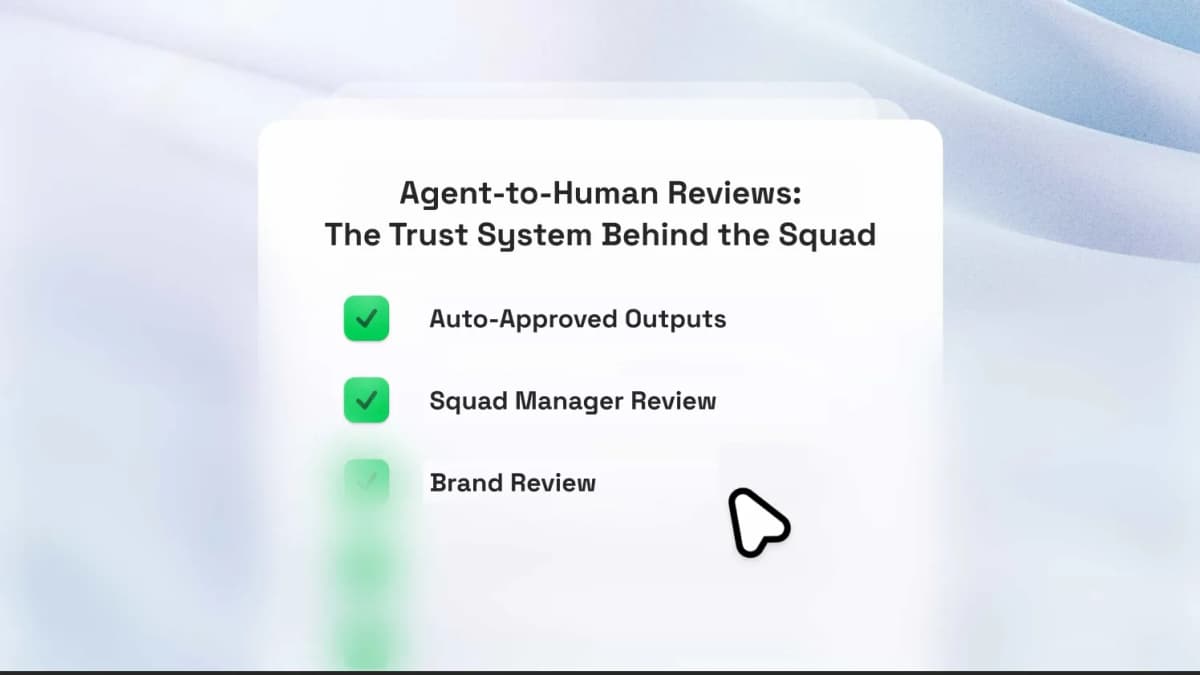
The review loop is where the Squad model earns trust or loses it.
Every agent output at ShopOS goes through one of three paths.
Path 1: Auto-Approved Outputs
Low-stakes, high-confidence outputs move to production or staging without human review. These may include support ticket drafts, SEO metadata variations, internal tagging, or structured updates where the risk is lower.
The Squad Manager pre-configures which output types can be auto-approved for each brand and what confidence threshold is required.
Path 2: Squad Manager Review
Medium-stakes outputs go to the Squad Manager’s review queue. These may include homepage copy, campaign messaging, performance summaries, CRM content, or merchandising recommendations.
The Squad Manager either approves, edits and approves, or flags the output for brand review. Most of these resolve in the same day.
Path 3: Brand Review
High-stakes outputs go directly to the brand’s designated reviewer. These may include brand positioning changes, major campaign creative directions, refund policy decisions, sensitive customer responses, or decisions with commercial risk.
The agent has done the work. The human makes the call.
Review paths are configurable per brand, per agent, and per output type. A brand that trusts Monica’s creative direction, Dinesh’s email outputs, or Richard’s Shopify workflows deeply might move those workflows from Path 2 to Path 1 after 6 weeks of consistent quality. A more cautious brand may keep Gavin’s ad spend recommendations at Path 3 indefinitely.
The goal is not to remove humans. The goal is to put humans where they are irreplaceable: strategic decisions, relationship calls, taste calls, and context that lives outside any database.
Everything else, the Squad runs.
Review Paths Inside the ShopOS Squad Model
| Review Path | Output Type | Human Involvement |
| Path 1: Auto-Approved | SEO metadata, internal tagging, structured updates | Minimal |
| Path 2: Squad Manager Review | Homepage copy, campaign messaging, CRM flows | Squad Manager reviews and edits |
| Path 3: Brand Review | Positioning shifts, campaign direction, policy decisions | Brand leadership approval required |
How AI Agents for Ecommerce Gain Trust
Agents do not start with credibility. They earn it by doing things in public.
When a brand first onboards, the Squad Manager runs the first few weeks of agent outputs in “show your work” mode. Every Monica output comes with a reasoning trace: why this creative direction, why this tone, and which Brand Memory nodes it drew from. Every Gavin report includes data sourcing: where each number came from and what comparison window was used. Every Richard workflow shows which Shopify changes were recommended and why. Every Big Head recommendation explains the SEO or GEO logic behind the update.
This is uncomfortable at first. Brand teams are not used to seeing the machine’s thinking. But it builds trust faster than anything else.
By week three, most brands stop reading every reasoning trace. They have seen enough to calibrate confidence. They have pushed back when something was off. They have seen the agent correct.
By week six, brand teams are briefing their agents directly for new use cases. They are not going through the Squad Manager for every task. They are developing their own working rhythm with the agents.
That is the signal ShopOS watches for. When a brand stops treating the Squad like a vendor tool and starts treating it like a team, the relationship compounds.
The Org Chart, Redrawn
At ShopOS internally, the agent org chart built itself the same way.
Monica, Gavin, Russ, Dinesh, Erlich, Richard, Big Head, and Jian-Yang are now part of how teams think about work inside ShopOS. Across Slack outputs, Cowork threads, and Notion updates, the agents became part of the operating rhythm organically. Not because it was mandated. Because the agents started showing up in Slack outputs, Cowork threads, and Notion updates. They were doing work. Visible work. Good work.
The etiquette emerged organically. When someone needs creative direction fast, they brief Monica, not a teammate. When they need a campaign performance read, they pull Gavin’s latest output before starting their own analysis. When a brand wants Shopify work reviewed, they bring in Richard. When email and CRM need movement, they brief Dinesh. When SEO or GEO visibility matters, they bring in Big Head. When brand intelligence needs clarity, they ask Jian-Yang. When social content needs direction, Erlich gets involved. When finance and growth context matters, Russ supports the call.
The human team did not shrink. It upgraded. Every ShopOS employee now manages a set of agents the way a senior producer manages a production team: setting direction, reviewing outputs, unblocking problems, and raising the ceiling.
Brandon’s rule at Every was simple: if an established process needs to be used or fixed, ask the agent. The same rule applies here. If it is a known workflow, the agent runs it. The human’s job is to handle what the agent cannot anticipate.
ShopOS is figuring out the edge cases in real time. There are moments where an agent’s output is technically correct but tonally off for a brand’s current season. There are moments where two agents’ outputs create an inconsistency that a human has to resolve. There are moments where the brand’s memory is stale and the agent is working from old context.
All of those are fixable. All of them are learning opportunities. The Squad Manager catches them. Brand Memory gets updated. The agent improves.
This is how organizational intelligence compounds. Not by adding more humans, but by building systems where humans and agents learn from each other continuously.
Why the Squad Model Matters for Shopify and DTC Teams
Shopify-led brands move fast. Product launches, discounts, bundles, campaign pages, PDP updates, SEO improvements, ad creative, social content, CRM flows, and merchandising changes all compete for attention. This is exactly where an AI platform for ecommerce brands has to connect content, store operations, and marketing execution. Product launches, discounts, bundles, campaign pages, PDP updates, SEO improvements, ad creative, social content, CRM flows, and merchandising changes all compete for attention.
That is why brands need an AI Shopify marketing platform that understands both marketing and store operations.
ShopOS connects agents to creative workflows through Monica, performance workflows through Gavin, finance and growth workflows through Russ, CRM workflows through Dinesh, social and content workflows through Erlich, Shopify-related workflows through Richard, SEO/GEO workflows through Big Head, and brand intelligence through Jian-Yang.
For DTC teams, this means AI can support work across the funnel:
- Product discovery
- PDP content
- Creative direction
- Store updates
- Email campaigns
- Paid media insights
- Organic content
- SEO and GEO visibility
- Financial and growth analysis
- Brand intelligence
Instead of using several disconnected tools, teams can work through one ecommerce AI operating system with shared memory and review logic.
What This Quarter Looks Like
The next phase for ShopOS is focused on bringing the Squad model to more fashion and DTC brands in a controlled, high-context way, continuing the larger vision behind ShopOS as an AI platform for ecommerce brands.
Each brand Squad is shaped around catalog size, workflow complexity, active channels, and AI readiness. Some brands begin with a leaner Squad. Larger brands with multiple markets, product categories, and campaign surfaces can expand into deeper agent structures over time.
The brands that move fastest are the ones that lean in early. They let the Squad run, build trust through the review process, expand agent scope gradually, and keep Brand Memory updated with fresh context.
For those brands, ShopOS stops being another tool in the stack. It becomes a working team layer.
Every edge case, every review loop, and every new skill added to an agent compounds into a system that gets better the longer a brand runs it.
The stores that learn, win.
Build Your Brand’s AI Squad With ShopOS
ShopOS helps ecommerce and DTC brands move away from fragmented AI workflows through a connected system built around AI agents, Brand Memory, Cowork, Spaces, Loops, Refine, Files, and human review workflows
If your team is managing growing SKU volumes, faster campaign cycles, Shopify updates, content demands, CRM pressure, and performance reporting, ShopOS can help you turn AI into a working brand team.
ShopOS helps ecommerce and DTC brands move away from fragmented AI workflows through a connected system built around AI agents, Brand Memory, Cowork, Spaces, Loops, Refine, Files, and human review workflows.
For brands looking to operationalize AI across creative, Shopify, CRM, SEO, and growth workflows, explore ShopOS Enterprise: https://shopos.ai/enterprise
FAQs
What is an AI platform for ecommerce brands?
An AI platform for ecommerce brands is a connected system that helps online brands manage content, creative, store operations, marketing workflows, customer communication, performance analysis, and brand intelligence using AI. ShopOS does this through AI agents, Brand Memory, Cowork, Spaces, Loops, Refine, Files, and human review paths.
How is ShopOS different from a normal AI content tool?
ShopOS is different because it is built around brand-specific AI Squads, not one-off content generation. A normal AI content tool may create a single output. ShopOS gives brands AI agents for ecommerce that remember context, follow workflows, use Brand Memory, and improve through review loops.
What are AI agents for ecommerce?
AI agents for ecommerce are role-based AI systems designed to manage specific ecommerce workflows. Monica supports creative direction, Gavin supports performance marketing, Russ supports finance and growth, Dinesh supports email and CRM, Erlich supports social and content, Richard supports Shopify store management, Big Head supports GEO and SEO, and Jian-Yang supports brand intelligence.
Why does Brand Memory matter for ecommerce AI?
Brand Memory matters because ecommerce brands need consistent voice, product accuracy, campaign context, visual references, and audience understanding across every output. Without memory, AI tools keep starting over. With Brand Memory, ShopOS agents can learn the brand over time and apply that knowledge across workflows.
Can ShopOS work as an AI Shopify marketing platform?
Yes. ShopOS supports Shopify-related workflows through Richard, along with Cowork, Spaces, Brand Memory, Files, Loops, and Refine. It can support Shopify store updates, product content, merchandising, campaign execution, CRM, paid marketing insights, and search visibility.
Is ShopOS useful as a DTC brand AI tool?
Yes. ShopOS is useful as a DTC brand AI tool because DTC teams often manage fast product launches, frequent campaigns, paid media pressure, email calendars, social content, PDP updates, and customer-facing communication. The Squad model helps these teams move faster while keeping brand context and human review in place.
How does ShopOS support SEO and GEO?
ShopOS supports SEO and GEO through Big Head, its AI GEO and SEO agent. Big Head can help with metadata, FAQs, structured content, search-friendly copy, generative engine visibility, and content designed for AI answer engines.
What role do humans play in the ShopOS Squad model?
Humans remain central to the ShopOS Squad model. Squad Managers direct agents, review important outputs, handle escalations, improve Brand Memory, and guide the operating rhythm. Brand teams make strategic decisions, approve high-stakes work, and provide feedback that helps agents improve.