
AI for Ecommerce·Jun 11, 2026
The best AI tools for ecommerce do more than generate ...

The best AI tools for ecommerce do more than generate copy, product images, or email drafts. They help DTC brands connect brand memory, product assets, creative workflows, Shopify operations, ads, SEO, GEO, human feedback, and performance learning. A strong stack should not only help a team create more output. It should help every channel work from the same context.
AI tools for ecommerce are easy to find now.
There are tools for product descriptions, ad creatives, product images, email campaigns, SEO, analytics, and store tasks. But many DTC brands do not struggle because they lack tools. They struggle because those tools do not work together.
One platform writes copy. Another creates visuals. Another manages email. Another runs ads. Shopify sits separately. SEO and GEO work often happen in another workflow. Assets are stored in folders. Performance learnings stay inside dashboards.
This creates a messy ecommerce tech stack.
Teams repeat the same briefs. Brand voice changes across channels. Product pages fall behind campaigns. Winning creatives are hard to reuse. Every tool needs the same context again.
That is why AI tools for ecommerce need to move beyond one-off generation. The real opportunity is a connected DTC Tech Stack where content, creative, email, Shopify, ads, SEO, GEO, assets, and performance learning support each other.
When AI tools for ecommerce share the same brand context, they stop acting like separate shortcuts and start supporting one operating system.
A DTC Tech Stack is the set of systems a direct-to-consumer brand uses to run ecommerce growth. It usually includes Shopify, email and CRM tools, paid media platforms, creative tools, asset storage, SEO tools, analytics dashboards, and AI tools for ecommerce workflows.
But a strong stack is not just a list of software.
It should help the brand work as one system. Product data, brand rules, creative assets, campaign plans, store updates, search content, and performance signals should stay connected.
A strong tech stack for ecommerce website growth should support both marketing and operations. It should help teams create, publish, update, test, and improve without rebuilding context at every step.
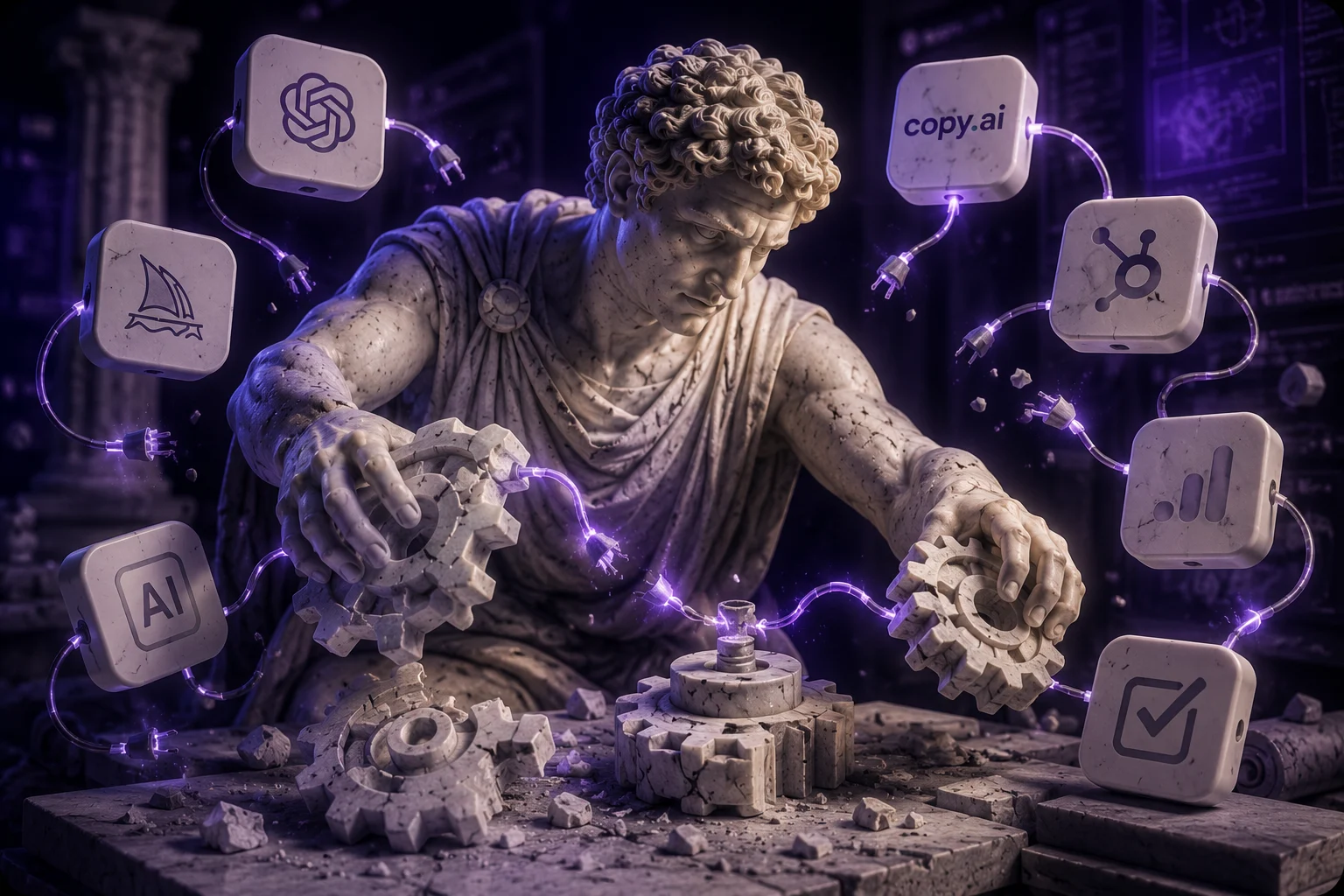
Separate tools can be useful for individual tasks. But ecommerce growth is not built on isolated tasks.
A product launch needs campaign visuals, PDP updates, email flows, ad creatives, social content, SEO content, GEO-ready answers, and performance review. If every step happens in a separate tool, the team has to carry context manually.
This creates four common problems.
First, brand voice becomes inconsistent. Generic AI tools can create fast output, but they do not always understand tone, product claims, model choices, visual style, CTAs, and words to avoid.
Second, creative and performance stay disconnected. A paid campaign may show which hook is working, but that learning may not improve the next email, product page, SEO article, social post, or creative brief.
Third, assets become difficult to reuse. Teams waste time searching for product images, UGC, campaign references, final ad creatives, video cuts, and past winners.
Fourth, human feedback gets lost. Teams correct tone, claims, visuals, and product details, but if that feedback does not train future output, the same corrections keep coming back.
| Area | Separate AI Tools | Connected AI Ecommerce Stack |
| Brand voice | Re-briefed every time | Stored in brand memory |
| Assets | Scattered across folders | Organized and searchable |
| Creative | Created in isolation | Connected to campaigns and performance |
| Shopify | Updated separately | Aligned with product and campaign workflows |
| SEO and GEO | Handled as separate tasks | Connected to buyer questions and product content |
| Feedback | One-time correction | Used to improve future output |
| Performance | Viewed in reports | Fed back into the next campaign |
This is why growing brands are moving beyond standalone DTC marketing tools. As operations become more complex, the challenge is no longer creating content faster. It is keeping creative, store operations, customer communication, search visibility, and performance insights aligned across every channel.
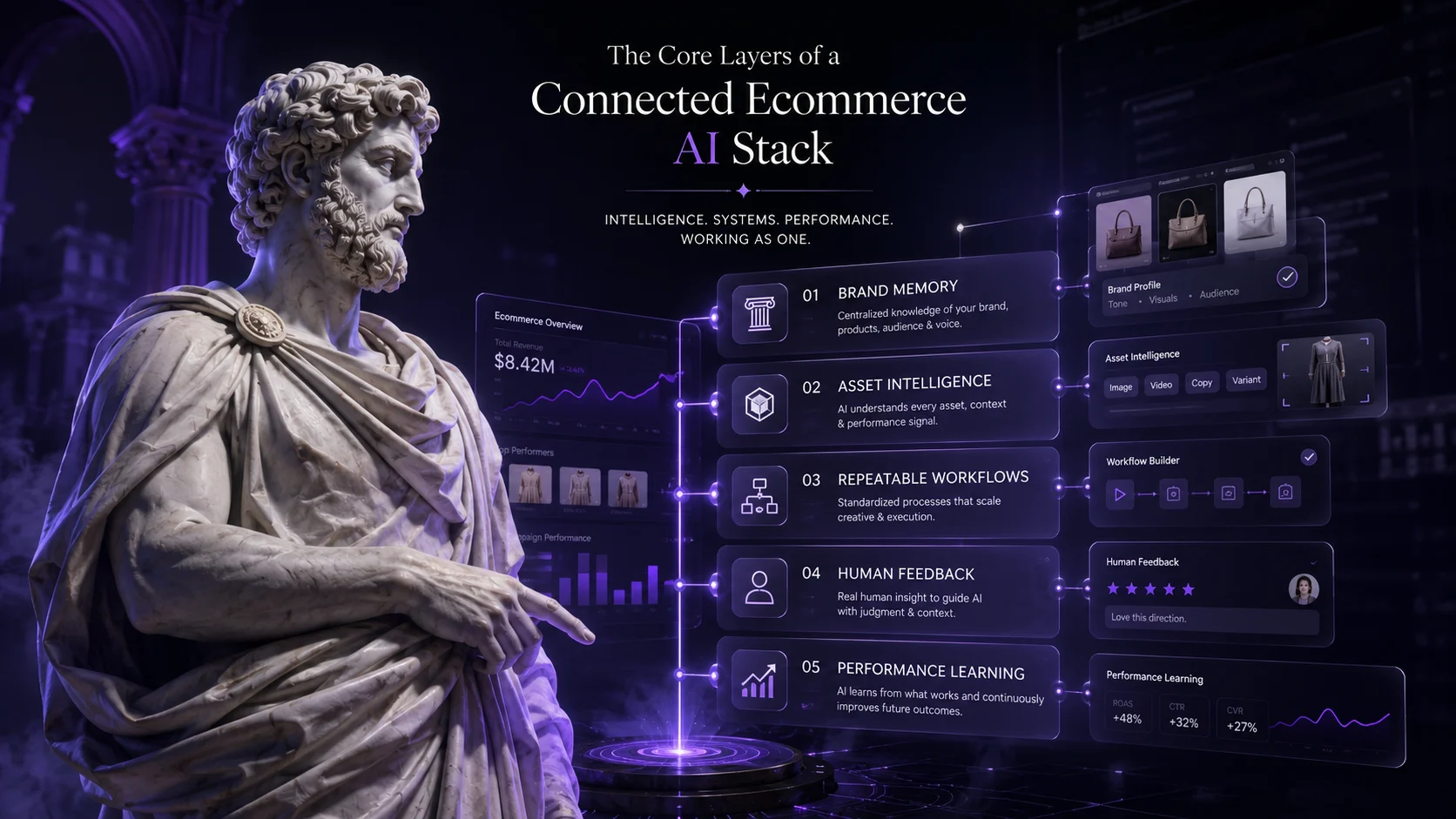
A connected stack needs more than content generation. It needs clear layers that support daily ecommerce work.
Brand memory stores the brand’s voice, visual rules, product language, audience context, style preferences, naming rules, and guidelines.
If one agent creates a product visual, another writes an email, another updates a Shopify product page, and another supports SEO or GEO content, they should all work from the same brand understanding.
Without this layer, AI tools for ecommerce can become fast but inconsistent.
A good ecommerce stack should make product images, ad creatives, campaign references, videos, UGC, catalog visuals, and brand assets easy to find and reuse.
For DTC brands, assets are growth inputs. A searchable asset system helps teams reuse proven creatives, identify content gaps, and brief new campaigns faster.
This matters for any brand building a stronger tech stack for ecommerce website performance.
Ecommerce work repeats every week.
Brands need product visuals, campaign assets, catalog content, lifestyle images, email flows, PDP updates, SEO content, and social content.
Instead of starting with a blank prompt every time, a connected stack should give teams structured workflows built around ecommerce tasks.
This is especially useful for teams using AI Marketing Tools for DTC but struggling to keep output consistent across campaigns.
Human review is still important.
The difference is that feedback should not disappear after approval. When a team corrects tone, product claims, visual style, image direction, or creative details, that feedback should improve future output.
This makes AI Tools for D2C Marketing more useful because the system learns from real brand review, not only from prompts.
A connected AI stack should learn what performs.
Creative, copy, product content, email campaigns, and product pages should improve through testing and campaign results. A disconnected tool creates content and stops. A connected stack learns what worked and uses that insight in the next cycle.
The layers above define what a connected ecommerce AI stack needs. The next step is turning those principles into daily execution.
That is where features such as Brand Memory, Files, Spaces, Cowork, Refine, and Loops become important.
Brand Memory gives every workflow access to the same voice, product language, positioning, and brand guidelines, reducing the need for repeated briefing.
Files creates a centralized home for product images, campaign assets, videos, UGC, creative references, and historical campaign materials.
Spaces helps teams run structured ecommerce workflows for launches, creative production, catalog updates, product content, and recurring marketing activities.
Cowork enables collaboration between people and AI agents, making it easier to assign work, review outputs, and move projects forward.
Refine captures human feedback and turns edits into reusable learning, helping future outputs become more accurate and brand-aligned.
Loops connects campaign results back into the workflow so future creative, content, and growth activities can benefit from previous performance insights.
Together, these features help transform AI tools for ecommerce from isolated generators into a connected operating system built around how modern DTC teams actually work.
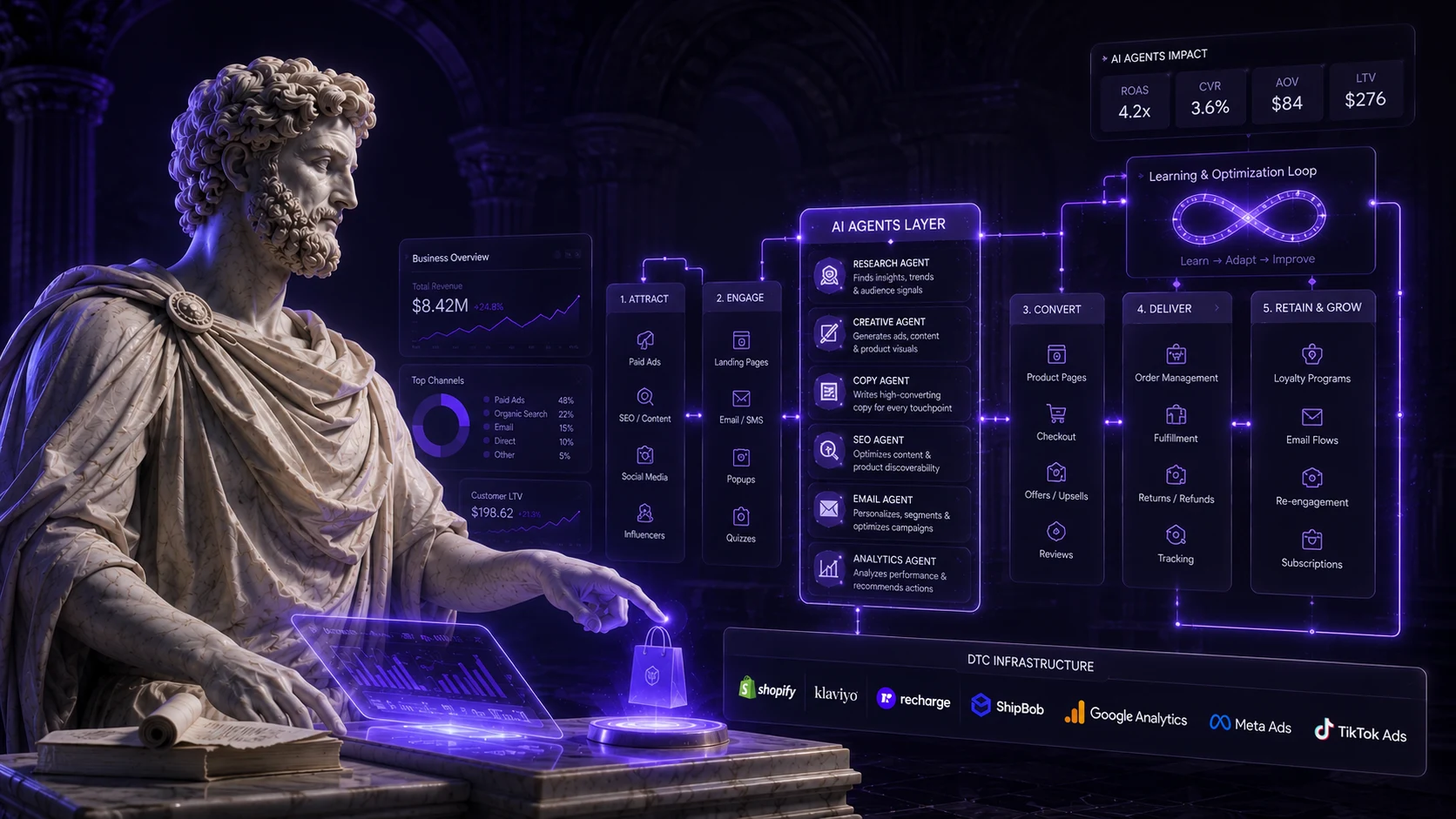
AI agents for ecommerce brands are useful because they support real ecommerce roles.
A generic AI tool may complete one task. An agent can support a function such as creative, email, Shopify operations, performance, SEO, GEO, or brand intelligence.
Monica supports creative direction, product visuals, ad creatives, and campaign storytelling.
Erlich supports social content, captions, hooks, and organic content planning.
Dinesh supports email, CRM, lifecycle flows, launch campaigns, and retention messaging.
Richard connects campaigns with Shopify store updates, product page improvements, catalog work, and store execution.
Gavin brings performance marketing insights, ad learnings, ROAS signals, and creative feedback.
Big Head supports SEO, GEO, AI search visibility, prompt gaps, crawlability checks, and citation opportunities.
Jian-Yang adds brand intelligence, competitor signals, audience insights, and positioning direction.
Russ supports finance and growth decisions where CAC, LTV, margins, and spend clarity matter.
Together, these agents show how DTC marketing tools can move beyond separate tasks and become a connected system for creative, content, email, store operations, ads, search visibility, brand strategy, and growth learning.
Let’s say a DTC skincare brand is launching a new moisturizer.
In a disconnected setup, the team may use one tool for product copy, one for visuals, one for email, one for ads, one for Shopify, one for SEO, and one for performance reporting.
With a connected workflow, the process is cleaner.
Brand intelligence identifies positioning, competitor angles, and audience signals. Brand memory keeps product language, visual style, and claim rules consistent. The asset library helps the team find product images and past campaign references. Creative workflows generate product visuals and ad directions. Social workflows turn the campaign into content. Email workflows build the launch and CRM flow. Shopify workflows support product page updates. SEO and GEO workflows identify content gaps so the product can be discovered in search and AI-generated answers. Performance workflows review results and send insights back into the next creative cycle.
This is what AI tools for ecommerce should do inside a connected stack. They should help the team create faster, stay consistent, and learn with every campaign.
A connected DTC Tech Stack also supports visibility across traditional search, answer engines, and AI-generated answers.
For SEO, a connected stack helps teams create stronger product pages, category pages, FAQs, buying guides, comparison content, metadata, and internal links. Store workflows can support Shopify page updates, SEO workflows can identify content gaps, and brand memory can keep search content aligned with the brand.
For AEO, the stack helps brands answer real buyer questions clearly. This includes questions around product fit, use cases, comparisons, ingredients, materials, shipping, quality, and buying decisions.
Generative Engine Optimization (GEO) focuses on improving visibility within AI-generated answers from platforms such as ChatGPT, Gemini, Perplexity, and Google AI Overviews.
For GEO, the stack helps ecommerce brands improve visibility when shoppers ask AI engines for recommendations, comparisons, alternatives, and buying advice. A GEO workflow can help brands identify prompt gaps, crawlability issues, citation opportunities, and answer-ready content needs.
GEO should not be separate from the ecommerce tech stack. It should connect with product content, buyer questions, SEO, and brand authority.
ShopOS brings these layers together through AI agents, Brand Memory, Files, Spaces, Cowork, Refine, and Loops.
It is not another single-use AI tool. It is built for ecommerce and DTC brands that need connected workflows across creative, content, email, Shopify, ads, SEO, GEO, assets, feedback, and performance learning.
This makes the platform relevant for teams that have already tried separate tools and now need a more unified way to run ecommerce work.
Point tools may work in the early stage. But a growing DTC brand should consider a connected platform when the current stack starts slowing the team down.
This usually happens when the team uses too many disconnected AI tools, brand voice keeps changing, creative production is slow, Shopify updates lag behind campaigns, email and ads do not match product pages, assets are hard to reuse, SEO and GEO are handled separately, human feedback keeps repeating, and performance learnings do not improve the next campaign.
For brands comparing AI tools for ecommerce, the key question is not only what the tool can generate. The better question is whether it can connect with the full ecommerce workflow.
Does your current stack only help create more output, or does it help the whole ecommerce operation work better?
For teams comparing AI Marketing Tools for DTC, this question matters. The best choice is not always the tool that creates the fastest first draft. It is the system that helps the team stay aligned across the full ecommerce workflow.
AI tools for ecommerce can help brands move faster.
But speed alone is not enough.
A DTC brand needs a stack that remembers the brand, organizes assets, supports workflows, connects channels, captures feedback, and learns from performance.
That is the real shift.
The future of ecommerce AI is not a long list of disconnected tools. It is a connected DTC Tech Stack where every agent, workflow, asset, and insight works together.
For teams evaluating AI Tools for DTC Marketing, the focus should be clear. Do not only ask what the tool can generate. Ask whether it can connect to the way the brand actually works.
AI tools for ecommerce can accelerate content creation, creative production, and campaign execution. But as brands grow, the real challenge becomes coordination.
Disconnected tools often create fragmented workflows, repeated briefs, inconsistent messaging, and missed opportunities to learn from performance.
A connected DTC Tech Stack helps solve that problem by bringing creative, content, store operations, search visibility, and performance insights into a shared system.
That is where ShopOS fits. By combining specialized AI agents with shared context, collaborative workflows, asset management, and continuous learning, it helps ecommerce teams operate more efficiently without adding more complexity to their stack.
For growing D2C brands, the future is not simply using more AI tools. It is building a system where every workflow contributes to better execution and better outcomes over time.
Most ecommerce teams do not need another AI tool. They need a system that connects creative, content, Shopify, email, SEO, GEO, assets, feedback, and performance learning in one place.
ShopOS helps DTC brands bring AI agents, workflows, assets, and brand knowledge together so every campaign starts with the right context and gets smarter over time.
See how ShopOS can help your ecommerce team work from a connected AI stack.
AI tools for ecommerce help online brands create product content, generate creatives, write emails, support ads, manage store tasks, improve SEO, analyze performance, and automate repeated workflows. The best tools connect with the wider ecommerce tech stack.
The best DTC Tech Stack connects Shopify, email, ads, creative, assets, SEO, GEO, analytics, and AI workflows. For growing brands, it should also include brand memory, human feedback, and performance learning.
A tech stack for ecommerce website growth includes the tools and workflows that support store management, product pages, creative assets, email, ads, analytics, SEO, GEO, and performance improvement.
D2C brands need connected AI tools so content, creative, email, Shopify updates, ads, SEO, GEO, and performance insights work together. Disconnected tools often create repeated work, inconsistent messaging, and slower execution.
AI agents for ecommerce brands are role-based AI coworkers that support specific workflows such as creative direction, social content, email marketing, Shopify store management, performance marketing, SEO, GEO, and brand intelligence.
Yes. AI Tools for DTC Marketing should understand product launches, customer journeys, retention, Shopify workflows, campaign assets, creative testing, and brand consistency. Generic AI tools usually support one task, while D2C-focused tools should support connected ecommerce workflows.
GEO helps ecommerce brands improve visibility in AI-generated answers and AI search platforms. It supports product discovery when shoppers ask AI engines for recommendations, comparisons, alternatives, and buying advice.
A connected platform is usually better for growing brands that need shared context across creative, content, email, Shopify, ads, SEO, GEO, feedback, and performance learning. Separate DTC marketing tools can help with individual tasks, but they often create gaps across the full workflow.

