
 ChatGPT
 Perplexity
 Claude
 Gemini
 Grok
Grok
UGC Videos. Customers don’t trust brands. They trust people who look like them.
This isn’t a new insight. Word-of-mouth has driven purchasing decisions for as long as commerce has existed. What’s changed is the format. Word-of-mouth at scale is now video. Short-form video that looks like it was filmed on a phone by a real person with a real opinion.
That’s UGC – user-generated content. And it converts.
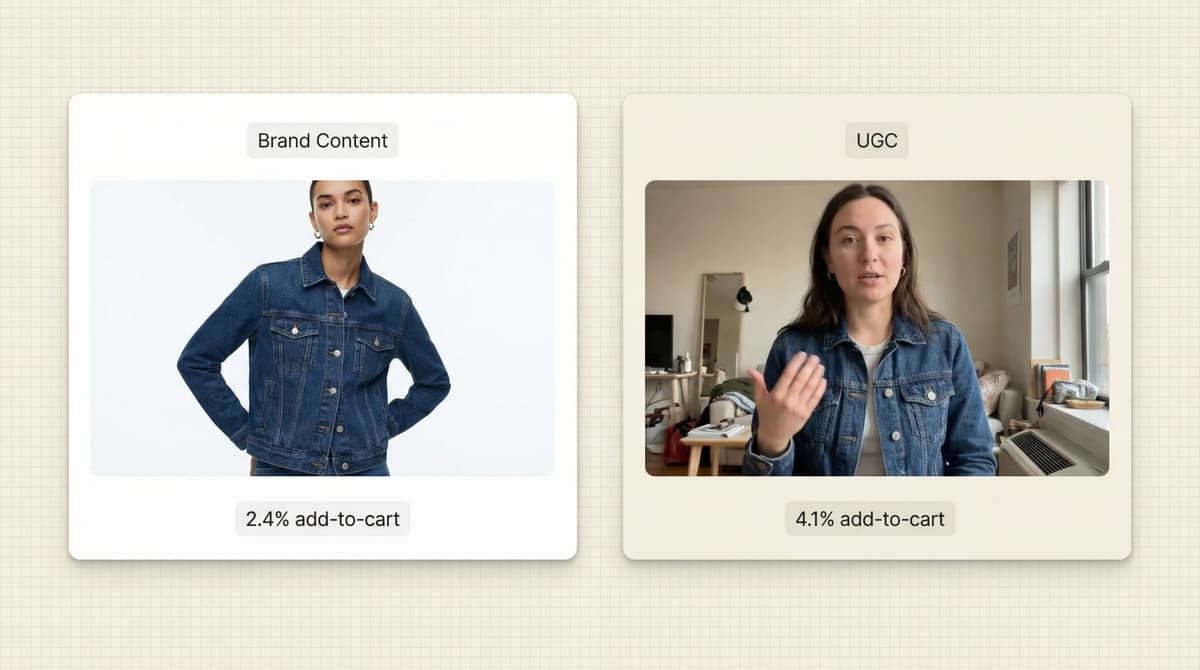
What Are UGC Videos in Ecommerce?
UGC videos are product-related videos created by real customers, users, or creators acting as users. They’re characterized by:
- Unpolished, authentic visual style (shot on phone, natural lighting, real environments)
- First-person narrative (“I’ve been using this for three weeks and…”)
- Real product experience (unboxing, trying on, using, comparing)
- Absence of brand production aesthetics
The format builds trust precisely because it doesn’t look like an ad. Viewers interpret polished brand video as promotional content and discount it accordingly. They interpret UGC as a peer recommendation and weight it as such.
UGC on product pages outperforms branded photography in conversion studies consistently. Nielsen research shows that 92% of consumers trust peer recommendations over brand advertising. When that peer recommendation is a video showing someone their own age wearing the dress or using the appliance, the conversion impact is significant.
How UGC Videos Increase Ecommerce Conversion Rates
The conversion mechanism works through multiple trust signals simultaneously.
| Trust Signal | How It Works | ||||
| Social proof | Someone else already bought this and likes it. | ||||
| The purchase is validated. | |||||
| Real-world representation | The product looks exactly like this in a real home, on a real body, in real lighting. | Expectation alignment reduces purchase anxiety. | |||
| Use-case demonstration | Watching someone else use a product removes uncertainty about whether it works for your specific context. “I have the same kitchen layout and it fits perfectly” closes the sale. | ||||
| Identity matching | Customers who see someone similar to them (age, body type, lifestyle, aesthetic) respond with higher conversion than to aspirational brand imagery. | ||||
| “If they like it, I probably will too.” | |||||
| Risk reduction | Honest UGC includes mild criticisms and caveats. | ||||
| “It runs slightly large, I’d size down.” This honesty increases trust more than it reduces conversion. Customers trust a reviewer who acknowledges imperfections. |
Quantified impact:
| Metric | Impact | Source |
| Web conversions on sites with UGC | 29% higher | Yotpo, 2023 |
| Click-through on UGC email campaigns vs. branded | 73% higher | Adweek |
| CPC on social ads using UGC creative vs. traditional | 50% lower | Nielsen, 2023 |
| Add-to-cart on product pages with video UGC vs. no video | 40–80% higher | Industry composite |
Best UGC Video Strategy for Online Stores
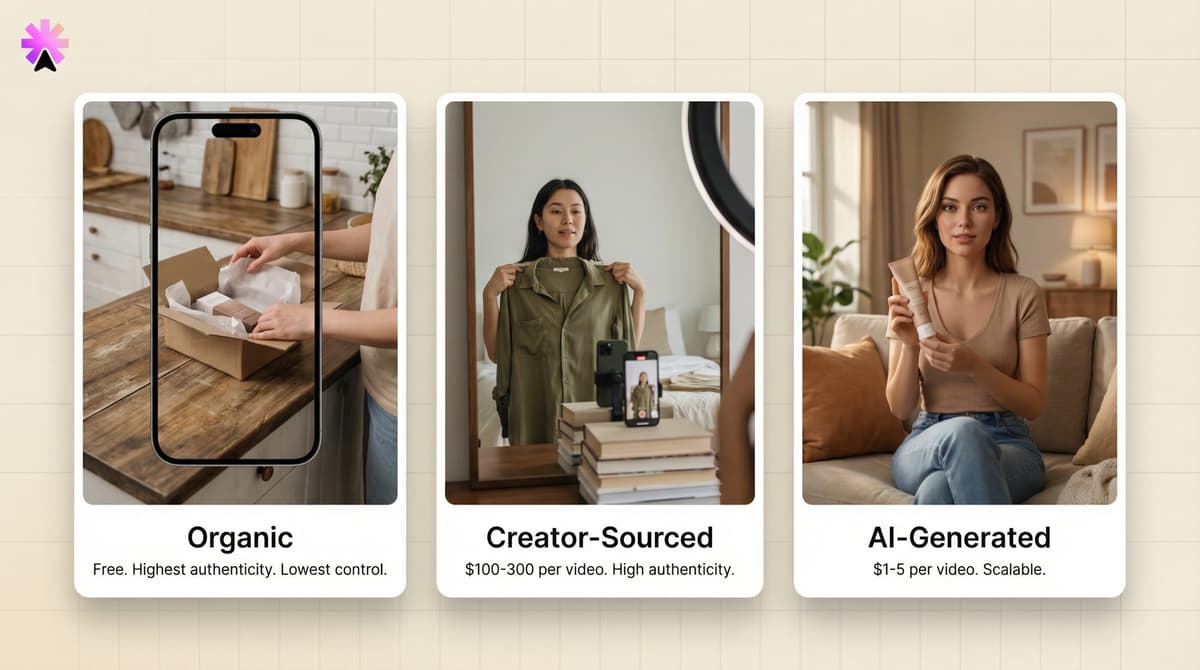
A UGC strategy requires sources of authentic content. There are three.
1. Organic customer UGC
Real customers posting about your product without being asked. The most authentic type. The least controllable. Requires a product good enough that customers want to share it.
Collection strategy: Monitor brand hashtags, product keywords, and tagged mentions. Send permission request to creators whose content you want to use. Offer discount or store credit in exchange for usage rights. Build a content library from ongoing organic collection.
2. Creator-sourced UGC
Hire creators to produce content in the UGC aesthetic – phone-shot, authentic-looking, personal narrative. They receive a brief and product, shoot in their own environment, deliver video in the expected style.
Creator brief template:
- Shoot on your personal phone camera
- Film in your home or regular environment
- Start with why you were interested in the product
- Show the product being used/worn naturally
- End with your honest impression after using it
- Do not use branded music or professional lighting
- Resolution: minimum 1080p, vertical format preferred
3. AI-generated UGC-style content
AI systems now generate content that matches the aesthetic of authentic UGC – scripted, but produced in the visual style of consumer-generated video, with the narrative patterns and authenticity signals that make UGC convert.
How to Create UGC Videos for Product Pages at Scale
Collecting organic UGC is valuable but slow. Creator-sourced UGC is higher quality but requires management. AI-generated UGC-style content scales without proportional cost.
The AI UGC production pipeline
Step 1: Script generation. AI generates authentic-sounding scripts based on product attributes, customer review data, and common UGC narrative patterns for the category. The script includes personal context, usage scenario, and honest product assessment.
Step 2: Avatar or creator selection. AI video generation platforms produce video using AI avatars, or the script can be sent to a creator network for filmed delivery. The AI option is faster and cheaper. Creator-filmed is more authentic.
Step 3: Visual production. For AI-generated: the avatar reads the script in a casual, realistic setting – bedroom, kitchen, street. For creator-filmed: creator delivers video per brief.
Step 4: Edit and format. Trim to 15–60 seconds. Add captions (critical for social distribution). Add product overlay or purchase link for shoppable integration.
Step 5: Test and measure. Deploy on product page and as paid social creative. Track view rate, click-through, conversion attribution.
ShopOS integrates AI UGC production with the commerce context graph. Performance data from each UGC video variant feeds back. The system identifies which script angles, which creator demographics, and which product focus points drive the highest conversion. Future UGC production starts from proven patterns.
Shoppable UGC Video Integration
Shoppable UGC combines the trust signals of authentic content with the conversion mechanics of in-video checkout.
A customer watches a creator demonstrate a jacket – real environment, honest commentary, natural styling. At the moment the creator says “I’ve been wearing this literally every day,” a product tag appears. One click adds to cart. The session converts without the customer leaving the video.
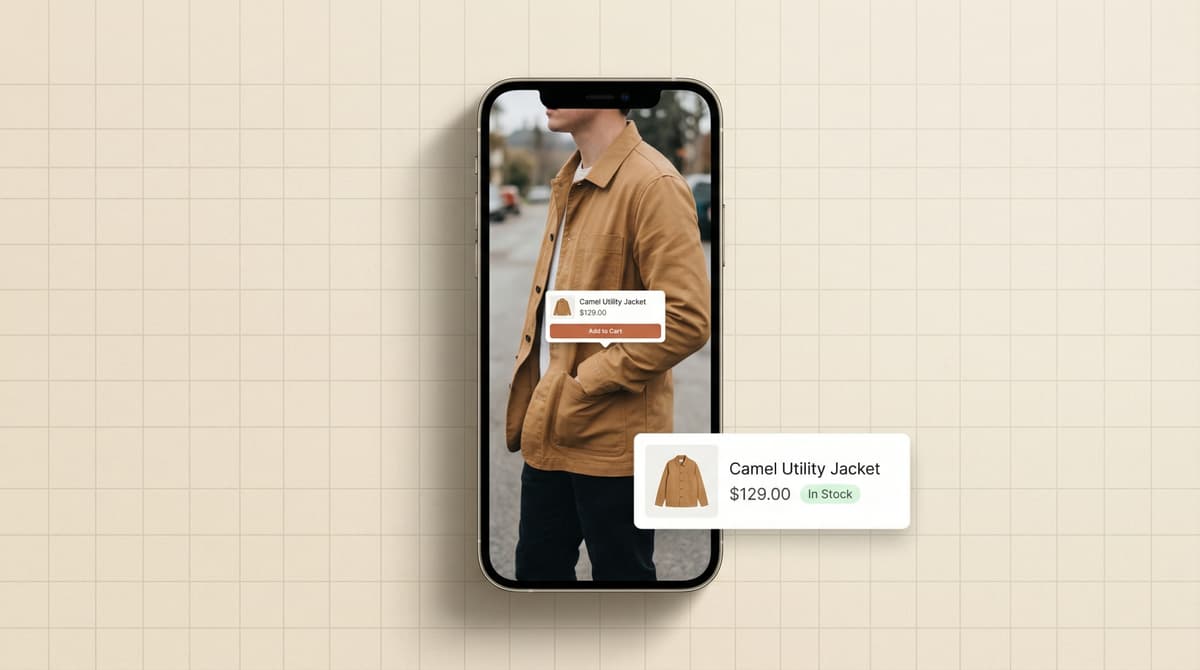
Implementation for Shopify
- Collect or create UGC video content
- Upload to shoppable video platform (Tolstoy, Videowise, or ShopOS)
- Tag products at relevant timestamps
- Embed on product pages or create UGC feed for collection/homepage placement
- Enable one-click add-to-cart from video tags
- Track revenue attributed to shoppable UGC
Placement hierarchy by conversion impact
| Rank | Placement | Goal | Intent Level |
| 1 | Product page | Direct conversion | Highest |
| 2 | Collection page | Discovery and cross-sell | Medium-high |
| 3 | Homepage | Brand trust for new visitors | Medium |
| 4 | Cart page | Upsell and order confidence | High (hesitant buyer) |
How to Scale UGC Video Ads Without Influencers
Influencer campaigns have a structural problem: they’re expensive, hard to scale, and performance is unpredictable. A single influencer partnership can cost $5K–$50K. Results vary widely.
The alternative is a systematic UGC creative production system that doesn’t depend on any single creator or relationship.
The scalable UGC ad production system
Source layer:
- 5–10 micro-creators per product category ($100–$300 per video)
- Organic customer collection (permission-based reposting)
- AI-generated UGC-style scripts performed by brand team or contractors
- Customer review mining (turn written reviews into narration scripts)
Production layer:
- Standardized brief template
- Review and quality scoring
- Caption automation
- Platform adaptation (1:1, 9:16, 4:5)
Testing layer:
- 5–10 UGC variations per product launch
- Paid social testing (Meta, TikTok) at $20–$50/day per variation
- Performance measurement at day 3, 7, 14
- Winners scaled, losers paused
Learning layer:
- Which creator type (age, demographic, style) drives best ROAS for each product category
- Which script angles (problem-solution, lifestyle, comparison, tutorial) perform by channel
- Which formats (talking head, hands-on demo, unboxing, try-on) convert by product type
Cost comparison
| Approach | Content Output | Monthly Cost | Testing Data |
| Traditional influencer campaign | 1–3 pieces of content | $10K–$50K | Minimal |
| Systematic UGC production | 20–40 pieces of tested content | $2K–$5K | Rich (by creator, angle, format, channel) |
The systematic approach produces more content, better testing data, and lower cost per converting creative.
Increase Trust Using Customer Video Testimonials
Video testimonials are a specific UGC subformat with distinct trust mechanics.
A written review says: “Great product, fast shipping, would recommend.” Useful. Low trust signal. Any brand could generate 100 of these.
A video testimonial shows: a real person, in their real environment, describing a real experience with the product. The viewer reads authentic body language, vocal inflection, and contextual detail. The trust signal is substantially higher.
Video testimonial collection tactics
| Tactic | How It Works | When to Use | ||||||||
| Post-purchase email | 14 days after delivery, send email requesting 30-second video review. Include a simple recording link and discount code for next purchase. | Default. Automate for every order. | ||||||||
| Review page video upload | Add video upload to your review form. | Most platforms (Yotpo, Okendo, Stamped) support video submissions. | Ongoing. Passive collection. | |||||||
| SMS request | High open rates. | Short message: “Enjoying your [product]? | Leave a 30-second video review and get 15% off: [link]” | Best for high-engagement customers. | ||||||
| Unboxing incentive | Card in packaging: “Film your unboxing for a chance to be featured on our homepage.” | QR code linking to submission form. | Every shipment. Low cost, high-quality UGC when it works. |
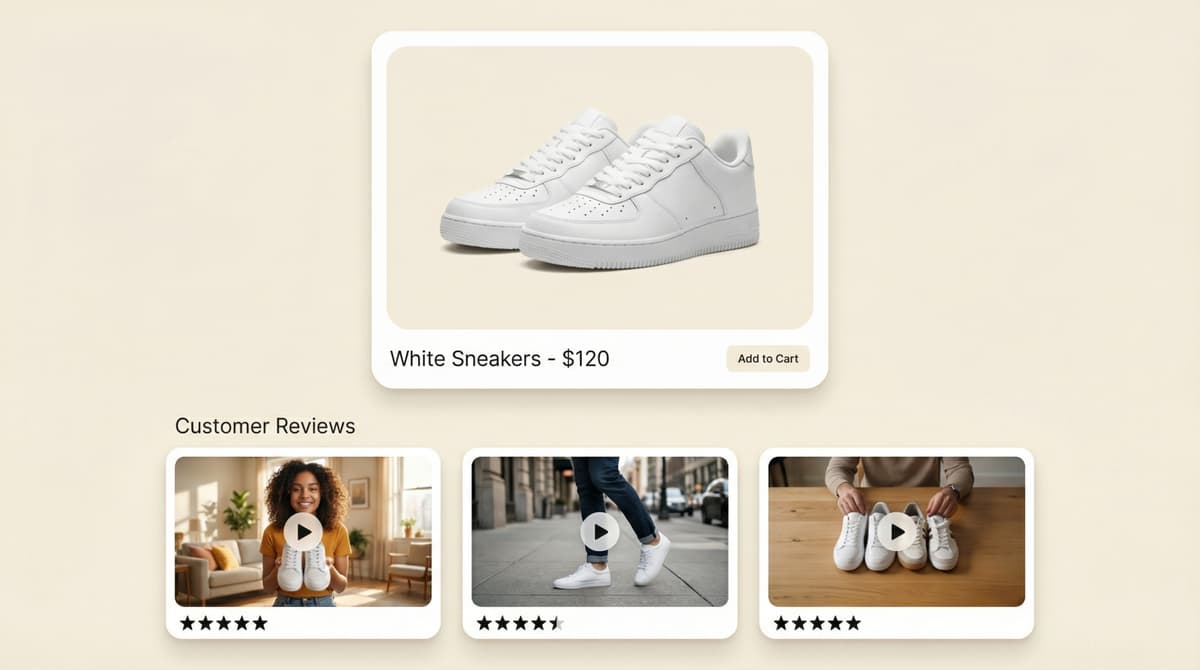
Video testimonial placement
| Placement | Purpose | ||||
| Product page | Primary conversion driver. | ||||
| Show 2–4 testimonials directly relevant to that product. | |||||
| Collection page | Category-level social proof. | ||||
| Homepage | Brand trust. | Use breadth of testimonials to signal customer satisfaction at scale. | |||
| Paid ads | Video testimonials as ad creative outperform most other formats in cost-per-acquisition. |
Video-Driven Ecommerce Growth: The Compounding Effect
Individual UGC videos drive one-time conversion impact. A systematic UGC strategy creates a compounding growth system.
The growth loop:
UGC collection grows the library → More content to test → Better creative data.
Better creative data improves ad performance → Lower CPA → Budget scales → More customers.
More customers generate more organic UGC → More authentic content to deploy → Better trust signals.
Better trust signals improve conversion rate → Higher revenue → More product investment → Better products → More authentic positive reviews.
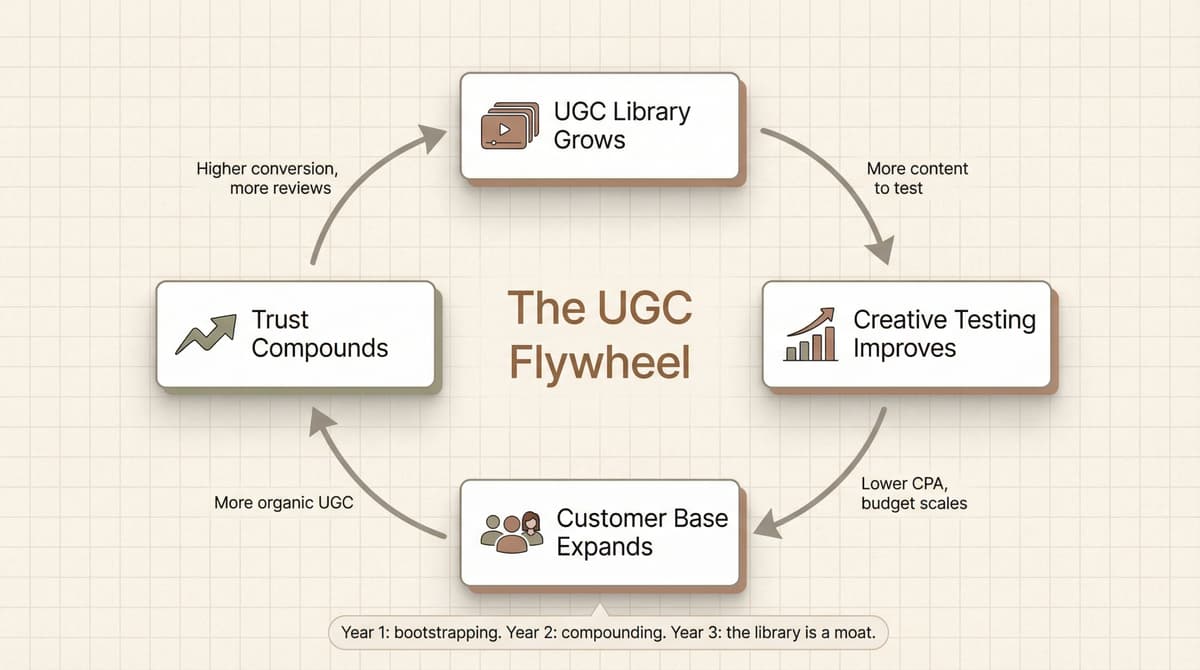
Brands that treat UGC as a systematic asset – collected, organized, tested, and deployed strategically – build content moats that competitors can’t replicate.
A brand with 2 years of UGC collection, testing history, and creative performance data knows which narratives, formats, and contexts drive conversion for their specific audience. Competitors starting from zero need years to build equivalent knowledge.
ShopOS builds this learning layer into the commerce context graph. Every UGC video’s performance is tracked, patterns are identified, and future production is informed by what has already proven to work.
[Start building your UGC video strategy →]


