

 ChatGPT
 Perplexity
 Claude
 Gemini
 Grok
Grok
There used to be a finish line in search marketing: page one.
If your brand ranked in the top three blue links for a high-intent query, you were visible. You earned the click. The traffic came. The game was understood by everyone playing it.
That finish line has moved.
When a DTC founder types “best protein powder for muscle recovery” into ChatGPT today, they do not get ten links. They get a synthesized answer with two or three brand recommendations, sometimes with reasoning, sometimes with a citation, sometimes with nothing but a confident AI recommendation.
If your brand is not in that answer, you were not in the consideration set. And the shopper may never click through to find you.
This is the shift that generative engine optimization was built to address.
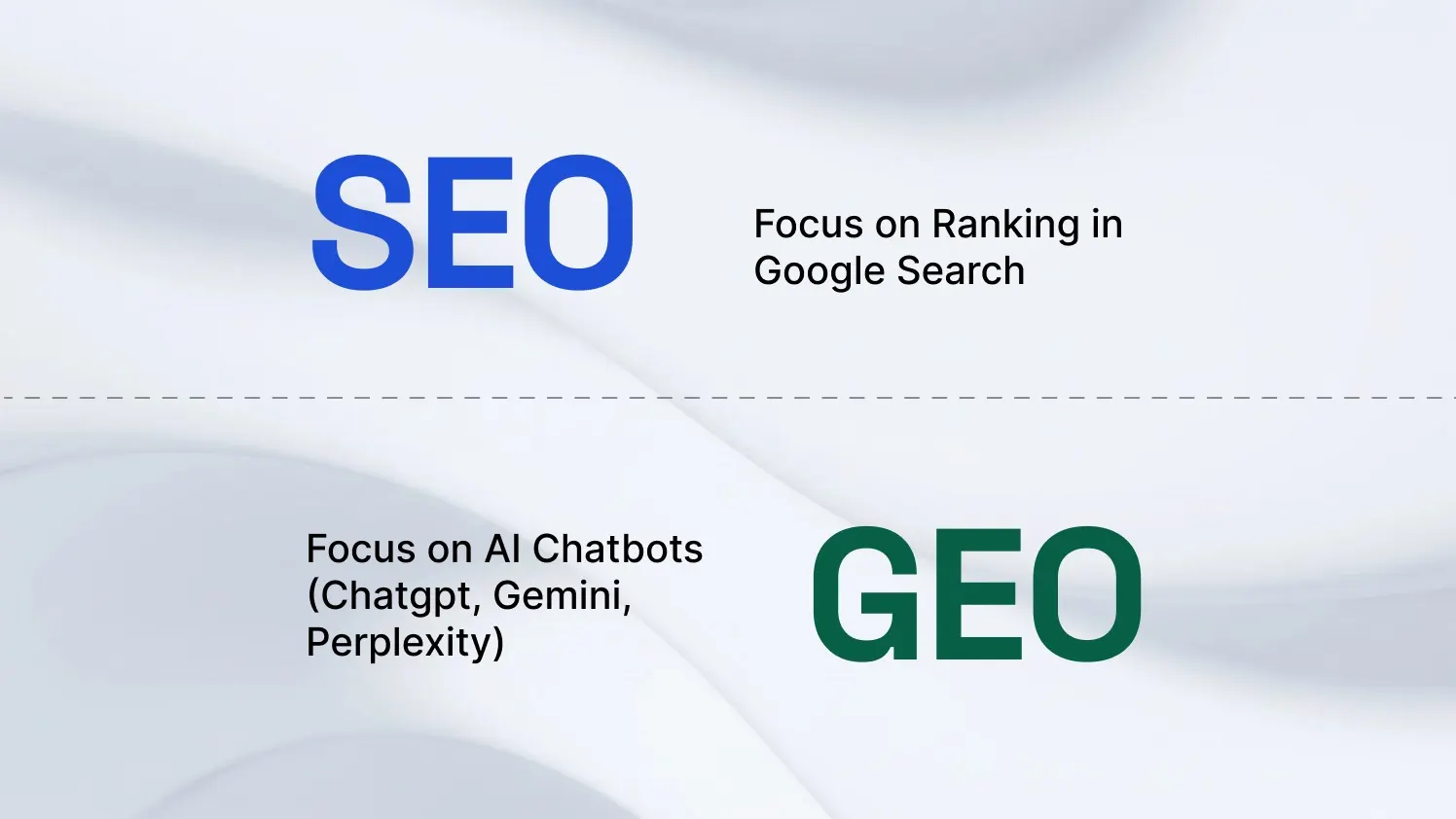
For marketers still asking what GEO SEO is, the simplest answer is this: SEO helps brands rank in search results, while GEO helps brands appear in AI-generated answers.
Generative engine optimization is not SEO with a new name. It is a different discipline built for a different kind of search engine.
This guide covers what it is, why it matters specifically for ecommerce and DTC brands, how generative engines actually decide what to cite, and what a practical GEO strategy looks like in 2026.
What Is Generative Engine Optimization?
Generative engine optimization (GEO) is the practice of structuring your content, product data, and brand presence so that AI-powered platforms can extract, trust, and cite your brand when answering user queries.
For anyone asking what is GEO SEO in practical terms, it is the process of making your brand easy for AI search engines to understand, verify, and recommend.
The platforms in question include ChatGPT, Perplexity, Google AI Overviews, Gemini, Claude, and Bing Copilot.
Each uses large language models to synthesize answers from content it has indexed or retrieved in real time. They do not return a ranked list of links. They return an answer and, within that answer, may cite specific brands, products, or sources.
Generative engine optimization is the discipline of making your brand one of those cited sources.
The term was first formalized in a landmark academic paper by researchers from Princeton University, Georgia Tech, IIT Delhi, and the Allen Institute for AI published at ACM KDD 2024.
The study introduced the GEO-bench benchmark, tested nine content optimization strategies across 10,000 queries, and found that the right content techniques could boost AI citation visibility by up to 40%. Adding statistics improved visibility by 41%. Citing external sources improved lower-ranked content by up to 115%.
In 2026, generative engine optimization has moved from an academic concept to a commercial priority.
According to OpenAI’s own reporting, ChatGPT now processes over 2.5 billion prompts every day. Per Adobe Analytics data covering over one trillion visits to US retail sites, AI-referred traffic to ecommerce stores grew 393% year-over-year in Q1 2026, and AI traffic now converts 42% better than non-AI traffic, a new record high as of March 2026.
For ecommerce brands, this is no longer a future consideration. It is a current distribution problem.
The instinct for most marketers is to treat GEO as an extension of SEO.
The logic makes sense on the surface: both are about search visibility, both require good content, both reward authority. But the underlying mechanics are different enough that treating GEO as just another SEO tactic will yield weak results.
Here is where GEO vs SEO becomes clear: the two disciplines may share the same visibility goal, but they operate very differently underneath.
1. What are you optimizing for?
SEO optimizes for a ranking position in search results. Generative engine optimization optimizes for inclusion in a synthesized answer.
A ranking can be measured and tracked with precision. An AI citation is probabilistic, variable, and does not always produce a click.
2. What the algorithm values
Traditional SEO rewards keyword relevance, backlink authority, and technical site health. Generative engines weigh content differently.
They prioritize clarity over creativity, structured information over discursive prose, factual density over keyword density, and source trustworthiness over domain authority scores.
3. How the user interacts with the result.
In traditional search, the user sees a list and decides which link to click. In generative search, the AI has already synthesized the answer.
The user often makes a decision based on what the AI said, without clicking through to verify it. This is the zero-click reality that GEO is built around. If the AI recommends your brand confidently, that is conversion-level influence without a single click.
4. How you measure success?
SEO measurement is click-based: impressions, clicks, CTR, and rankings. Generative engine optimization measurement is citation-based: how often is your brand mentioned in AI-generated answers, across which platforms, in which query categories, with which sentiment.
The measurement infrastructure is newer and less standardized, but it is developing quickly.
5. What “good content” means.
For SEO, good content ranks. For generative engine optimization, good content gets cited. Those two outcomes sometimes overlap, but not always.
An article that ranks well for a keyword may be too discursive or poorly structured for an AI to extract a usable answer from it.
Conversely, a well-structured, authoritative FAQ page may be heavily cited by Perplexity even if it sits on page three of Google.
The broader implication is that GEO and SEO need to coexist in a brand’s content strategy, with different success metrics and different content standards applied to each.
How GEO Works
Understanding GEO without understanding how generative engines operate is like trying to do SEO without understanding how Google crawls a page. The mechanics shape the tactics.
Generative search engines (like ChatGPT, Gemini) do not simply index and retrieve. They synthesize.
When a user submits a query, the system retrieves relevant content from its index or the web in real time, evaluates the credibility and clarity of that content, extracts the most relevant passages, and compiles them into a coherent, conversational answer. The output is the AI’s synthesis, not a direct copy of any single source.
This is why traditional keyword optimization has a limited impact on generative engine optimization performance.
The AI is not looking for a page that mentions the query term most frequently. It is looking for a source that can provide a clear, credible, well-structured answer that it can extract with confidence.
This is also the foundation for understanding how to rank in AI search. Brands need content that answers the query directly, provides AI with sufficient factual context, and makes the source easy to trust.
Several factors influence whether a generative engine cites a source:
1. Clarity and structure.
AI systems extract answers more reliably from content that is clearly organized. Headers, concise paragraphs, defined terms, and direct answers to specific questions all make extraction easier. Ambiguous marketing language and vague claims make it harder.
2. Factual density.
Generative engines favor content that contains specific, verifiable claims: data points, named products, defined processes, concrete examples. A page that says “our product is the best choice” gives the AI nothing to work with. A page that explains what the product contains, how it works, and who it is for gives the AI a usable answer.
3. Source authority and trust signals.
Citations from credible sources, presence on third-party review platforms, structured data markup, and consistent brand information across the web all contribute to how much a generative engine trusts your content.
4. Answer-readiness.
Content written for the full-sentence, conversational queries that AI search attracts gets cited more often than content written for two-word keywords. “What is the best protein powder for endurance athletes?” requires a very different content approach than “protein powder.”
5. Schema and structured data.
For ecommerce specifically, a complete product schema including identifiers, availability, pricing, condition, and review aggregates gives generative engines the verifiable data they need to recommend your products accurately and confidently.
Why Generative Engine Optimization Matters More for Ecommerce

GEO (Generative engine optimization) is relevant across industries, but for ecommerce and DTC brands, the stakes are particularly sharp.
E-commerce is one of the most query-rich categories in AI search.
Shoppers ask questions constantly: What is the best collagen supplement for women over 40? Which running shoes have the best cushioning for flat feet? What is a good gift for someone who travels for work?
These are exactly the kinds of conversational, intent-rich queries that generative engines answer, and that consumers are increasingly asking AI directly before they ever visit a store or run a traditional search.
According to Adobe Analytics, 39% of US consumers have already used generative AI for online shopping, with 85% saying it improved their experience.
AI-referred traffic to US retail sites grew 393% year-over-year in Q1 2026 and converted 42% better than non-AI traffic in March 2026, per the same Adobe data. When a shopper arrives at your store via an AI citation, they spend 48% longer on the site and browse 13% more pages because the AI has already answered their core objections before they arrive.
For Shopify-native D2C brands, generative engine optimization rewards what good brand-building has always rewarded: credibility, clarity, and consistency.
That is why AI search visibility for ecommerce depends heavily on product accuracy, category authority, structured content, and consistent brand signals across the web.
The brand that has invested in authoritative content, accurate product information, structured data, and third-party validation is the brand that gets cited.
The inverse is equally true.
A brand with thin product descriptions, no schema markup, no third-party reviews, and content written for keyword density rather than genuine clarity will be systematically invisible in AI-generated search answers, regardless of how well it ranks on Google.
The Core Pillars of a Generative Engine Optimization Strategy for DTC Brands
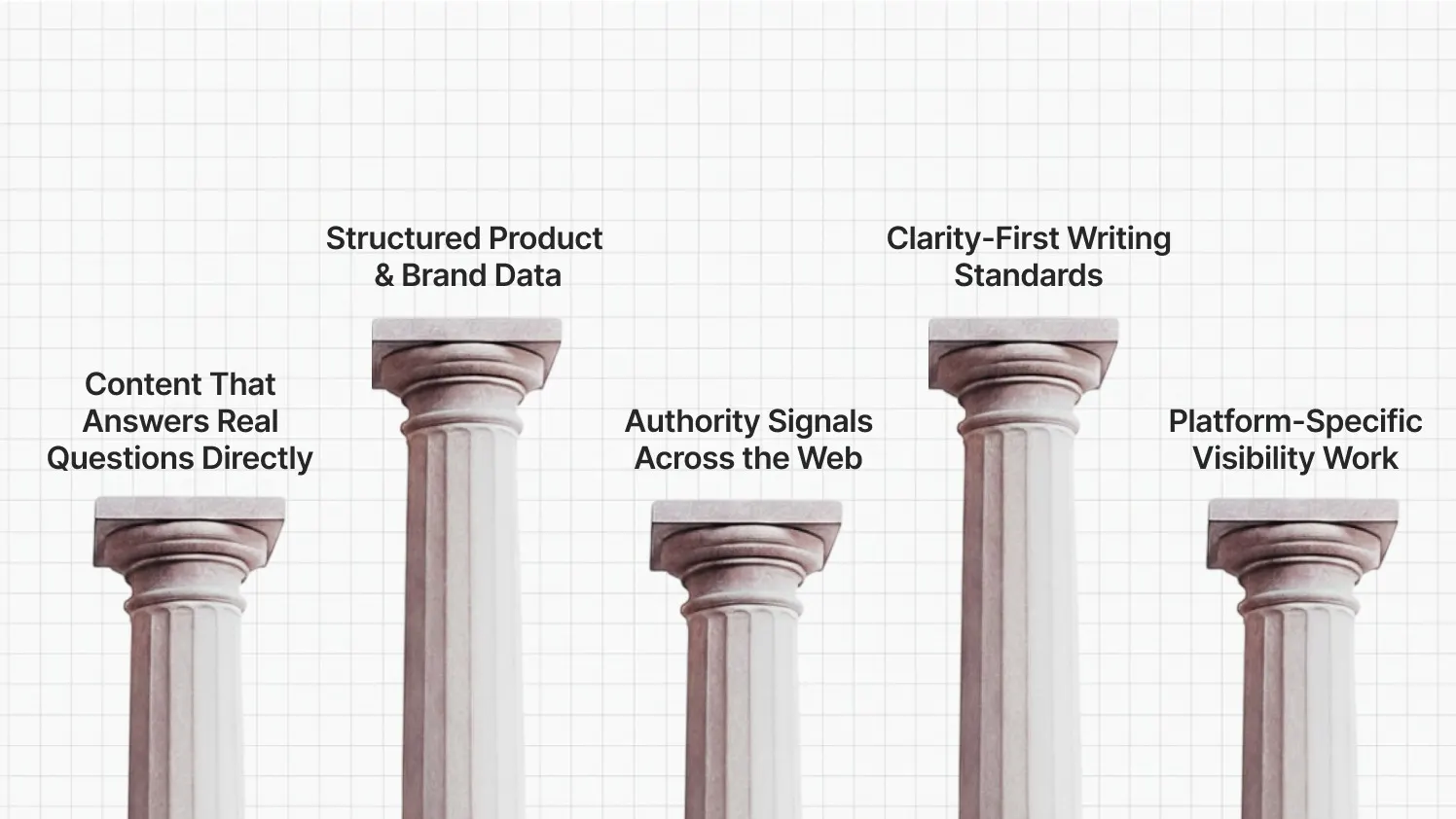
Generative engine optimization is not a single tactic. It is a set of overlapping disciplines that together increase the probability of your d2c brand being cited in AI-generated answers across platforms and query categories.
1. Content That Answers Real Questions Directly
The foundational unit of GEO (generative engine optimization) is content that answers a specific, real question clearly and completely. Not content built around a keyword. Content built around a query.
“Best protein powder for muscle recovery” is a query. The content that gets cited for it does not dance around the answer. It names specific products, explains the relevant mechanisms in plain language, cites evidence where possible, and gives the reader or the AI extracting the answer exactly what they need to make a decision.
For DTC brands, this means building out content that covers the real questions your target buyers ask, in the language they use, at the level of specificity that makes the answer actually useful. Generic category content ranks for vanity traffic. Specific, question-answering content gets cited.
2. Structured Product and Brand Data
For ecommerce specifically, your product data infrastructure is a generative engine optimization signal.
Complete product schema with accurate identifiers, pricing, availability, review aggregates, and product attributes gives generative engines the structured data they need to recommend your products accurately and confidently. An AI that cannot verify your product’s basic attributes is unlikely to recommend it in a direct comparison query.
Beyond product schema, your brand’s presence across structured third-party sources matters. Reviews on major platforms, listings in credible directories, citations in authoritative publications, and consistent brand data all contribute to the trust signals that generative engines use to evaluate source credibility.
3. Authority Signals Across the Web
Generative engines do not only look at your own content. They look at what other credible sources say about you.
If a brand wants to get cited by ChatGPT, it needs more than polished owned content. It needs proof across third-party sources, reviews, mentions, and trusted references that AI systems can recognize.
This means GEO strategy includes active work to build citations and mentions across authoritative sources: press coverage, third-party reviews, influencer content that gets indexed, and links from publications that AI systems treat as trusted sources.
Original research and data is particularly powerful here. A brand that publishes its own study, a survey of customer behavior, an analysis of product performance data, a benchmark report for its category, creates a citation magnet that compounds over time. The Princeton research itself demonstrated that citing external sources improved AI citation visibility by up to 115% for lower-ranked content. The same principle applies in reverse: becoming a source that others cite.
4. Clarity-First Writing Standards
Most marketing content is written to persuade. Generative engine optimization content needs to be written to inform clearly and to be understood by a system that has no patience for ambiguity.
This means shorter paragraphs with clearer topic sentences. Defined terms on first use. Headers that describe exactly what a section covers. Leading with the answer and following with the explanation, not building slowly to a conclusion.
This does not mean content should be dry. It means the clarity of the information cannot be sacrificed for the elegance of the writing. A generative engine extracting an answer from your content does not appreciate a graceful introduction. It needs the answer in the first two sentences.
5. Platform-Specific Visibility Work
Not all generative engines operate the same way. Perplexity visibility depends heavily on real-time web retrieval, recent content, clear answers, and strong source attribution. Google AI Overviews draw more heavily from content that already ranks well in traditional search. ChatGPT’s browsing mode favors authoritative domains with strong citation histories.
A mature generative engine optimization strategy accounts for these differences rather than treating all AI search as a single surface.
How to Audit Your Brand’s GEO Visibility
Before building a generative engine optimization strategy, you need a clear picture of where your brand currently stands in AI-generated search.
The audit process does not require specialized tools to start. Open ChatGPT, Perplexity, and Google with AI Overviews enabled. Type your top five product category queries as a real shopper would write them, in full conversational sentences. For each query, record: whether your brand appears, how it is described, which competitors are cited, and which third-party sources are being referenced.
This process helps brands understand how to rank in AI search across different platforms instead of relying only on traditional keyword rankings.
It can also show where AI search visibility for ecommerce is strongest, where competitors dominate, and which content gaps are stopping your brand from being included in AI-generated recommendations.
Per SparkToro’s 2026 analysis, there is less than a 1-in-100 chance of getting the exact same AI answer twice, so run each query at least three times to get a representative picture.
What you are looking for is your citation rate across relevant queries, your share of mentions relative to competitors, the accuracy of how your brand is described when it does appear, and the gap between queries where you rank in traditional search versus where you appear in AI-generated answers.
That gap is your generative engine optimization opportunity.
What to Fix First: GEO for Ecommerce Brands on Shopify
For DTC brands on Shopify with limited time and resources, the sequence of GEO work matters.
Start with the highest-intent query categories for your product range. These are the queries where a shopper is closest to a purchase decision, and where a generative engine optimization citation carries the most conversion weight.
Within those categories, audit your product data first. Incomplete schema, missing review aggregates, and inaccurate product attributes are the fastest generative engine optimization fixes with the most direct impact on product recommendation queries. Critically, Adobe’s April 2026 AI visibility data found that product detail pages score an average of only 66% on machine readability, the lowest of any page type on ecommerce sites. Most DTC brands have a significant GEO opportunity sitting on their PDPs right now.
Then move to content. For each high-priority query category, assess whether you have a page that directly answers the question a shopper would ask. If you do not, build it. If you do, evaluate whether it meets clarity-first writing standards.
Brands improving AI search visibility for ecommerce should prioritize product detail pages, comparison pages, FAQ sections, and category content that answer real shopper questions clearly.
Third-party authority is the long game. Press mentions, review platform presence, and original research compound over time, but they need something credible to point back to.
How Long Does Generative Engine Optimization Take to Show Results?
This is the question most brands ask and rarely get a straight answer on.
Generative engine optimization is not a campaign. It is infrastructure. The timeline depends heavily on which part of the discipline you are investing in.
Technical fixes, completing product schema, improving page machine-readability, fixing structured data gaps, can impact how generative engines read and retrieve your content within weeks of implementation.
Content-based generative engine optimization, building question-answering articles, refreshing PDPs for clarity and factual density, creating FAQ content, typically takes two to four months before meaningful citation gains appear, as AI systems need time to crawl, index, and begin extracting from new content.
Authority-building, press mentions, third-party citations, original research, is a six-to-twelve month investment minimum. But it compounds in a way that technical and content work alone cannot replicate.
The brands seeing the strongest GEO results in 2026 are those that started the infrastructure work in 2024 and 2025. The window to build a meaningful head start in your category is open now, but it is narrowing as more brands recognize what is at stake.
How ShopOS Handles Generative Engine Optimization for Ecommerce Brands

Most GEO tools audit your visibility and hand you a report. ShopOS executes.
Big Head is the GEO SEO agent inside ShopOS. His job is to grow organic and generative-engine visibility for ecommerce brands so they show up wherever customers are searching, whether that is Google, ChatGPT, Perplexity, Google AI Overviews, or the next platform to absorb a meaningful share of commercial intent.
For brands trying to get cited by ChatGPT, Big Head focuses on citation-ready content, structured product data, and clear source signals that make AI extraction easier.
What makes Big Head different from a standalone generative engine optimization tool is the system he operates inside.
Generative engine optimization requires three things to work at scale: citation-ready content, accurate and structured product data, and consistent brand authority across the web. Most brands treat these as three separate workstreams managed by different people with different tools. Inside ShopOS, they are connected.
Brand Memory is the foundation that makes Big Head’s work compoundable. Every piece of content produced inside ShopOS, whether that is a campaign brief from Monica, a product description, a blog post, or a social caption, carries the same brand voice, the same factual accuracy, and the same structured clarity that generative engines need to extract and cite. Big Head does not fight against inconsistent content from the rest of the team. The system produces content that is GEO-ready by default.
On the execution side, Big Head audits the brand’s current visibility across generative platforms, identifies the query categories where the brand is absent or underrepresented, and builds the content and optimization strategy to close those gaps. For a DTC brand on Shopify, that means working with real product data directly from the store, not manually exported spreadsheets, and producing content structured for both traditional search rankings and AI citation simultaneously.
This same process strengthens Perplexity visibility because fresh, structured, source-backed content gives retrieval-based platforms stronger material to reference.
The agent handoff matters here too. When Big Head identifies a product category that needs stronger generative engine optimization content, Monica produces the creative assets alongside it. When structured product data needs updating for schema purposes, Richard, the Shopify Store Manager agent, handles the store-side execution. When performance data shows that a product is being recommended by AI but not converting once the shopper arrives, Gavin, the Performance Marketing agent, has the context to act.
For Shopify-native DTC brands, this is the practical difference between generative engine optimization as a separate project and GEO as an embedded operational capability. The content gets created, the product data stays accurate, the brand authority builds consistently, and Big Head ensures all of it works together toward the same outcome: your brand being the one AI systems cite when your customers ask the questions that matter most.
What Generative Engine Optimization Does Not Replace
Generative engine optimization is a serious and growing discipline. It is not a replacement for the marketing foundations that have always driven ecommerce growth.
Traditional SEO still matters. A significant share of commercial intent still flows through Google’s standard search results, and for many product categories, ranking in those results remains the primary organic distribution channel. GEO strategy should complement SEO, not compete with it, and the content standards GEO demands also make content perform better in traditional search.
Paid media still matters. AI-generated answers are influential, but they do not cover every touchpoint in the purchase journey. Performance marketing, retargeting, and paid social still drive conversion for DTC brands at a scale that organic visibility alone cannot match.
Brand building still matters. The brands that get cited by AI systems most consistently are the brands that have invested in genuine reputation: consistent product quality, real customer reviews, credible press presence, and clear positioning in their category.
What generative engine optimization changes is the distribution of organic visibility. The brand that only optimized for blue-link rankings is now invisible in a growing share of search interactions. The brand that builds for both surfaces its credibility wherever the search happens. For DTC brands that want to operate across every channel where their customers search, Google, ChatGPT, Perplexity, and beyond, ShopOS is built to handle exactly that, with Big Head, Brand Memory, and a connected agent ecosystem that keeps all of it working together.
GEO in 2026: Where This Is Headed
The trajectory for generative search is clear, even if the exact shape of the next two years is not.
AI-generated answers are taking a growing share of search interactions across every category. Adobe’s Q1 2026 data shows AI-referred traffic to US retail sites up 393% year-over-year, with conversion rates now outperforming every traditional traffic channel. The platforms driving this, ChatGPT, Perplexity, Google AI Overviews, are investing in better retrieval, better product-specific recommendation capabilities, and tighter integrations with ecommerce infrastructure.
For DTC brands, the window to build generative engine optimization authority is open now, while the discipline is still early enough that systematic investment creates a meaningful head start. The brands building citation-ready content, completing product data, and accumulating third-party authority now are the brands that will be the AI’s default recommendation in their category in two years.
Generative engine optimization is not a trend to monitor from a distance. It is a channel to build into, starting with the query categories closest to your highest-intent customers.
Page One Isn’t the Finish Line Anymore
Your brand can rank and still disappear when a shopper asks AI what to buy.
Big Head shows you where that happens, which high-intent queries you are missing, and what needs to change across content, product data, and AI visibility.
See Where Big Head Can Put Your Brand in the Answer: Book a Demo
FAQs
What is generative engine optimization (GEO)?
Generative engine optimization is the practice of structuring your content, product data, and brand presence so that AI-powered search platforms, including ChatGPT, Perplexity, Google AI Overviews, and Gemini, cite, reference, and recommend your brand when answering user queries. Where traditional SEO earns a ranking in a list of links, generative engine optimization earns a mention inside the AI’s synthesized answer.
For anyone still asking what is GEO SEO, the answer is simple: it is the shift from optimizing only for search rankings to optimizing for AI citations, brand mentions, and recommendation visibility.
How is GEO different from SEO?
The difference between GEO vs SEO comes down to the outcome each discipline is built for. GEO and SEO both aim for search visibility, but they optimize for different outcomes. SEO optimizes for ranking position. Generative engine optimization optimizes for citation inside an AI-generated answer. The content standards differ, GEO rewards clarity, factual density, and answer-readiness over keyword density. The metrics differ, GEO tracks citation rate and mention sentiment rather than clicks and rankings. And the user behavior differs, AI search users often make decisions based on the AI’s answer without clicking through to the source.
Does my Google ranking affect my GEO performance?
Yes, particularly for Google AI Overviews, which draws heavily from pages that already rank well in traditional search. For ChatGPT and Perplexity, which perform their own independent retrieval, your Google ranking matters less than your content’s clarity, factual density, and source attribution. A page that ranks poorly on Google can still earn strong AI citations on other platforms if it is structured well. The most robust generative engine optimization strategy builds for both, since the content standards that earn AI citations also tend to improve traditional search performance.
Which AI platforms does GEO cover?
Generative engine optimization is relevant across all major generative search platforms: ChatGPT, Perplexity, Google AI Overviews, Gemini, Claude, and Bing Copilot. Each has different retrieval architectures and content preferences, so a mature GEO strategy accounts for platform-specific differences rather than treating all AI search as a single surface.
Why does generative engine optimization matter for ecommerce brands specifically?
Ecommerce is one of the most query-rich categories in AI search. Shoppers increasingly ask AI systems for product recommendations, comparisons, and purchasing guidance before visiting a store. Per Adobe Analytics, AI-referred traffic to US retail sites grew 393% year-over-year in Q1 2026 and converted 42% better than non-AI traffic in March 2026. When a shopper arrives via an AI citation, they spend 48% longer on site and browse 13% more pages because the AI has already answered their core objections. If your brand is not being cited, you are missing that trust advantage at the highest-intent moment in the purchase journey. This makes AI search visibility for ecommerce a serious growth priority, especially for DTC brands competing in crowded product categories.
How do I know if my brand is appearing in AI-generated answers?
The fastest starting point is a manual audit: open ChatGPT, Perplexity, and Google AI Overviews, type your top product category queries as a shopper would ask them in a full sentence, and record whether your brand appears, how it is described, and which competitors are cited. Run each query at least three times, since AI answers vary significantly. Per SparkToro’s 2026 analysis, there is less than a 1-in-100 chance of getting the identical answer twice. Dedicated GEO monitoring tools are also emerging that track citation rates across platforms systematically. The same audit can also reveal where your brand can improve Perplexity visibility, where it already appears in ChatGPT-style answers, and which content gaps need to be fixed first.
How long does generative engine optimization take to show results?
It depends on which part of the discipline you invest in first. Technical fixes, product schema, structured data, page machine-readability, can show impact within weeks. Content-based GEO typically takes two to four months before meaningful citation gains appear, as AI systems need time to crawl and begin extracting from new content. Authority-building through press, third-party citations, and original research is a six-to-twelve month investment, but it compounds over time in a way that technical and content work alone cannot replicate.
What is the fastest GEO fix for an ecommerce brand?
For most Shopify-native DTC brands, the fastest generative engine optimization gains come from completing product schema markup with accurate identifiers, pricing, availability, and review aggregates. Adobe’s April 2026 AI visibility data found that product detail pages average only 66% machine readability, the lowest score of any page type on ecommerce sites. Most DTC brands have a significant GEO gap sitting on their PDPs right now. After product data, audit whether your highest-intent content directly answers the conversational questions shoppers ask AI, and rewrite anything that buries the answer.
For brands learning how to rank in AI search, this means fixing product data first, then creating clear content that AI systems can extract and cite confidently.
How does ShopOS help with generative engine optimization?
ShopOS handles generative engine optimization as an embedded capability, not a separate tool. Big Head, the GEO and SEO agent, audits your brand’s current visibility across generative platforms, identifies query categories where you are absent or underrepresented, and builds the content and optimization strategy to close those gaps. Brand Memory ensures every piece of content produced inside ShopOS carries the structured clarity and brand accuracy that generative engines need to cite your brand with confidence. For Shopify-native DTC brands, this means product data, content, and brand authority all work together toward the same GEO outcome without managing three separate workstreams across three separate tools.
For ecommerce teams trying to get cited by ChatGPT, this connected system matters because AI visibility depends on content, product data, and authority working together.