

Resale is growing faster than retail. The global secondhand market is projected to reach $350B by 2028, growing at 3x the pace of new retail (ThredUp 2024 Resale Report). Vestiaire Collective, Vinted, Depop, The RealReal are scaling quickly. So are in-house recommerce programs from Patagonia, REI, and Levi’s.
The bottleneck across all of them is the same: content production.
Each resale item is unique. Every returned jacket, every pre-owned sneaker, every vintage piece needs its own photography, its own description, its own condition assessment, its own listing metadata. You can’t templatize a product that exists as a single unit.
At 10,000 items per month, that content requirement becomes an operational crisis. AI is the first technology that actually solves it.
Why Recommerce Content Is Different
New retail product content scales well with AI because the product repeats. Generate 20 images of a jacket, use them for every unit sold in that colorway, update next season.
Recommerce content has no equivalent shortcut. Each item has:
- A unique condition (pristine, excellent, good, fair – with specific notes)
- A unique set of wear marks, alterations, or defects
- A unique provenance (original packaging, previous owner’s care)
- Unique variant details (exact size, exact colorway for a product that may have sold in 6 colors)
Content production scales linearly with inventory volume. 10,000 listings per month needs 10,000 content creation cycles per month.
Traditional recommerce operations handle this with human teams: condition assessors, photographers, copywriters, and catalogers. A well-run operation takes 15–25 minutes per item from intake to listing. At 10,000 items per month, that’s 2,500–4,000 person-hours monthly for content alone.
AI compresses this to under 3 minutes per item.
AI Product Media Generation for Resale
The core challenge for resale photography: the product arrives in unpredictable condition and configuration. The photography workflow needs to be flexible enough to handle every variation while producing consistent, quality outputs.
The AI-powered resale photography pipeline:
Step 1: Intake capture. Staff photograph the item on a lightbox table. Standard 360° protocol: front, back, left, right, detail shots of labels, hardware, and wear areas. 3–5 minutes per item with a consistent process. No artistic direction required.
Step 2: AI image processing. The captured images go through the pipeline:
- Background removal and standardization
- Lighting normalization (corrects for poor intake lighting conditions)
- Color accuracy correction
- Automatic crop and frame for platform specifications
- Defect/wear area highlighting (draws attention to the specific marks disclosed in condition notes)
- Generation of styled presentation image from the raw product captures
Step 3: Quality scoring. Vision AI assesses each processed image set. Flags low-quality outputs for manual review. Scores presentation quality against platform benchmarks.
Step 4: Auto-generation of lifestyle context. For premium resale platforms, AI generates a lifestyle context image – the pre-owned Bottega Veneta bag placed on a neutral surface with appropriate lighting. Generated from the product image, not from a physical shoot.
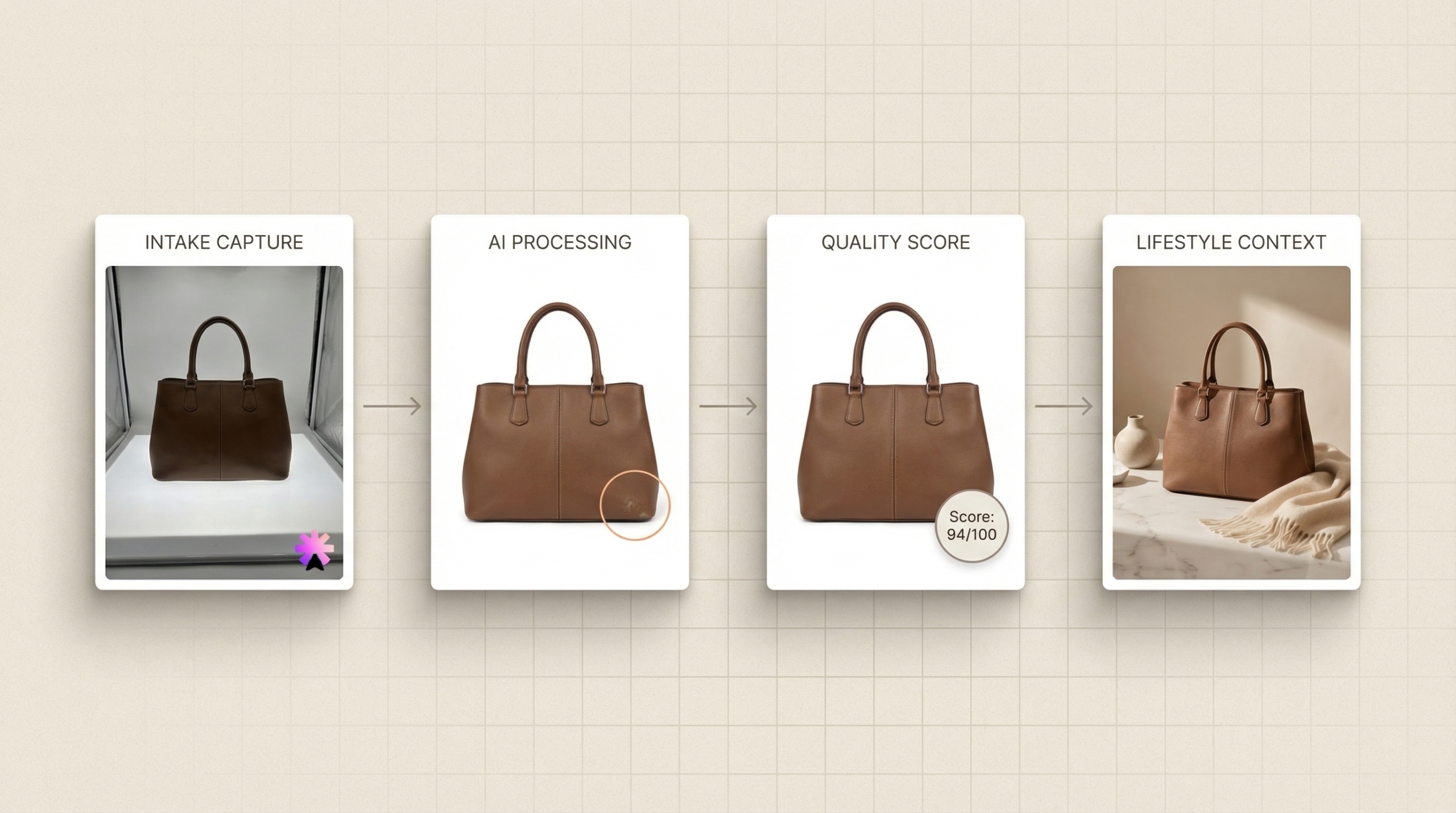
Output: a listing-ready image set in 90 seconds per item. Processing runs in parallel across the full daily intake volume.
How to Scale Recommerce Listings With AI
Content for resale listings has three components: photography, description, and condition disclosure.
AI description generation for recommerce
Input: Brand, product name, size, colorway, material composition, condition grade, intake photographs.
Output: A complete listing description including product story (the original product, when it was made, what makes it desirable), current condition description (what it looks like now, what wear is visible, what care has been taken), and provenance notes (original packaging, previous care, alterations).
The AI system pulls from a structured product knowledge base for brand and product information and generates condition-specific language from the intake condition assessment form.
For luxury resale, where item provenance and condition language directly affect buyer confidence and conversion, AI-generated descriptions that match buyer expectations consistently outperform brief, manually written descriptions.

Condition mapping to conversion language
| Grade | Conversion Language |
| Pristine | “Shows no signs of previous wear. Retains original shape, structure, and color integrity.” |
| Excellent | “Light signs of previous ownership. No visible marks under normal viewing distance.” |
| Good | “Shows moderate signs of previous wear consistent with careful use. [Specific details].” |
| Fair | “Shows visible signs of use. [Itemized defect disclosure].” |
The AI system generates condition language that is accurate, detailed, and optimized for conversion – disclosing defects while contextualizing them honestly (“shows the patina of careful use over time”).
Automating content for returned inventory
Returns are recommerce’s highest-velocity category. A brand doing $50M in annual ecommerce likely processes $10M–$20M in returns. Each return needs triage (resellable as new, resellable as like-new, resellable as recommerce, not resellable), photography, description update, and republishing.
AI automation compresses the return-to-relisting cycle from days to hours. The returned item arrives, gets triaged and photographed during quality control, AI generates updated imagery and description, and the relisted product goes live before the end of the day.
AI Video Generator for Ecommerce Listings
Video converts better than static imagery across every ecommerce platform. This is well-documented.
For new retail products, video is achievable at scale with AI video generation. For recommerce, where each item is unique, video production was previously reserved for luxury items where the margin justified the production cost.
AI video generation changes this.
AI-powered recommerce video production
Input: 8–12 high-quality static captures of the item.
Output: A 15–30 second product video showing the item from multiple angles, with smooth transitions, appropriate lighting, and optional overlay text (condition grade, key details, price).
The video is generated from static inputs using video synthesis models. No physical video production. No lighting rig. No editing time.
At 3,000 items per month, this produces 3,000 product videos per month. At $0.50–$1.50 per video generation cost, the economics are viable even at low average selling prices.
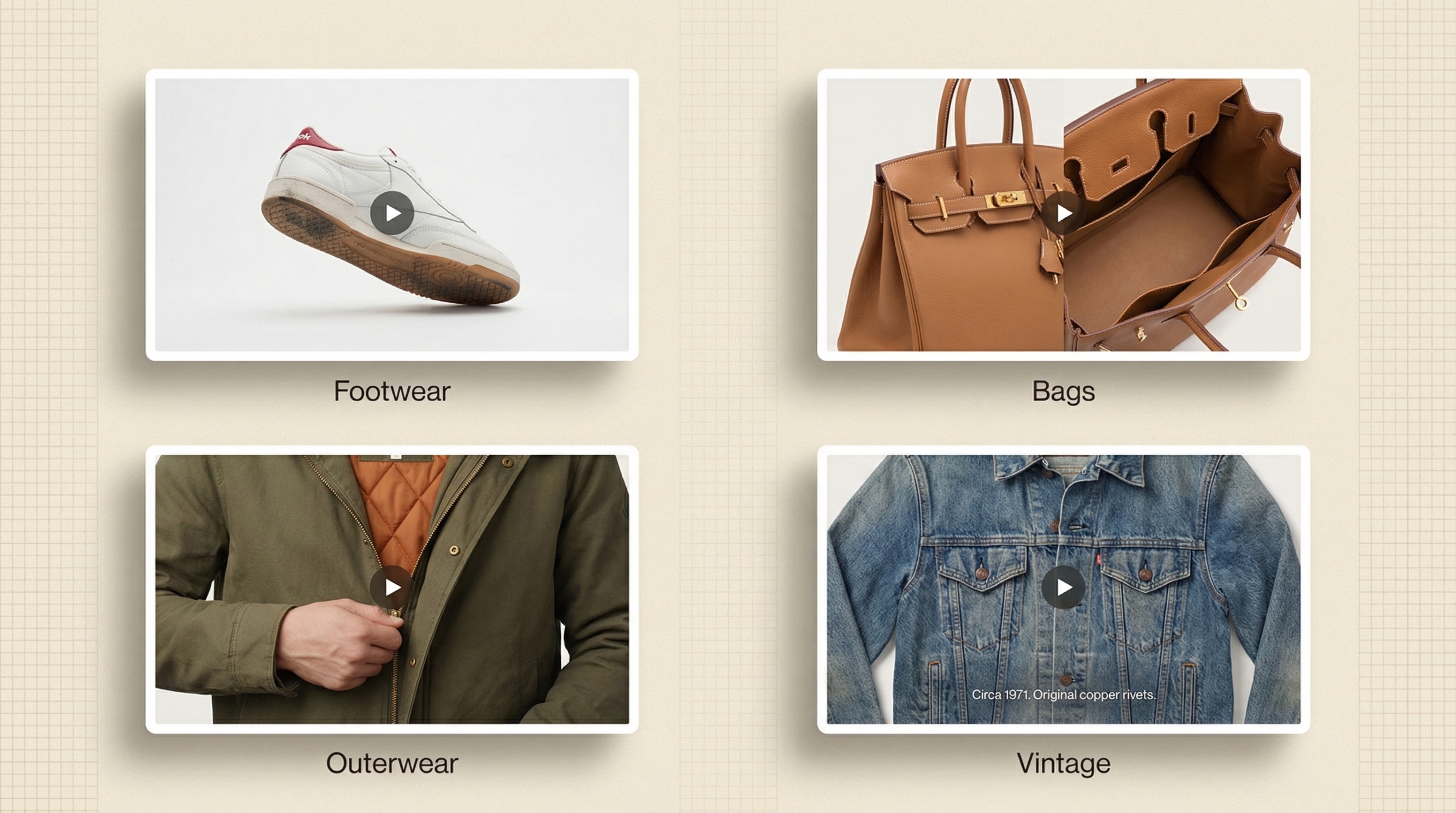
Where recommerce video drives the most value
| Category | Why Video Matters |
| Footwear | 360° rotation lets buyers assess sole wear, upper condition, and hardware – all key resale decision factors – better than static photography |
| Bags | Handles, corners, hardware, interior condition – high-consideration details for luxury resale buyers |
| Outerwear | Construction quality, lining condition, zipper function – evident in video, harder to communicate in stills |
| Vintage | Provenance storytelling benefits from video narration and detail reveals |
Optimize Resale Listings for AI Search
Search behavior on resale platforms is evolving. Buyers increasingly use natural language queries rather than keyword search. “Good condition wide-leg jeans under $80 in size 28” rather than “wide leg jeans.”
AI search systems on resale platforms (and increasingly on Google Shopping) interpret these natural language queries and match against listing metadata.
Optimizing resale listings for AI search requires:
Rich attribute tagging. Beyond brand and size: style era, fit type, material composition, color family, occasion, care instructions, weight category. Each attribute becomes a matchable dimension for semantic search.
Condition language standardization. Resale platforms with AI search ranking reward consistent, detailed condition disclosure. Listings that describe specific wear areas outperform listings with generic grade labels.
Long-tail keyword integration. “1990s Japanese selvedge denim size 32” captures a specific buyer segment that “vintage jeans 32” does not. AI description generators trained on resale search patterns naturally incorporate these specific terms.
Provenance signals. Original box, authentication certificate, receipt – these structured data points influence AI search ranking on luxury resale platforms. They should be captured in the intake form and included in listing metadata.
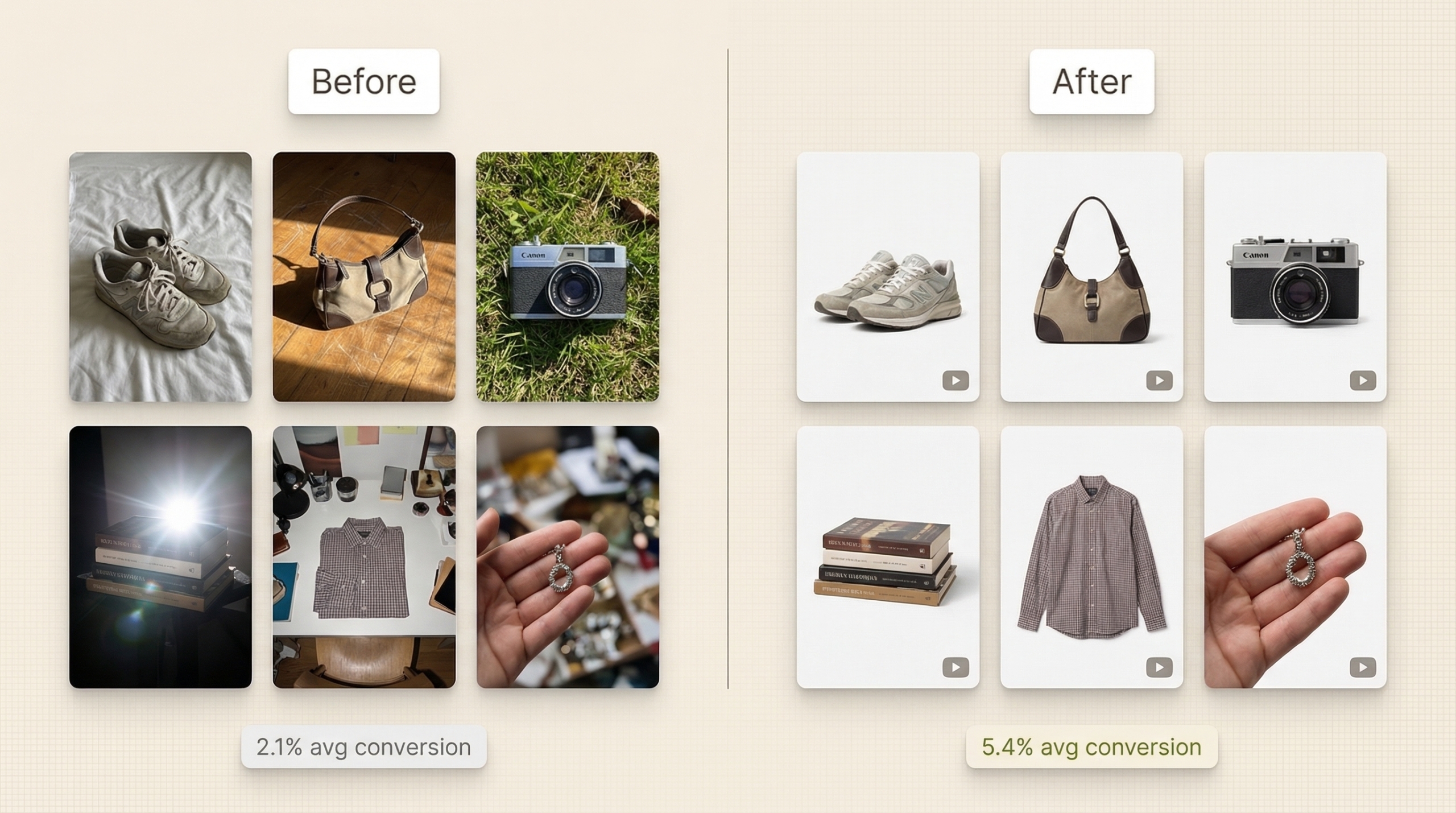
How to Increase Resale Conversion Rate With Better Visuals
Conversion rate on resale platforms correlates more strongly with image quality than with price. A well-photographed item priced at market converts better than a poorly photographed item priced below market.
Data from resale platform research:
| Visual Factor | Impact |
| Items with 6+ images vs. 2–3 images | 2.3x conversion rate (eBay Seller Performance data) |
| Lifestyle presentation images on premium resale | 15–25% price premium |
| Video listings on Vinted and Depop vs. static-only | 40–60% higher engagement |
| Consistent background and framing on multi-seller platforms | Increased brand recognition and repeat purchase rates |
AI visual production directly addresses each of these:
- Batch processing ensures every item reaches a minimum of 6 quality images
- AI lifestyle image generation adds context framing without physical production
- AI video generation makes video listings economically viable across all price points
- Standardized AI processing ensures consistent background, framing, and color treatment across the full catalog
Circular Commerce Content Automation: The Full Pipeline
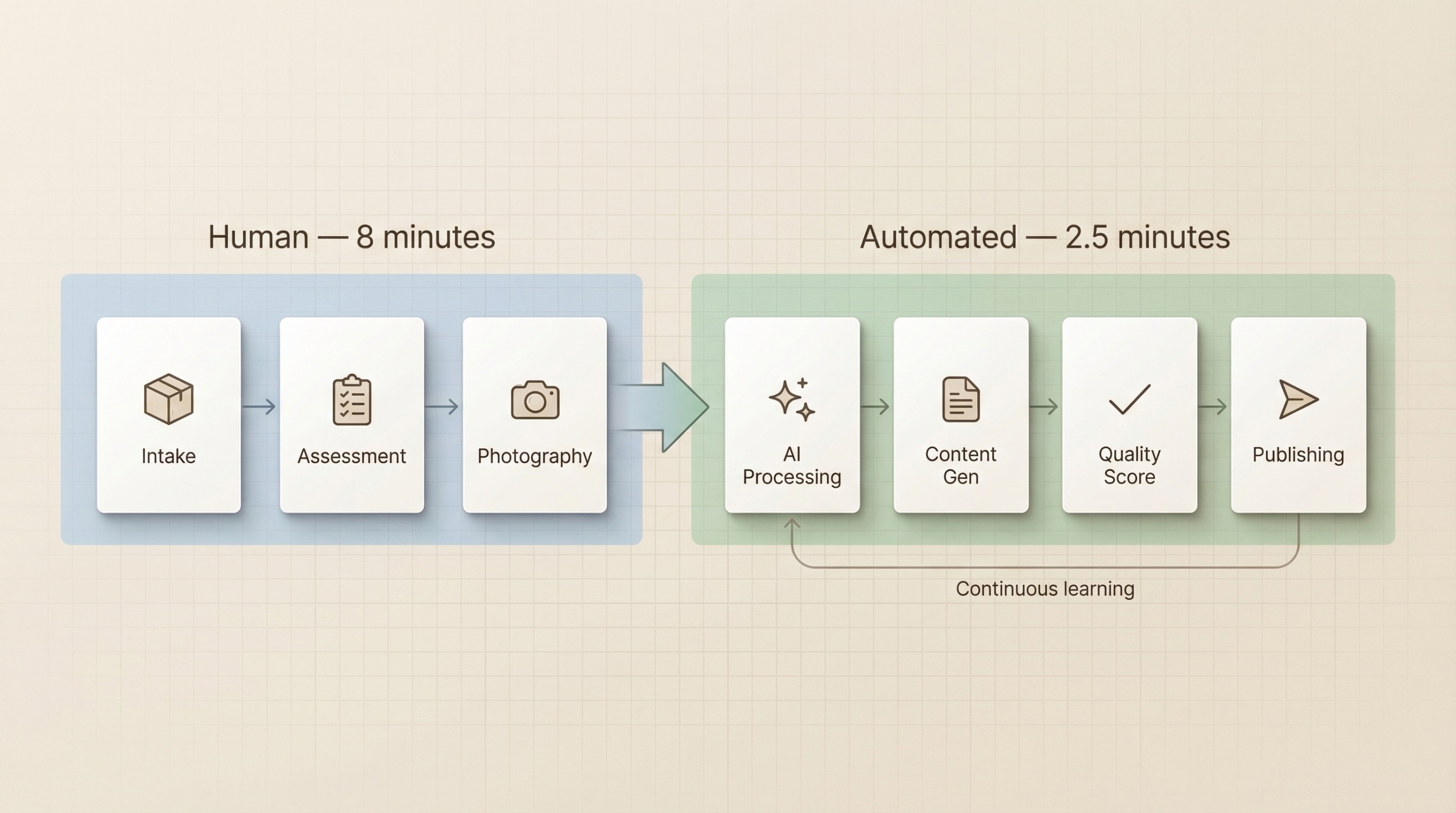
Putting the pieces together, a fully automated circular commerce content pipeline:
| Stage | Activity | Time Per Item | Method |
| Intake | Item received, condition triaged, assigned to queue | – | Human |
| Assessment | Condition form completed (grade, specific wear notes, included accessories) | 5 min | Human |
| Photography | Standardized capture protocol on lightbox (front, back, left, right, details) | 3 min | Human |
| AI Processing | Background standardization, lighting correction, color normalization, styled presentation generation, video synthesis | 90 sec | Automated |
| Content Generation | Title, description, condition disclosure, attribute tags, pricing recommendation based on comparable sold items | 30 sec | Automated |
| Quality Scoring | Vision AI scores image quality. NLP scores description quality. Flags below-threshold outputs for manual review | 10 sec | Automated |
| Publishing | Approved listings push to all connected platforms simultaneously – own site, Depop, eBay, Poshmark, Vestiaire | 20 sec | Automated |
| Performance Tracking | View count, save rate, conversion rate, days-to-sell tracked per item and per category | Ongoing | Automated |
| Feedback | Slow-moving categories get content refresh. Fast-moving categories inform intake prioritization | Ongoing | AI-assisted |
Total human time per item: 8–10 minutes (down from 15–25 minutes traditional).
Listing quality: Substantially higher across all dimensions.
Time-to-live: Same day for all items.
AI Catalog Management System for Resale: Build vs. Buy
For recommerce operations scaling past 1,000 items per month, the build-vs-buy question becomes relevant.
Build makes sense when:
- The resale operation is core to the brand’s business model (not an add-on)
- The brand has specific authentication or condition assessment protocols that require custom integration
- The platform has unique data assets (proprietary authentication data, buyer behavioral data) that should inform the AI system
Buy and integrate makes sense when:
- The resale operation is growing quickly and needs to scale without proportional engineering investment
- The brand wants to focus on customer experience, not content production infrastructure
- Standard API integrations with existing resale marketplaces are sufficient
ShopOS provides the AI catalog management infrastructure that connects intake data to AI content generation to platform publishing. The commerce context graph accumulates item performance data: which visual treatments lead to faster sales, which description patterns drive higher prices, which categories are undersupplied in current inventory. This feeds back to intake prioritization and content generation parameters.
The platform learns what converts in your specific resale market, not the general market.
Reduce Time to List Resale Products: The Operations Case
Every day an item sits in the warehouse unlisted is revenue not earned. For resale operations, time-to-list is a key operational metric.
The economics of faster listing:
| Metric | Traditional | AI-Automated |
| Avg. selling price | $80 | $80 |
| Time from intake to listing | 3–5 days | Same day |
| Avg. days to sale after listing | 14 days | 14 days |
| Total time from intake to revenue | 17–19 days | 14–15 days |
| Capital recovery improvement | – | 15–20% faster |
At 5,000 items per month at $80 average selling price, the working capital freed up by same-day listing is significant. Items that would have generated revenue in week 3 now generate revenue in week 2.
Multiply this across annual volume and the operational value of AI content automation becomes substantial – before considering quality improvements and conversion rate gains.
The recommerce market is growing. The brands winning it are building content pipelines that scale. AI is the infrastructure that makes that possible.
[Start automating your recommerce content pipeline →]