

Fashion retail is a strange industry. It moves fast culturally (trends, micro-trends, viral moments) and moves slow operationally. A product that goes viral on Tuesday takes four months to restock. A campaign brief submitted in October launches in December. By then the moment is gone.
AI doesn’t fix fashion’s taste problem. Nobody can predict which color becomes the color of the season. AI fixes fashion’s execution problem. The gap between insight and action is closing fast.
Here’s what that looks like across the full stack.
The AI-Powered Fashion Operating Model
The traditional fashion operating model has five structural bottlenecks:
| Bottleneck | Traditional Timeline |
| Trend identification | Monthly or quarterly reviews |
| Photoshoot production | 4–8 weeks minimum |
| Catalog creation and copywriting | Lags behind inventory arrival |
| Creative testing | Quarterly budgets, 3–5 variations |
| Supply chain decisions | Based on historical data, not real-time signals |
The AI-powered fashion operating model changes the time constant at each stage.
Trend intelligence becomes continuous. AI systems monitor social platforms, search data, competitor inventory, and cultural signals at real-time intervals. A brand detects a trend in its infancy, not its peak.
Visual production becomes on-demand. AI fashion photoshoots generate campaign-quality imagery from product data. No studio booking. No model scheduling. No retouching queue. The brand produces visual content at the speed of inventory, not the speed of creative logistics.
Catalog production becomes automated. SKU arrives in the warehouse. AI generates title, description, attributes, and channel-adapted listings in minutes. The product is live before it’s physically shelved.
Creative testing becomes continuous. Hundreds of variations tested in parallel, with winning patterns feeding the next generation automatically.
Supply chain decisions become predictive. AI systems factor in social signal velocity, historical sell-through by category, competitor inventory gaps, and seasonal demand curves. Reorder decisions happen ahead of stockout events, not after.
How AI Is Transforming Fashion Retail: Visual Production
The photoshoot has been fashion’s most expensive and least scalable production process for 100 years.
A mid-size fashion brand with 300 seasonal SKUs needs:
- Studio bookings for 15–20 shoot days
- Model fees for each session
- Photographer and crew costs
- Post-production retouching (typically 7–14 days turnaround)
- Styling and art direction overhead
Total cost: $150K–$500K per season depending on brand tier. Total time: 6–10 weeks.
AI fashion photoshoots change this equation entirely.
Generative AI systems take product images (flat lay, ghost mannequin, supplier renders) and produce styled, on-model content across multiple settings, ethnicities, body types, and contexts. One source product image generates 20 variations in hours.
A dress that needed 8 shoot days now generates 40 campaign images in an afternoon.
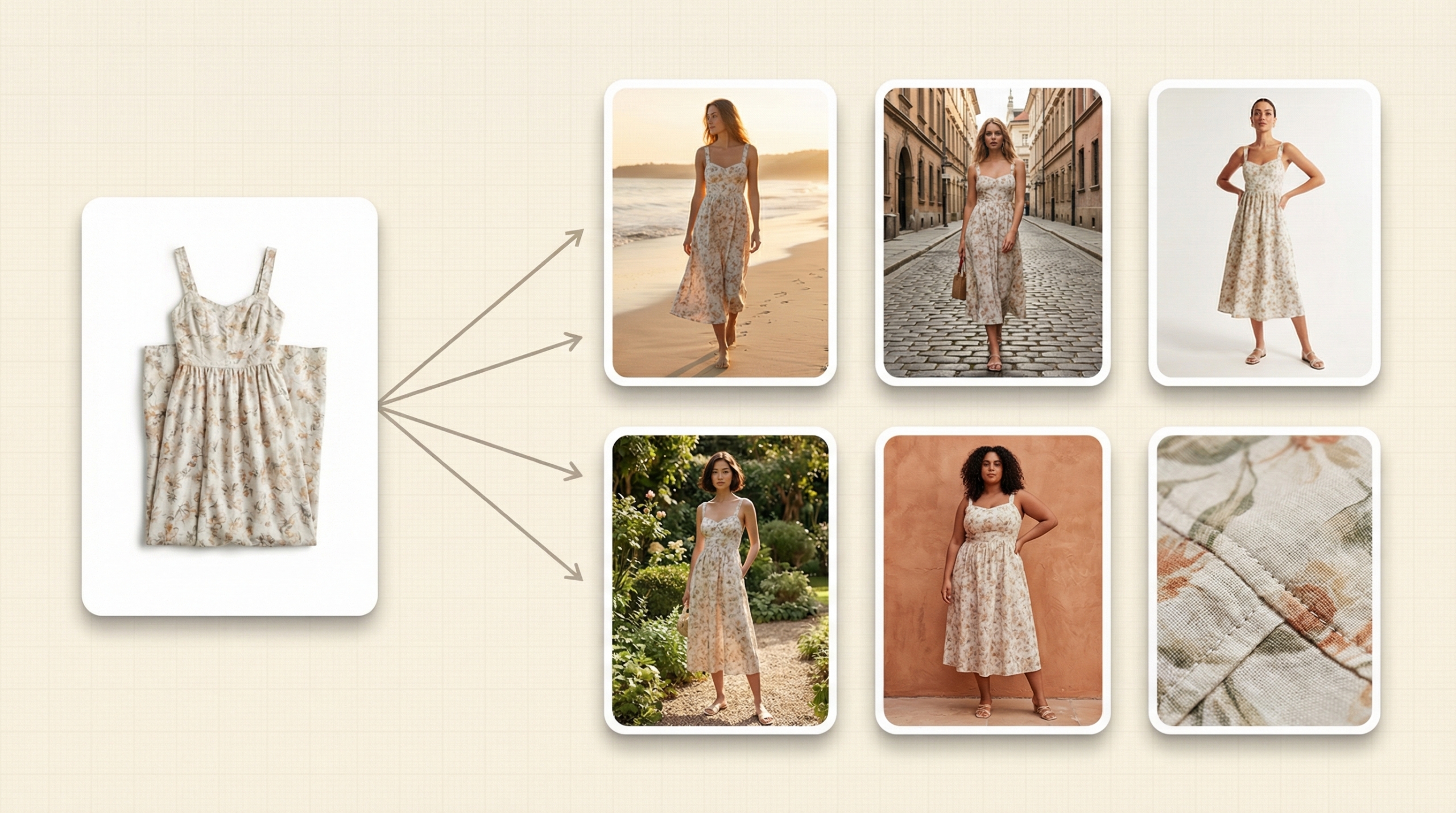
The economics shift from fixed production costs to variable, per-SKU costs. Small brands can produce fashion-quality imagery that was previously only accessible to brands with six-figure production budgets.
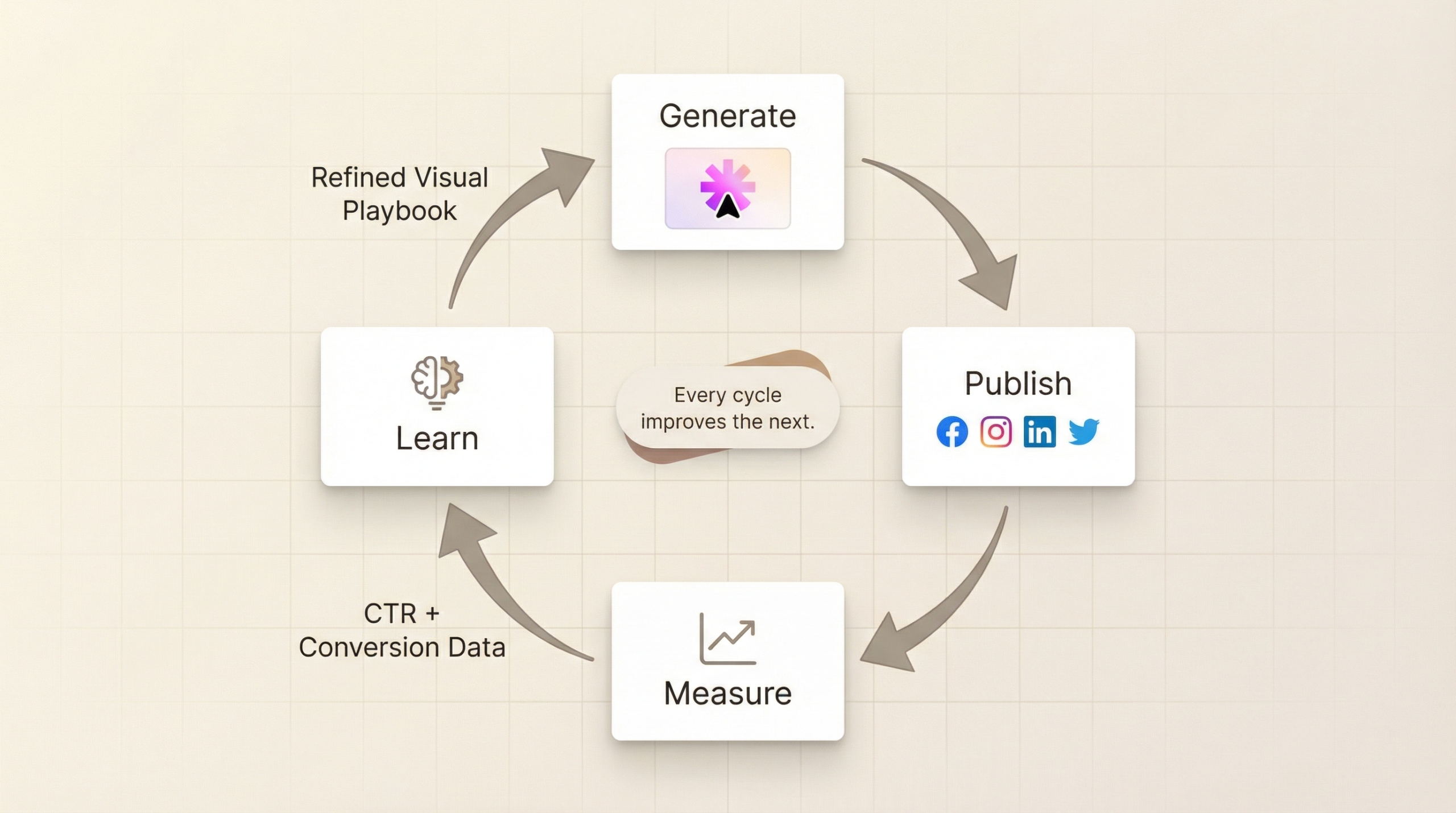
ShopOS builds this visual intelligence into the commerce context graph. Every image generated gets scored (lighting quality, brand fit, composition). Performance data from Meta and Instagram feeds back to the system. The platform learns which visual treatments convert for each brand’s specific audience over time.
Autonomous Shopping Agents and Fashion Ecommerce Conversions
Shopping agents are the next major shift in how customers interact with fashion inventory.
A traditional fashion ecommerce experience is browse-based. Customer lands on a category page. Filters by size and color. Scrolls through 40–100 products. Maybe converts. Mostly bounces.
Autonomous shopping agents are intent-based. The customer states what they want. The agent interprets context (budget, occasion, size, style history, current inventory) and surfaces a curated edit.
“I need something for a beach wedding in Santorini, June, budget around $300.”
A shopping agent with real inventory context returns: three dresses that match the occasion, climate, price point, and the customer’s size and historical style preferences. With availability confirmation. With complementary pieces if the customer wants to complete the look.
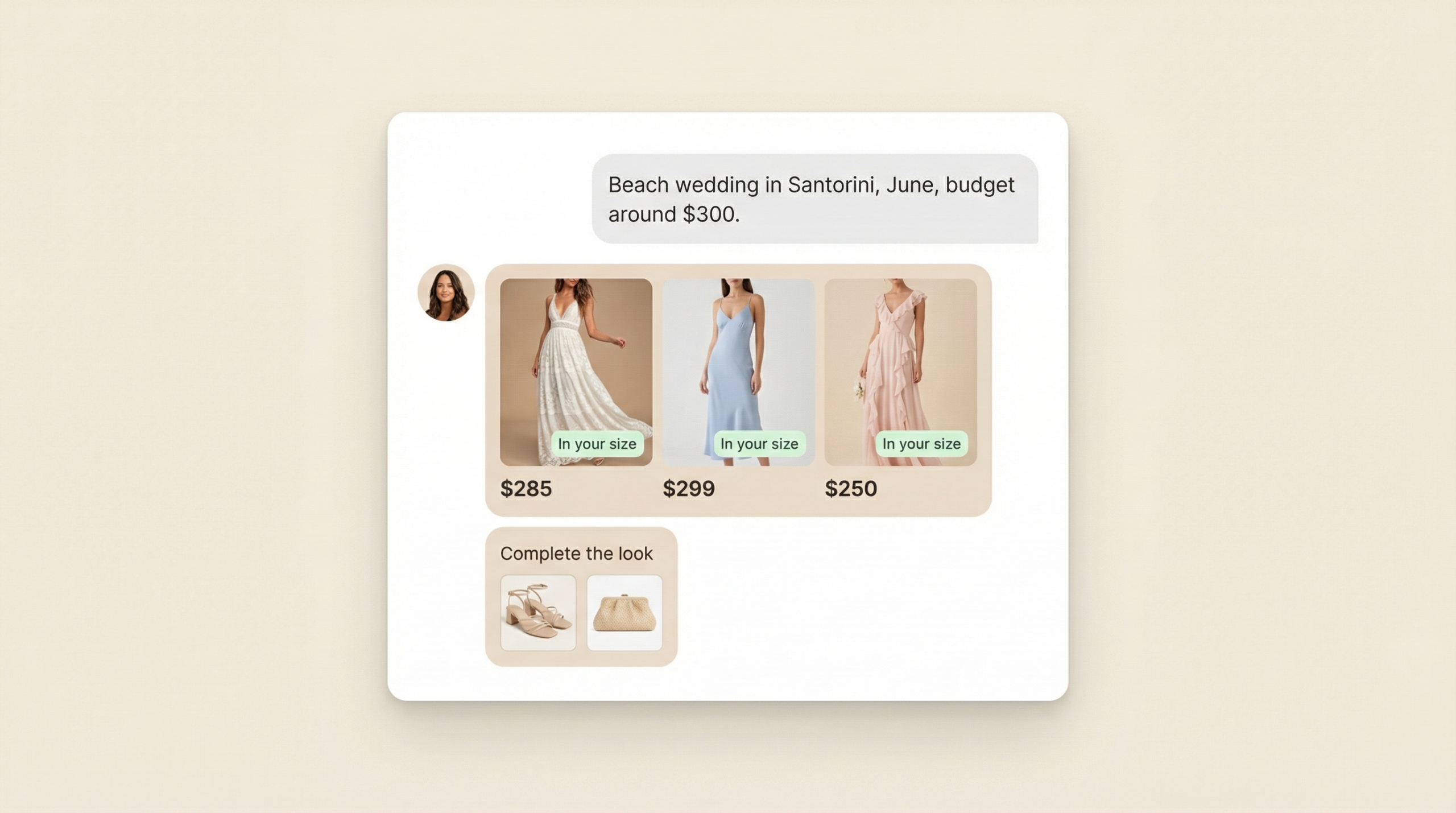
Conversion rates on agent-assisted sessions run 4–8x higher than browse-based sessions in early implementations. Basket size increases because the agent makes outfit-level recommendations, not product-level ones.
The key infrastructure requirement is deep product data. Agents can only make good recommendations when every SKU has rich attributes, accurate sizing information, occasion tagging, and cross-product relationship mapping. Catalog infrastructure comes before agent deployment.
How AI Reduces Return Rates in Fashion Ecommerce
Fashion ecommerce return rates run 20–40% for most brands. Each return costs $15–$30 to process. At scale, returns are a material margin problem.
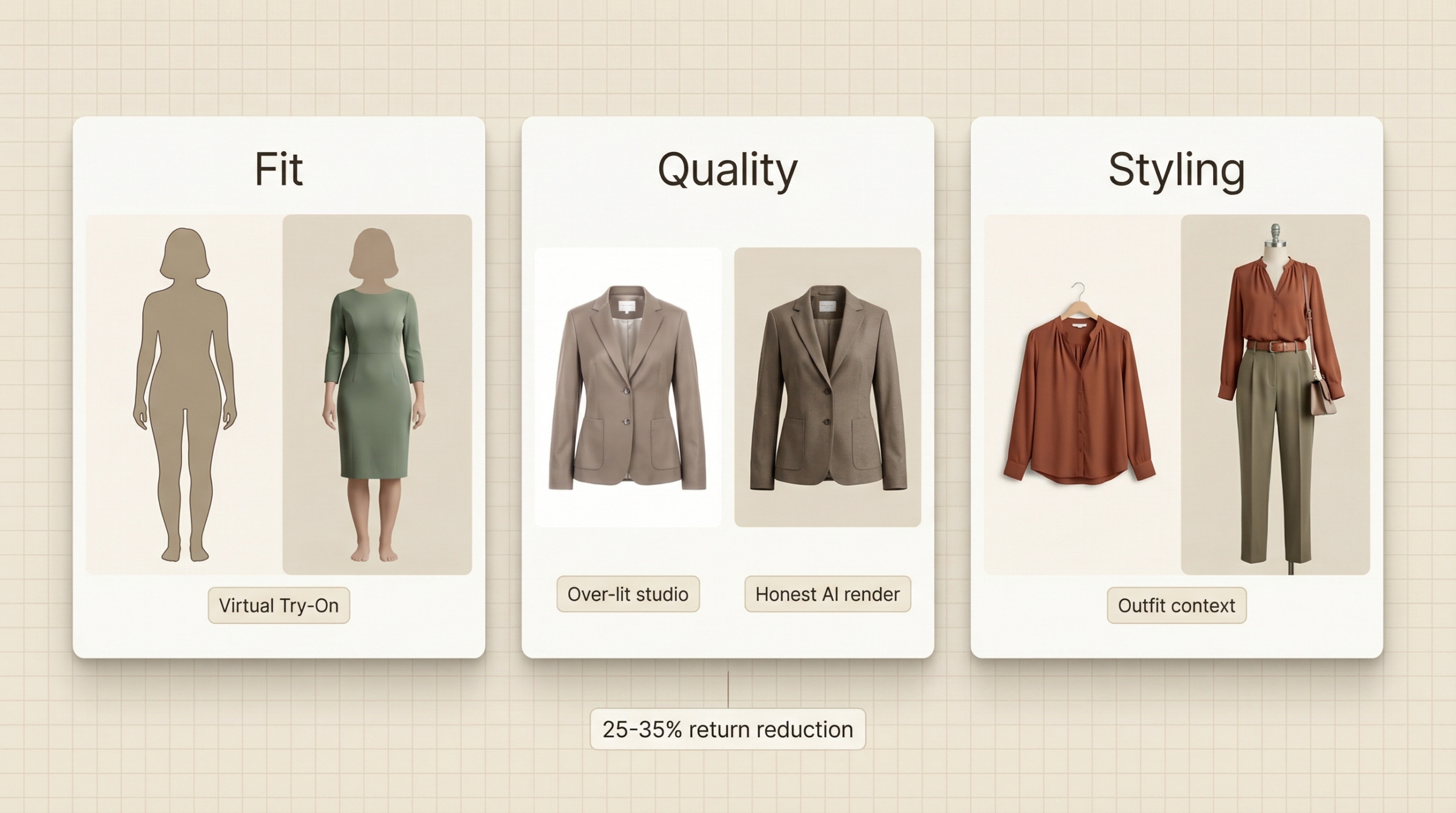
Most returns fall into three categories:
| Return Category | Root Cause | % of Returns |
| Fit issues | Sizing ran small, style translated differently than expected | ~45% |
| Quality mismatch | Product appeared higher quality in images than in reality | ~30% |
| Styling mismatch | Customer couldn’t integrate the piece into their wardrobe | ~25% |
AI addresses all three.
AI-powered virtual try-on reduces fit surprises. When customers see how a garment drapes on a body type matching their own, conversion improves and returns decrease. Early implementations show 25–35% return rate reduction on virtual try-on sessions.
Honest visual production reduces quality mismatch. AI-generated imagery that accurately represents fabric texture, weight, and drape creates accurate customer expectations. Photoshoot lighting that flatters products beyond recognition creates the opposite.
Outfit completion tools reduce styling mismatch. When a customer sees a complete outfit, they understand how the piece works in context. They’re less likely to return it because it doesn’t fit their existing wardrobe.
Implementing AI-Powered Virtual Try-On in Fashion Stores
Virtual try-on is moving from novelty to standard feature. The underlying technology has improved significantly over the past two years.
The technical architecture:
- Product fit model trained on garment geometry, fabric behavior, and size charts
- Customer body estimation from a few reference photos or measurements input
- Rendering engine that applies the garment to the customer’s estimated body shape
- Result display with multiple poses and lighting conditions
Implementation options:
Embedded on PDP. Customer activates try-on from the product page. Uploads 2–3 photos. Sees result within 30–60 seconds. Best for high-consideration purchases (dresses, jackets, tailoring).
Lookbook mode. AI generates 8–12 diverse model representations of each product automatically. Customer filters by body type closest to their own. Lower friction than custom try-on. Broader coverage across catalog.
Style finder tool. Customer describes their style, occasion, and fit preferences. AI generates styled editorial showing how the brand’s inventory fits their expressed aesthetic. High-intent discovery.
For Shopify stores, virtual try-on integrations connect directly to product variant data. The inventory system updates in real-time, so the try-on experience always shows available sizes.
AI Supply Chain Optimization for Fashion Brands
Fashion supply chain planning is a forecasting problem. The challenge: traditional forecasting relies heavily on historical data, and fashion has a notoriously short shelf life for historical relevance.
What worked last spring may not apply to this spring. A new trend can make last season’s inventory obsolete overnight. A viral moment can create a demand spike no historical model anticipates.
AI supply chain optimization integrates live signals into the forecasting model:
Social velocity signals. How fast is a product being shared, saved, and tagged? Products gaining social momentum are likely to convert at higher rates before traditional demand curves show the spike.
Search trend integration. Rising search volume for specific product attributes (a particular color, silhouette, or material) signals demand before purchase intent reaches checkout.
Competitor inventory mapping. If a competitor sells out of a category, demand doesn’t disappear. It redistributes. Brands monitoring competitor inventory gaps can capture that redirected demand with faster reorder cycles.
Sell-through velocity modeling. Products selling faster than their category average get flagged for reorder. Products selling slower than expected get flagged for markdown or promotional activation before they consume warehouse space through a full season.
Return pattern integration. High return rates on specific SKUs signal fit, quality, or presentation problems. Catching these patterns at 5% return rate (vs. discovering them at 40%) allows intervention before substantial inventory exposure.
Predictive AI and Fashion Inventory Planning
The most expensive inventory mistake in fashion is buying wrong. Over-buying creates markdowns that erode margin. Under-buying creates missed revenue and frustrated customers.
Predictive retail supply chain models reduce both error types.
The model ingests: historical sell-through by category, style, color, and size. Current season demand signals. Social and search trend data. Macro context (travel seasons, event calendars, economic conditions). Competitor behavior.
Output: a demand range by SKU with confidence intervals.
Not “order 500 units” but “order 400–600 units with 75% confidence, flagging this SKU as trend-dependent so reorder trigger activates at 200 units remaining instead of standard 100.”
The confidence intervals are the useful part. A buyer who knows which SKUs have high forecast uncertainty makes different buying decisions than one who treats all forecasts as equally reliable.
AI-Driven Merchandising: The Storefront as a Learning System
Static storefronts leave conversion on the table.
A homepage that shows the same hero image, the same featured collection, and the same promotional banner to every visitor (new, returning, high-intent, low-intent) is optimized for ease of management. Not for conversion.
AI-driven merchandising turns the storefront into a learning system.
First-time visitor sees the brand story, bestsellers, and social proof. The goal: establishing trust and brand positioning.
Returning visitor who browsed knitwear on their last session sees new knitwear arrivals, restocked sizes in previously viewed items, and styling content featuring knitwear.
Ad-referred visitor arriving from a Meta ad about summer dresses sees a landing experience built around summer dresses. Not the brand homepage with full navigation and irrelevant hero banners.
Loyalty customer sees early access to new collections and content that acknowledges their relationship with the brand.
Each experience draws on the brand’s accumulated knowledge of what works for each visitor type. The system learns which content drives conversion at each stage of the customer lifecycle.
Generative AI in Fashion: What’s Production-Ready Now
There’s a gap between what’s been announced and what actually works in production.
Production-ready today
- AI fashion photoshoots for model imagery (replaces or supplements studio shoots)
- AI catalog production (automated titles, descriptions, attributes)
- AI copy generation (product descriptions, ad copy, email content)
- Basic virtual try-on (lookbook-style diverse model representations)
- Creative performance loops (automated A/B testing with learning feedback)
- Storefront personalization (segment-based content adaptation)
Maturing, deployed by early movers
- Custom AI fashion model generation (brand-exclusive model appearance and style)
- Real-time style agent on storefront
- Predictive inventory optimization integrated with buying systems
Early stage
- Full autonomous shopping agent with natural language interface
- Real-time individual-level outfit generation based on user’s wardrobe data
- Cross-brand trend modeling with direct supply chain integration
The production-ready category is where the ROI sits right now. Brands adopting AI-native visual production and catalog automation are cutting production costs 60–90% and compressing time-to-market from weeks to days.
The Fashion Brands Winning With AI
The brands gaining ground with AI share operational characteristics.
They started with infrastructure. Clean catalog data. Organized asset libraries. Documented brand standards. AI applied to messy data produces messy outputs. The brands that invested in data quality first are seeing 3–4x better results than brands who treated AI as a shortcut around operational discipline.
They measure everything. Every AI-generated image gets tested. Every copy variation gets tracked. Every storefront personalization experiment has a control group. Learning requires measurement.
They build feedback loops. The marketing team feeds performance data back to the creative brief. The creative brief feeds back to catalog standards. Catalog standards feed back to production guidelines. The system improves every cycle.
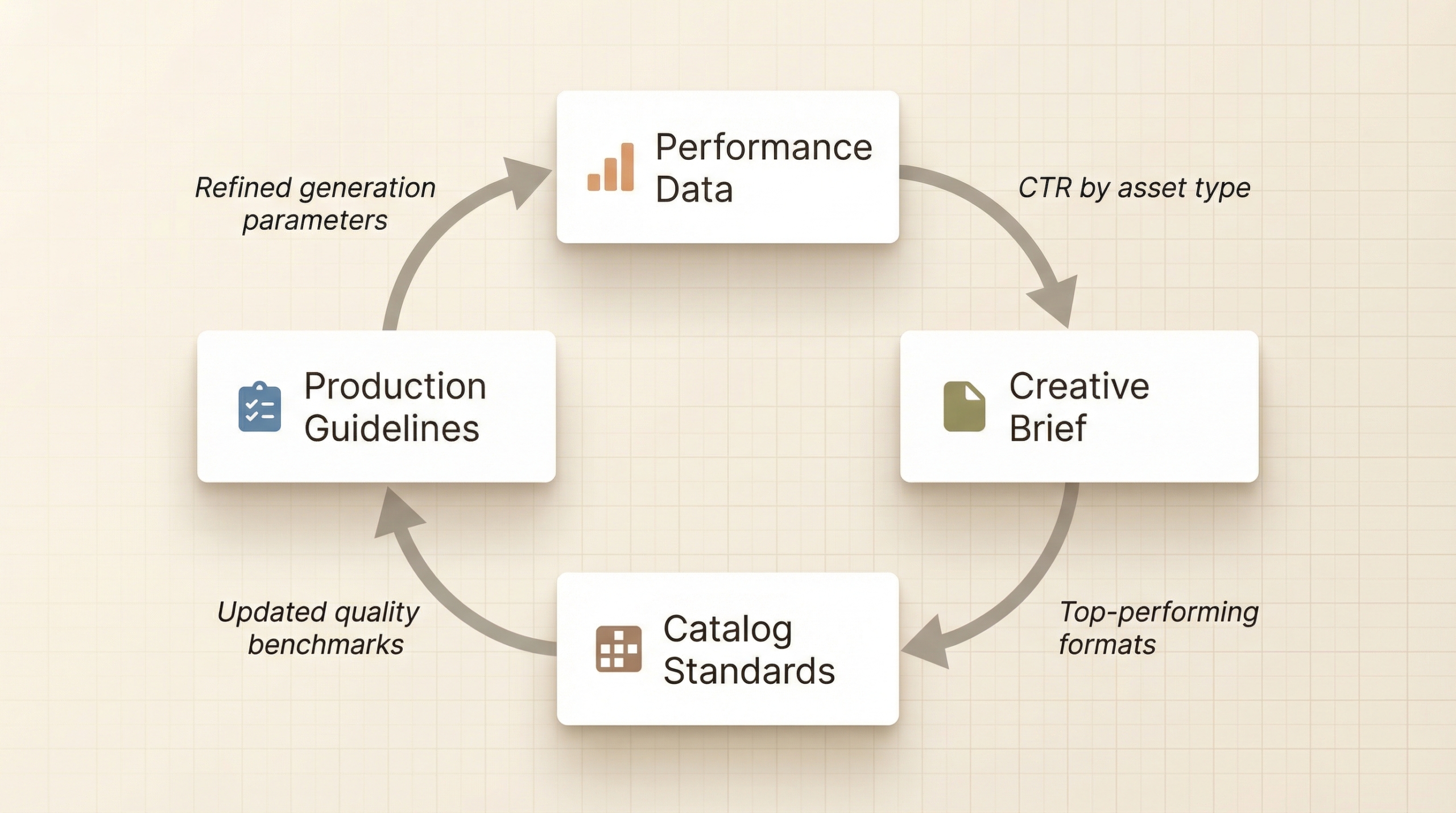
This is the shift that matters. From fashion brands that generate content to fashion brands that learn from it.