

Most ecommerce brands hit a wall around $5M ARR.
Orders come in. SKUs multiply. Channels expand. The systems that worked at $1M start cracking under the weight of scale.
The wall feels like a people problem. Hire more coordinators, more content writers, more catalog managers. But hiring solves the symptom. The cause is simpler: most ecommerce operations run on manual processes that scale linearly. Revenue needs to scale exponentially. That gap is where growth stalls.
The brands breaking through share one thing. They automate the repeatable, personalize the meaningful, and learn continuously from every interaction.
This guide covers how.
Why Most Ecommerce Growth Strategies Plateau
Growth stalls for predictable reasons.
Catalog complexity outpaces content capacity. A 500-SKU catalog needs 500 titles, 500 descriptions, 500 image sets, and 500 metadata fields. Per channel. Manual teams can’t keep pace. Products launch late. Pages stay thin. Conversion suffers.
Channel expansion creates content debt. Going from Shopify to Amazon to Instagram Shopping to Google Shopping means adapting every asset for every format. Most brands create once and push everywhere. Platform algorithms penalize non-native content.
Testing stays shallow. The average ecommerce brand tests 3–5 creative variables per quarter. The feedback loop takes weeks. Winning insights get buried in spreadsheets.
Personalization stays surface-level. Showing “recommended products” based on a last click is a recommendation widget. Customers know the difference. Engagement rates confirm it.
These problems compound. Fix one without the others and you hit a different ceiling six months later.
The Infrastructure Layer: AI Catalog Management
Catalog management is the foundation everything else rests on.
A well-managed catalog means every SKU has accurate titles, enriched descriptions, correct attributes, quality images, and channel-specific metadata. Most brands have none of these at scale. They have a Shopify backend full of drafts, inconsistent naming conventions, and images uploaded at whatever resolution the supplier sent.
AI catalog management changes the input-to-output ratio. Modern AI catalog systems can:
- Auto-generate product titles and descriptions from raw SKU data, supplier specs, or product images
- Score existing copy against readability, keyword density, and conversion benchmarks
- Identify catalog gaps: missing attributes, thin descriptions, non-compliant image dimensions
- Adapt listings automatically across channel formats (Amazon A+ content vs. Instagram Shopping vs. Google Shopping)
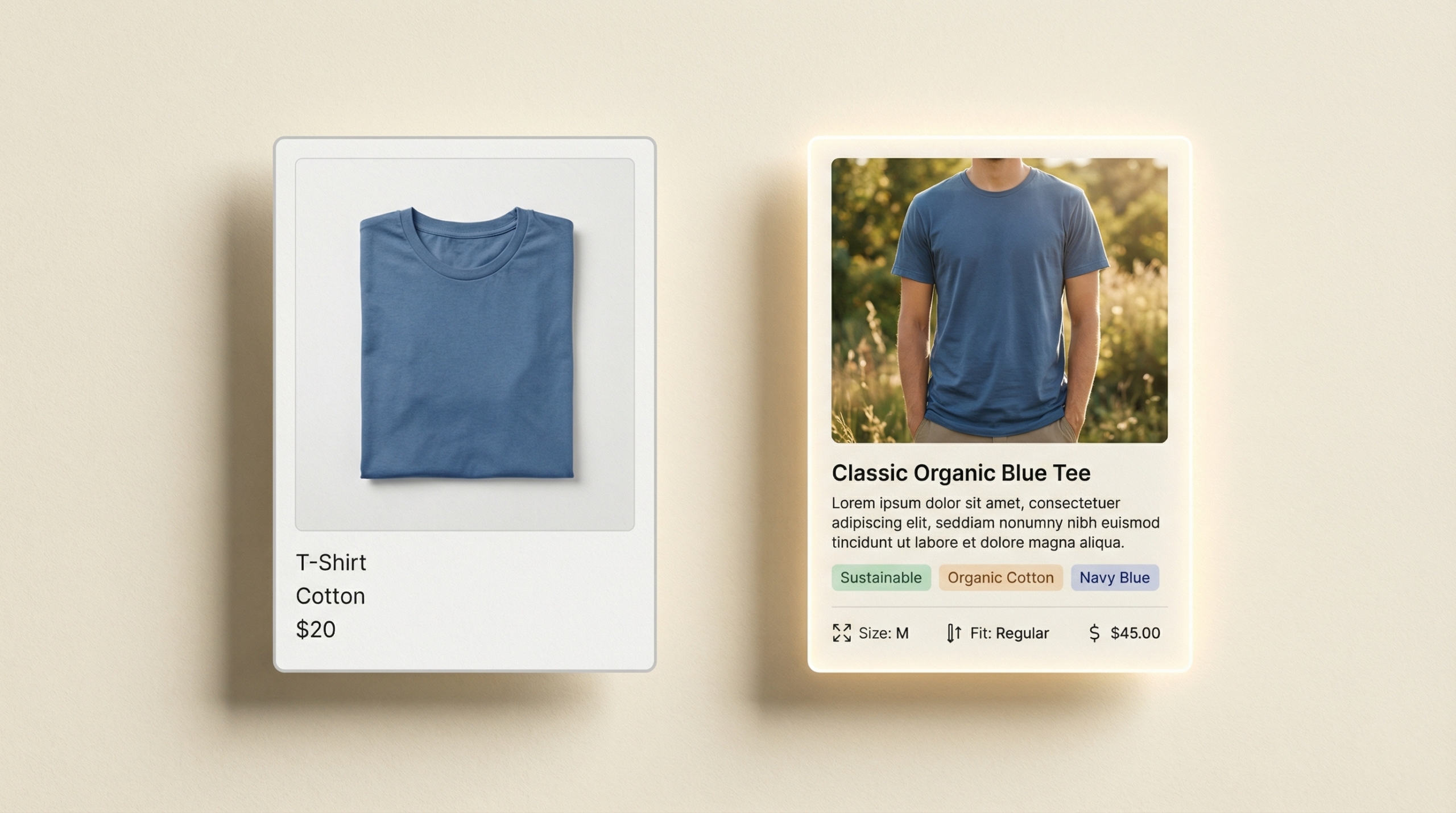
Platforms like ShopOS connect catalog intelligence directly to performance data. An image that converts at 2.8% CTR on Meta gets flagged as a proven asset. Future catalog builds pull from that winning pool automatically.
AI catalog optimization at the SKU level means:
- Running descriptions through channel-specific ranking signals
- Auto-tagging products with attributes (material, fit, occasion, color family) that power search and recommendation engines
- Keeping metadata synchronized across channels without manual reconciliation
The compounding effect matters here. A brand that continuously optimizes catalog data builds an asset library that grows more valuable over time. A brand doing it manually falls behind, because the catalog grows faster than the team.
Ecommerce Workflow Automation: Where Teams Get Leverage
Workflow automation removes the work that shouldn’t require people.
Consider a typical product launch sequence at a mid-size fashion brand:
| Day | Task |
| 1 | Photography brief sent to creative team |
| 5 | Shoot happens |
| 7 | Raw images delivered |
| 10–14 | Retouching queue |
| 15 | Copywriter briefs for product descriptions |
| 18 | Copy delivered |
| 20 | Upload to Shopify, Amazon, Google Shopping |
| 21 | Ad creative brief to performance team |
| 28 | Ads live |
28 days from brief to live. For every SKU. At 200 new SKUs per season, this is a bottleneck factory.
Ecommerce workflow automation compresses this:
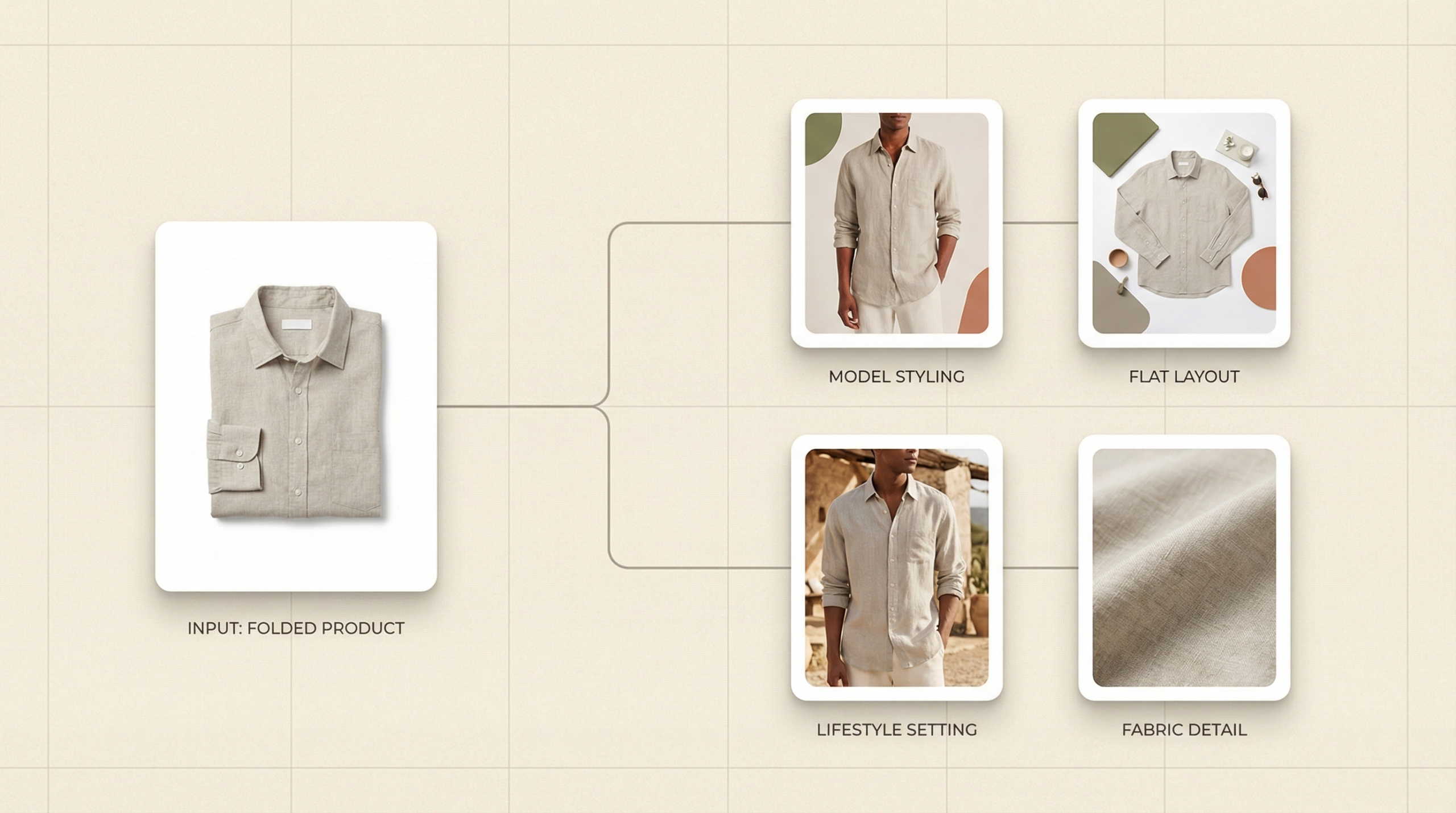
- Automated image generation from product specs
- Auto-generated descriptions triggered by SKU upload
- Channel-adaptive content that publishes in platform-native formats
- Performance team receives pre-built creative variations, not raw brief documents
The same launch sequence with automation runs in 2–3 days.
ShopOS Plans automate the New Product Launch sequence end-to-end: catalog creation, marketplace adaptation, marketing assets, and copy. In 45 minutes.
Scaling Ecommerce Operations Without Scaling Headcount
Scaling headcount to match catalog growth is a losing equation. Labor costs scale linearly. Revenue needs to scale geometrically.
The brands scaling sustainably use a different model. They separate workflows that require human judgment from workflows that require human oversight.
Human judgment: Creative strategy. Brand positioning. Customer relationship management. Pricing decisions.
Human oversight: Content generation. Catalog maintenance. Asset tagging. Channel adaptation. Performance reporting.
The second category is where most ecommerce teams spend 70% of their time. Automation reclaims it.
At the infrastructure level, scaling ecommerce operations requires four things:
Unified asset intelligence. One source of truth for every image, video, and copy asset. Tagged by performance, linked to SKUs, scored by quality. Not scattered across Dropbox, Google Drive, Slack, and email threads.
Channel-aware publishing pipelines. Content generated once, adapted automatically for every platform. Meta specs differ from Amazon specs differ from Google specs. Manual adaptation breaks past 100 SKUs.
Systematic creative testing. Continuous loops where every ad variation feeds performance data back to the next generation of creative. Not quarterly A/B tests with results buried in a deck.
Centralized brand context. Brand voice, visual style, compliance rules, and messaging guidelines stored in one place and applied automatically to every output. Not re-explained to every freelancer, every new tool, every new team member.
AI Personalization in Ecommerce: Beyond Recommendations
Personalization in ecommerce has earned its underwhelming reputation. Product carousels showing items you looked at once. Email subject lines with your first name. Discount codes triggered by cart abandonment. This is personalization at its most primitive.
AI personalization operates at a different level when built on real behavioral context.
Storefront personalization. First-time visitors see social proof (reviews, ratings, brand story). Returning customers see bestsellers and new arrivals. High-intent sessions (long dwell time, multiple product views) trigger inventory urgency signals.
Product page personalization. A customer who bought activewear sees the legging styled with a sports bra. A customer who bought workwear sees the blazer styled with trousers. Same product, contextually relevant display.
Search personalization. Query results weighted by past purchase behavior, not keyword match alone. Someone who consistently buys size M in fitted cuts sees size M fitted cuts surface first.
Email and ad personalization. Creative reflects where the customer is in their lifecycle:
- New customer → brand story + bestsellers
- Lapsed customer → reactivation offer + what they missed
- Loyal customer → early access + community signals
The difference between surface-level and genuine personalization is data depth. Shallow systems know what you clicked. Deep systems know what you bought, what you returned, how often you browse before converting, and what messaging moved you last time.
Building that data depth requires a system that learns continuously. Not one that runs a quarterly segmentation refresh.
Building the Commerce Context Graph
The most durable ecommerce growth strategies share a structural property: they get smarter over time.
A brand that ran 200 ad variations over 12 months knows which colors, hooks, formats, and offers work for its specific audience. A brand using generic AI tools in month 12 looks the same as it did in month 1.
The difference is accumulated context.
ShopOS builds a commerce context graph for each brand. Every interaction adds to it:
- File uploads add visual performance data
- Loops add creative and copy performance patterns
- Refine edits add quality benchmarks
- Brand Memory stores the DNA that keeps every output consistent
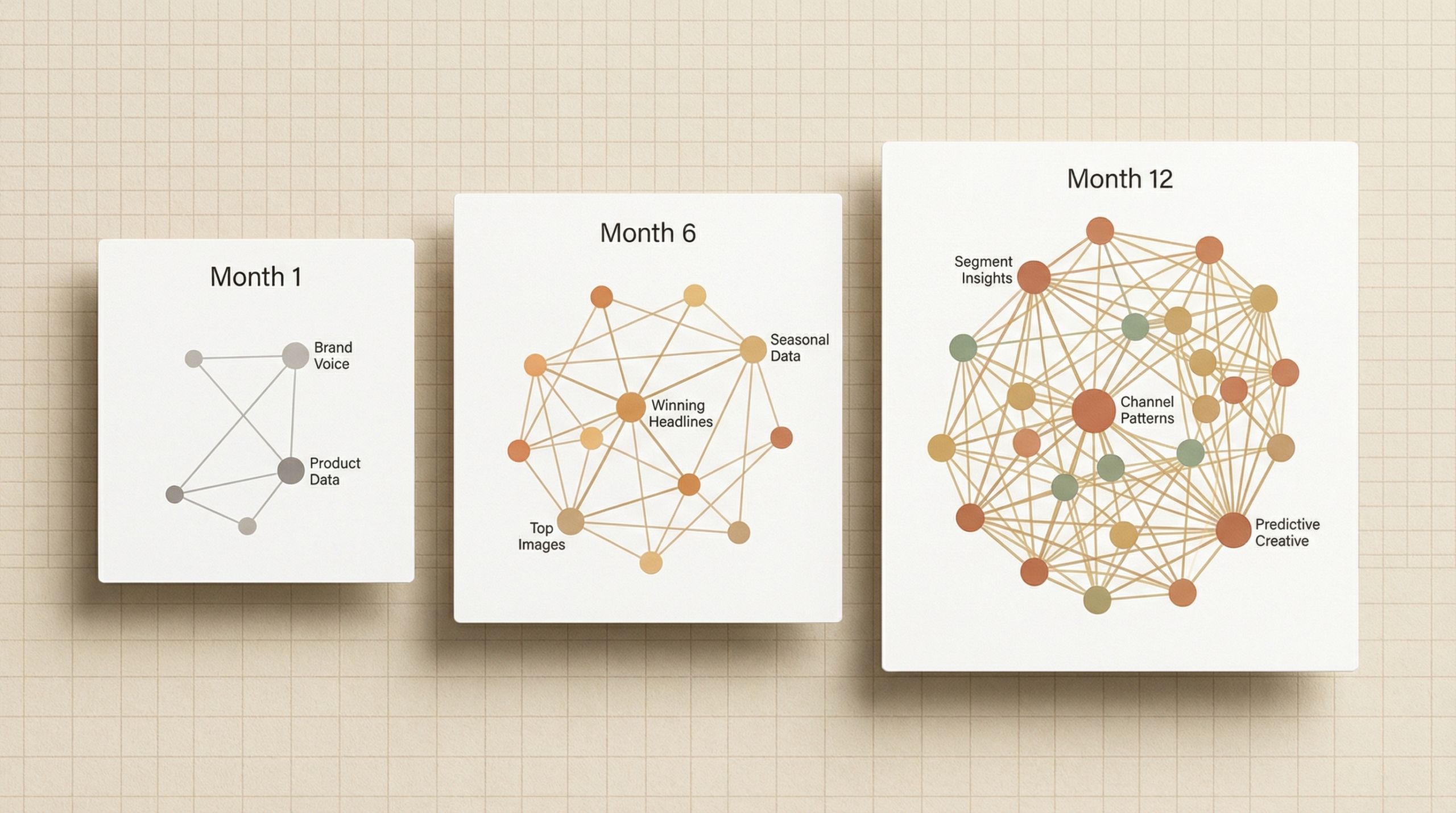
At month 1, the graph is thin. The system has basic brand voice and some initial assets.
At month 12, the graph is a competitive asset. It knows which images convert by season. Which headlines outperform by channel. Which product combinations drive the highest basket value. Which customer segments respond to which messaging angles.
That accumulated knowledge is something no competitor can replicate. They can copy your product. They can match your price. They cannot access 12 months of brand-specific learning.
The Ecommerce Growth Stack: What Actually Moves the Needle
Most ecommerce brands underinvest in infrastructure and overinvest in tactics. They spend $50K on influencer campaigns before fixing catalog data quality. They run paid acquisition to poorly personalized landing pages. They test creatives without feeding results back to their content process.
The growth stack that compounds over time has four layers:
Foundation layer: Catalog infrastructure. Clean data, rich attributes, quality assets, channel-native formats.
Intelligence layer: Performance tracking. Which assets convert, which copy resonates, which channels over- or under-perform vs. category benchmarks.
Execution layer: Automated workflows. Generate, adapt, publish, test, learn. Without a human bottleneck in every step.
Learning layer: Continuous improvement. Every output feeds the next generation. Patterns accumulate. The system grows more accurate over time.
Each layer depends on the one below it. Brands that skip the foundation and jump to execution hit walls fast. Brands that build bottom-up compound their returns quarter over quarter.
Ecommerce Trends Worth Acting On in 2025
AI-native catalog production. Brands generating catalog assets from SKU data and brand context. No photoshoots required for the first pass. Production time: days, not weeks. Cost per asset: dollars, not hundreds.
Continuous creative testing. Moving from quarterly A/B tests to always-on loops that test, measure, and improve without manual management cycles.
Contextual storefront personalization. Storefronts that adapt to visitor context: first visit vs. returning, low vs. high intent, acquisition vs. retention.
Video as default commerce format. Short-form product videos outperforming static images across Instagram, TikTok, Pinterest, and Google Shopping. Brands building video pipelines that scale to hundreds of SKUs without proportional cost increases.
Agentic commerce. Autonomous systems that execute tasks (reorder inventory, refresh underperforming listings, pause low-ROAS ad sets) without human approval queues.
The brands implementing these now will have 12+ months of learning by the time competitors start.
How to Start
The easiest starting point is a catalog audit.
Pull your top 100 SKUs. Score them against five dimensions:
- Title clarity – Does the title contain the product name, key attribute, and category?
- Description depth – Does the description go beyond a single sentence? Does it include materials, sizing, use cases?
- Image quality – Are images high-resolution, properly lit, and formatted for each sales channel?
- Attribute completeness – Are all filterable attributes (color, material, size, occasion) filled in?
- Channel-specific compliance – Does the listing meet each platform’s format and character requirements?
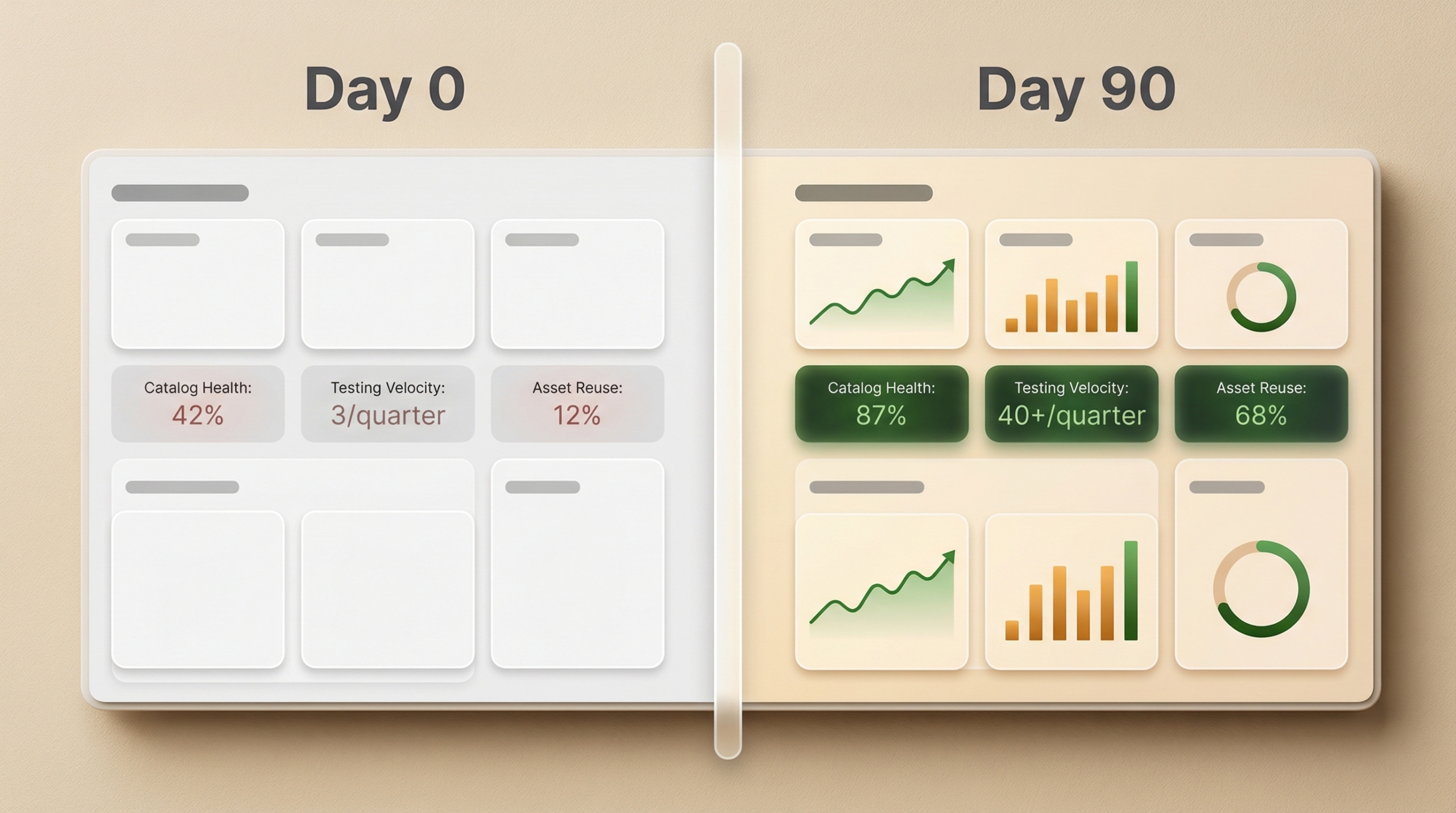
Most brands find 40–60% of their catalog has meaningful gaps across these five dimensions.
Fix the gaps with automation. Generate missing descriptions. Score and rank existing images. Add missing attributes. Publish optimized versions to each channel.
Then run your first Loop. Take 10 ad variations of your top-converting product. Measure CTR and ROAS at day 7 and day 14. Feed results back. Generate 10 improved variations. Repeat.
After 90 days, your catalog is cleaner, your creative is more effective, and your system knows more about your brand than it did at the start.
That is the ecommerce growth strategy that scales.
Start building your commerce context graph →