

Shoppable video has graduated from experimental format to revenue channel. The data supports the investment: brands adding shoppable video to their PDPs and collections pages report 25–80% lift in conversion rates. Cost-per-click on shoppable video ads runs 40–60% lower than static equivalent creative.
The platform landscape has matured significantly. There are now real differences between solutions in features, pricing, and fit for different brand types.
This guide compares the 10 most significant shoppable video platforms available in 2026, with honest assessment of where each one wins and where it falls short.
What to Look for in a Shoppable Video Platform
Before the comparison, the evaluation criteria.
| Criteria | What It Means | Why It Matters |
| Integration depth | Does it pull live inventory and pricing? Auto-sync when products change? | Stale product data in video tags kills trust and conversion |
| In-video purchase flow | Can customers add to cart without leaving the video? Or does it redirect? | Fewer steps from tag to cart = higher conversion |
| Video production support | Does the platform help produce video, or only distribute it? | Brands without video teams need production built in |
| Mobile performance | How does it render and convert on small screens? | 62%+ of ecommerce traffic is mobile |
| Analytics depth | View-through, click-through from tags, add-to-cart rate, purchase attribution? | Can’t optimize what you can’t measure |
| Content management | Playlists, calendars, scheduling, A/B testing? | Operational features matter at scale |
| Pricing model | Per-video, monthly flat, or revenue share? | Match against your expected usage volume |
The 10 Platforms
1. Tolstoy
Best for: Shopify brands wanting quick setup and interactive video.
Tolstoy is the most widely adopted shoppable video platform on Shopify with 8,000+ active store installations. The interface is accessible, the Shopify integration is native and reliable, and setup time runs 30–60 minutes.
| Strengths | Limitations |
| Fastest Shopify setup | Analytics basic on lower tiers |
| Video quizzes and branching video flows (interactive product finding) | Limited AI content generation |
| Floating video bubble widget (adds video anywhere without code) | Creator marketplace is small vs. competitors |
| Solid mobile rendering |
Pricing: Free tier (1 video, limited views). Pro from $19/month. Business from $99/month.
Best use case: Fashion and beauty brands with existing video content who want to add shoppable functionality quickly.
2. Videowise
Best for: Performance-focused brands wanting deep conversion analytics.
Videowise positions aggressively on conversion rate and ROI measurement. Their analytics dashboard tracks engagement, click-through, add-to-cart, and purchase attribution at the video and individual tag level.
| Strengths | Limitations |
| Best-in-class analytics for shoppable video | Higher price point than comparable platforms |
| AI-powered “smart feed” (algorithmically surfaces highest-converting content) | UX can be complex for smaller teams |
| A/B testing for video placements natively | Video production help is limited |
| Strong WooCommerce and Shopify support |
Pricing: Starts from $49/month, scales with video views/revenue. Enterprise pricing available.
Best use case: Growth-stage DTC brands with performance marketing teams who want to optimize shoppable video like a paid channel.
3. Firework
Best for: Enterprise brands and retailers wanting live shopping and high-production video commerce.
Firework started as a live shopping platform and expanded into full video commerce. Strong with larger retailers – they work with Walmart, Samsung, and various enterprise brands. The platform handles high traffic volumes and offers white-label capabilities.
| Strengths | Limitations |
| Live shopping functionality (real-time video selling events) | Expensive for SMB brands |
| Enterprise-grade infrastructure and SLAs | Setup requires more technical resources |
| Strong SEO consideration (video content indexed by Google) | Best features unlock at enterprise pricing |
| Multi-brand and multi-market support |
Pricing: Starts around $500/month. Enterprise pricing on request.
Best use case: Enterprise retailers, brands doing regular live shopping events, multi-region commerce operations.
4. Bambuser
Best for: Live shopping and simulcast commerce for mid-to-enterprise brands.
Bambuser dominates live shopping in Europe and has strong adoption in fashion and beauty. Their simulcast feature lets brands stream live shopping events to multiple platforms simultaneously – website, Instagram, YouTube.
| Strengths | Limitations |
| Best live shopping UX | Pricing above market rate for smaller brands |
| Simultaneous multi-platform streaming | Live shopping requires scheduling and promotion overhead |
| Replay viewing with shoppable tags preserved | Video-on-demand features less mature than live features |
| Integration with most major ecommerce platforms |
Pricing: Quote-based. Estimated entry at $1,000/month for SMB tier.
Best use case: Fashion and beauty brands that run regular live shopping events and want professional multi-platform broadcast capability.
5. Vimeo Showcase (with Shoppable Features)
Best for: Brands already using Vimeo for hosting who want basic shoppable features.
Vimeo’s business tiers include shoppable video capabilities – product links overlaid on hosted video. Less sophisticated than dedicated shoppable video platforms but cost-effective for brands already paying for Vimeo hosting.
| Strengths | Limitations |
| No additional platform cost if already on Vimeo Business | Limited in-video checkout (redirects to product page, no direct add-to-cart) |
| Clean, unbranded player | Basic analytics compared to dedicated platforms |
| Strong video quality and CDN performance | No AI content features |
| Reliable global delivery | Limited Shopify integration depth |
Pricing: Vimeo Business from $50/month. Shoppable features included.
Best use case: Brands using Vimeo for video hosting who want to add basic shoppable links without adopting an additional platform.
6. Smartzer
Best for: Fashion and apparel brands wanting interactive lookbook-style shoppable video.
Smartzer specializes in interactive video for fashion. Their lookbook video format is the best in market – video plays as editorial content, and each product visible in the video has an interactive tag layer. Customers click anywhere to see all tagged items in a side panel.
| Strengths | Limitations |
| Best fashion lookbook shoppable format | Fashion-specific, not general ecommerce |
| Multi-product tagging in a single video frame | Limited analytics depth compared to Videowise |
| Used by luxury and premium fashion brands | Price point above SMB accessibility |
| Custom player UI matching brand aesthetics |
Pricing: Contact for pricing. Typically $500–$2,000/month for brand tier.
Best use case: Fashion, luxury, and lifestyle brands running editorial video campaigns with multiple products.
7. Channelize.io
Best for: Brands wanting live and video commerce at accessible pricing.
Channelize offers live shopping and video-on-demand shoppable features with pricing accessible to growth-stage brands. Good Shopify and WooCommerce integration. Active in South/Southeast Asia and growing in US/European markets.
| Strengths | Limitations |
| Accessible pricing vs. enterprise alternatives | Less established brand trust than top-tier platforms |
| Both live and on-demand shoppable video | Analytics less mature than Videowise |
| Strong mobile experience | Limited AI content generation |
| White-label option for agencies |
Pricing: From $79/month for Starter, $299/month for Business.
Best use case: Growth-stage brands wanting live shopping capability without enterprise pricing.
8. Cinemate
Best for: Brands that want AI-powered video production integrated with shoppable distribution.
Cinemate combines AI video generation with shoppable distribution. The brand uploads product images and Cinemate generates product showcase videos automatically, then makes them shoppable and distributes to product pages. Positions at the intersection of AI production and video commerce.
| Strengths | Limitations |
| AI video generation from product images (reduces production cost) | AI video quality not yet matching professional production for hero placements |
| Tight production-to-distribution workflow | Less mature analytics than pure-play video commerce platforms |
| Good Shopify integration | Smaller customer base, less proven at scale |
| Lower cost per video than manual production |
Pricing: From $99/month including AI video generation credits.
Best use case: Brands that need both video production capability and shoppable distribution without a large content team.
9. MikMak
Best for: Multi-channel brands wanting shoppable video that works across every platform and retailer.
MikMak operates in the “shoppable media” category – any content, on any platform, linked to purchase. Their strength is multi-retailer checkout: a customer watching a shoppable video can choose to buy from Amazon, Target, Walmart, or the brand direct – all from within the same video experience.
| Strengths | Limitations |
| Multi-retailer purchase routing (buy from whichever retailer the customer prefers) | Pricing built for larger brands |
| Works across paid social, CTV, display, and owned channels | Setup complexity is higher |
| Strong for CPG and multi-channel brands | Overkill for DTC-only brands |
| Advanced attribution across touchpoints |
Pricing: Enterprise pricing. Estimated $2,000–$5,000+/month.
Best use case: Brands selling through multiple retail channels who want shoppable media that respects customer channel preference.
10. ShopOS
Best for: Ecommerce brands that want AI-generated video content integrated with a learning commerce platform.
ShopOS approaches shoppable video from a different angle than pure-play video commerce platforms. The video capability is part of a broader commerce context graph that connects content generation, performance tracking, and continuous learning.
What makes it different: Video content generated by ShopOS links to SKU data in the brand’s commerce context graph. Performance data from each video – view rate, click-through, add-to-cart, conversion – feeds back to the system. Over time, the platform learns which video formats, visual treatments, and product contexts drive the best conversion for that specific brand.
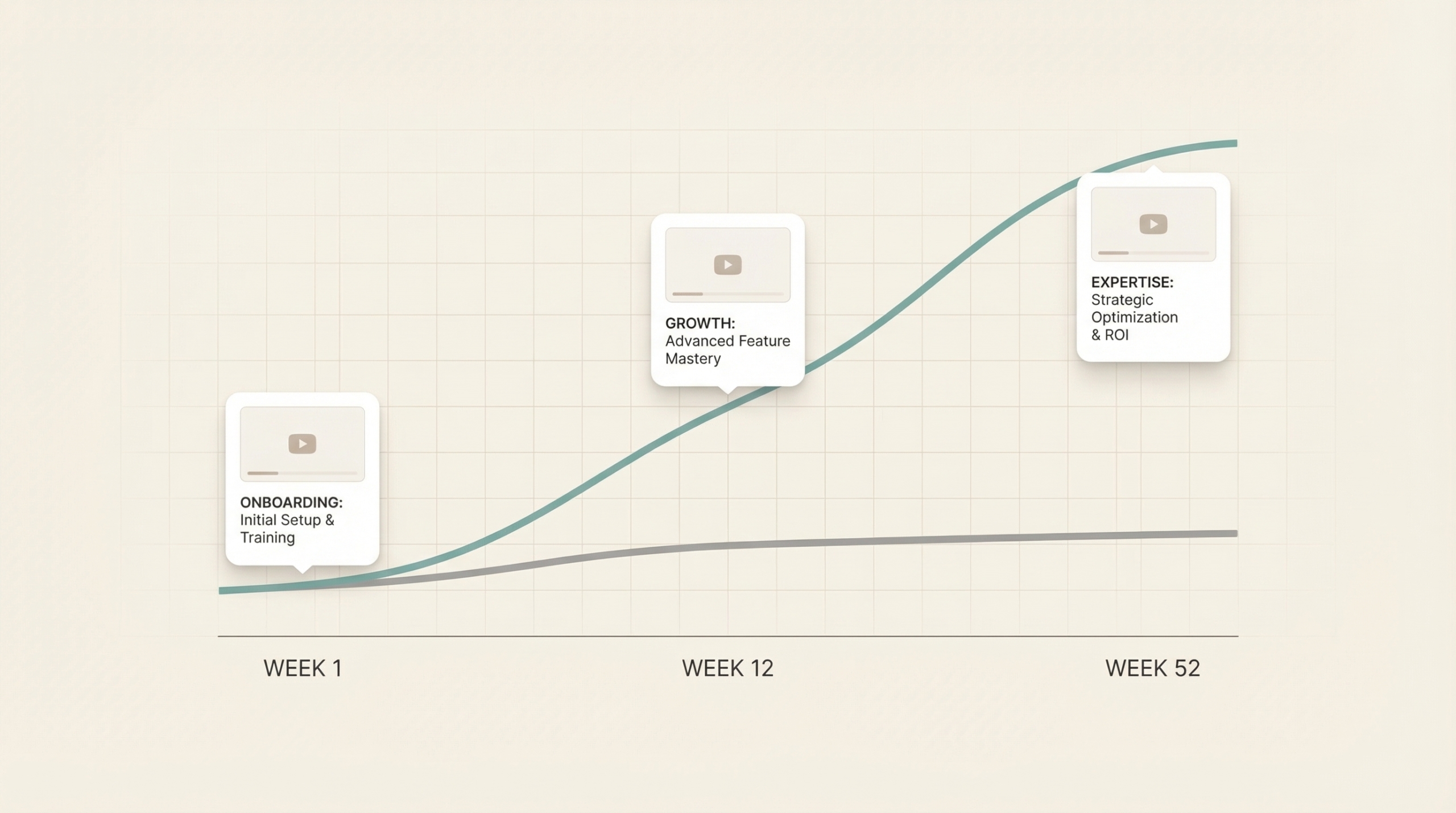
At Week 1, the system generates baseline video content from product data. At Week 52, it knows which video approaches work for this brand’s audience and generates starting from that accumulated knowledge.
| Strengths | Limitations |
| AI video generation from product images (no production team required) | Newer platform than established video commerce pure-plays |
| Performance data feeds continuous learning loop | Live shopping not currently a core feature |
| Commerce context graph connects video to catalog and creative strategy | |
| Integrated with Brand Memory, Files, and Loops for compound improvement | |
| Shoppable integration with Shopify |
Pricing: See pricing at app.shopos.ai/onboarding.
Best use case: Ecommerce brands that want video content production and distribution as part of a systematic, learning-based commerce platform – brands thinking 6–12 months ahead, not just this quarter’s conversion rate.
Comparison Summary
| Platform | Best For | Pricing Start | AI Video | Live Shopping | Analytics |
| Tolstoy | Quick Shopify setup | Free / $19 | No | No | Basic |
| Videowise | Conversion analytics | $49 | No | No | Best-in-class |
| Firework | Enterprise / live | ~$500 | No | Yes | Strong |
| Bambuser | Live simulcast | ~$1,000 | No | Best | Moderate |
| Vimeo | Basic shoppable | $50 | No | No | Basic |
| Smartzer | Fashion lookbooks | ~$500 | No | No | Moderate |
| Channelize | Accessible live | $79 | No | Yes | Developing |
| Cinemate | AI production | $99 | Yes | No | Basic |
| MikMak | Multi-retailer | ~$2,000 | No | No | Advanced |
| ShopOS | Learning platform | See site | Yes | No | Learning-based |
How to Choose the Right Shoppable Video Platform
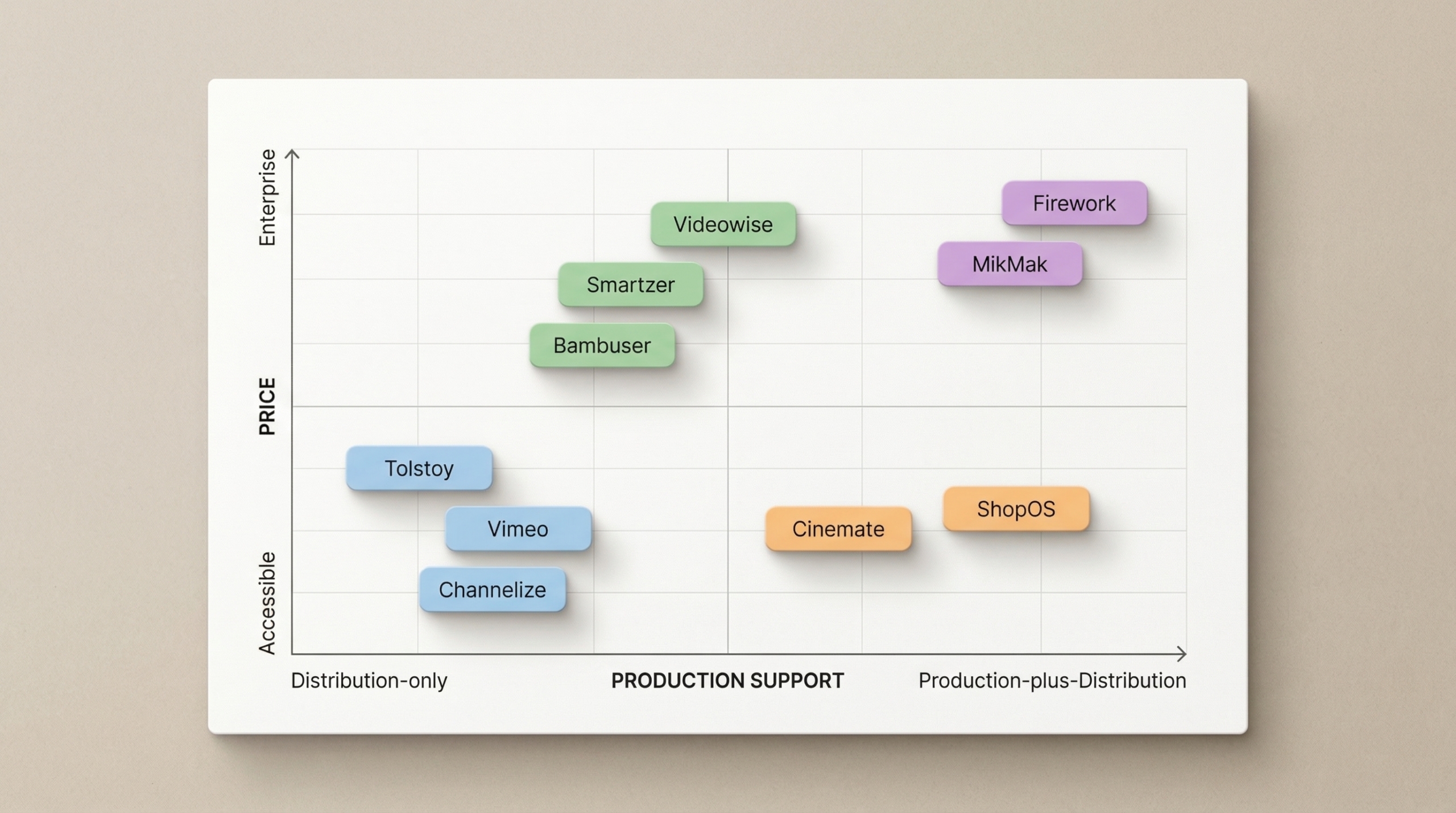
You’re a Shopify brand under $5M revenue and want to start quickly → Tolstoy. Easiest setup, free tier to prove value, upgrade as needed.
You’re focused on conversion rate optimization and need data → Videowise. Best analytics, A/B testing, performance focus.
You’re running regular live shopping events → Bambuser (Europe) or Firework (US). Both handle live at scale.
You’re a fashion brand doing editorial campaigns → Smartzer. Lookbook format is purpose-built for this.
You need multi-retailer channel routing → MikMak. Nothing else does multi-retailer purchase routing as well.
You want video production and distribution in one system → Cinemate or ShopOS.
You want a platform that gets smarter over time and connects video to your full commerce strategy → ShopOS. The learning loop and commerce context graph make it the right choice for brands building a compounding system, not just this quarter’s conversion rate.
Start converting more with shoppable video →