
AI for Ecommerce·May 7, 2026
Synopsis The fashion retail industry is undergoing one of the ...

The fashion retail industry is undergoing one of the most significant operational shifts in its history. Artificial intelligence is no longer a feature reserved for Nike or Zara. It is now accessible, practical, and increasingly necessary for any brand competing in the ecommerce space.
This guide breaks down what AI in fashion retail truly means, which functions it covers across the retail value chain, the major tools available today sorted by what they actually do, and where platforms like ShopOS fit into that picture. If you are running a fashion ecommerce brand and trying to figure out where AI belongs in your stack, this is where to start.
When most people hear “AI in fashion,” they picture image generation. A tool that puts a jacket on a model in seconds, or produces campaign visuals without a photographer. That is a real and valuable use case. But it is a fraction of what AI in fashion retail actually covers.
The full picture is considerably wider. AI is now being applied across product design, inventory forecasting, visual search, customer personalisation, content production, ad creative, post-purchase support, and catalog management. For an ecommerce brand, that is essentially every operational layer from ideation to fulfilment.
Understanding where AI applies, and which tools address which problems, is the difference between picking up one useful add-on and genuinely building a more efficient, higher-converting operation.
Breaking this down by function makes it easier to evaluate tools against your actual needs rather than a feature list.
AI tools in this category take a sketch, a text prompt, or a reference image and produce a finished garment visual. Physical sampling is expensive and slow. Brands using AI for design visualisation report significantly faster iteration cycles, with some cutting sample production costs by as much as 70 percent. For small and mid-size DTC brands, this makes high-quality product development accessible without large design budgets.
This is the category that gets the most attention. Producing on-model photography at scale has historically been one of the biggest cost and time bottlenecks in fashion ecommerce. AI tools now generate on-model product images, lifestyle shots, background replacements, and campaign visuals in a fraction of the time and cost. The quality gap between AI-generated and studio photography has largely closed for catalog and ad use cases.
AI-driven recommendation engines analyse browsing behaviour, purchase history, and style preferences to surface products more likely to convert. For fashion, where customer intent is highly subjective and search terms are often vague (“something for a summer wedding” rather than “white midi dress”), this is particularly valuable. Visual search, where a shopper uploads a photo to find similar products, also lives in this layer.
Overstock and stockouts are two of the most expensive problems in fashion retail. AI forecasting tools analyse sales data, seasonal patterns, and real-time signals to help brands make more accurate purchasing and replenishment decisions. Not the most visible AI application, but consistently one of the highest financial returns.
Writing product descriptions, generating ad copy, producing email campaigns, and creating social content at the pace modern ecommerce demands is resource-intensive. AI tools handle high-volume content production while maintaining brand voice and optimising for conversion.
AI-powered support tools handle the bulk of repetitive post-purchase queries: order status, returns, refunds, exchange requests. The better platforms handle these across chat, email, and voice, with accuracy rates that have made them genuinely viable for brands looking to reduce support overhead without sacrificing experience quality.
Before covering the broader tool landscape, one platform deserves a mention upfront: ShopOS. It is an AI-native operating system built specifically for ecommerce and DTC brands, with a particular depth in fashion retail. It covers image generation, video production, catalog management, ad creative, performance tracking, and more, through a squad of specialised AI agents that run 24/7 on your brand’s behalf.
The reason it is worth flagging now is that most tools below solve one problem well. ShopOS is built to handle the full content and commerce stack. More on that further down.
Jump to the full breakdown: How to Scale a DTC Brand

A significant portion of AI tools in fashion right now are image generation platforms. Impressive outputs, genuine creative value. But they are built primarily for designers and creatives, not for ecommerce operators running a catalog, managing SKUs, or optimising ad performance.
Midjourney is the most widely known AI image generation tool, and the quality of its outputs is hard to argue with. For editorial imagery, campaign concepts, and mood board exploration, it is excellent. For fashion brands, it works well in early creative stages: generating visual concepts, exploring aesthetics, producing reference images for shoots or campaigns.
Where it falls short for ecommerce is operational integration. Midjourney does not know your catalog. It does not connect to Shopify, track what images convert, or produce consistent on-model product images across hundreds of SKUs at scale. It is a creative tool, and a good one. But it sits firmly in the ideation layer rather than the commerce layer.
Higgsfield operates in AI video generation, producing high-quality content from product images or text prompts. For fashion brands building out social content, particularly short-form video for Instagram and TikTok, Higgsfield is one of the more capable tools available. It brings static product imagery to life and produces campaign-quality video without a production crew.
Like Midjourney, the limitation for ecommerce teams is the absence of catalog-level integration. Impressive creative, but feeding outputs into a commerce workflow requires additional tooling.
Adobe Firefly is the AI layer built into the Creative Cloud ecosystem. For teams already working in Photoshop and Premiere, it is a natural extension: background replacement, generative fill, AI-assisted editing at speed. The advantage is integration with existing creative workflows. The limitation, again, is that it is a creative tool rather than a commerce platform.
Runway is a strong video generation platform used extensively in fashion campaigns. It handles text-to-video, image-to-video, and advanced editing capabilities that have made it popular for brands producing visual content at scale. Useful for campaign-level creative. Outside the core stack for day-to-day ecommerce operations.
A second tier of tools has been built with ecommerce operations more specifically in mind. These sit closer to the catalog and conversion layer.
Pomelli focuses on AI-powered product photography for ecommerce, generating clean, consistent on-model and lifestyle imagery from product photos. It addresses one of the core visual production challenges for online fashion retailers: producing quality imagery at catalog scale without ongoing photography costs. For brands with large SKU counts and limited production budgets, it is a practical solution for the imagery layer.
Vue.ai applies computer vision and machine learning across several ecommerce functions: automated product tagging, visual recommendations, on-model image generation, and personalised shopping experiences. Adopted by larger fashion retailers and offering genuine depth in personalisation and catalog enrichment. Enterprise-oriented in pricing and implementation.
Syte specialises in visual search and product discovery. Shoppers can upload an image and find similar products within the retailer’s catalog. The platform’s AI also tags and categorises products to improve findability. For fashion, where shoppers often know what they want visually but struggle to describe it in words, this is a high-value capability.
PhotoRoom handles background removal, product staging, and on-model image generation at speed. Particularly useful for small to mid-size brands needing to produce consistent product images without a studio setup. The batch processing capability makes it practical for catalog-scale work.
These platforms all solve real problems. The gap they leave collectively is that each addresses one part of the workflow. A brand using several of them ends up with a fragmented stack, disconnected data, and no single view of what content is actually performing.
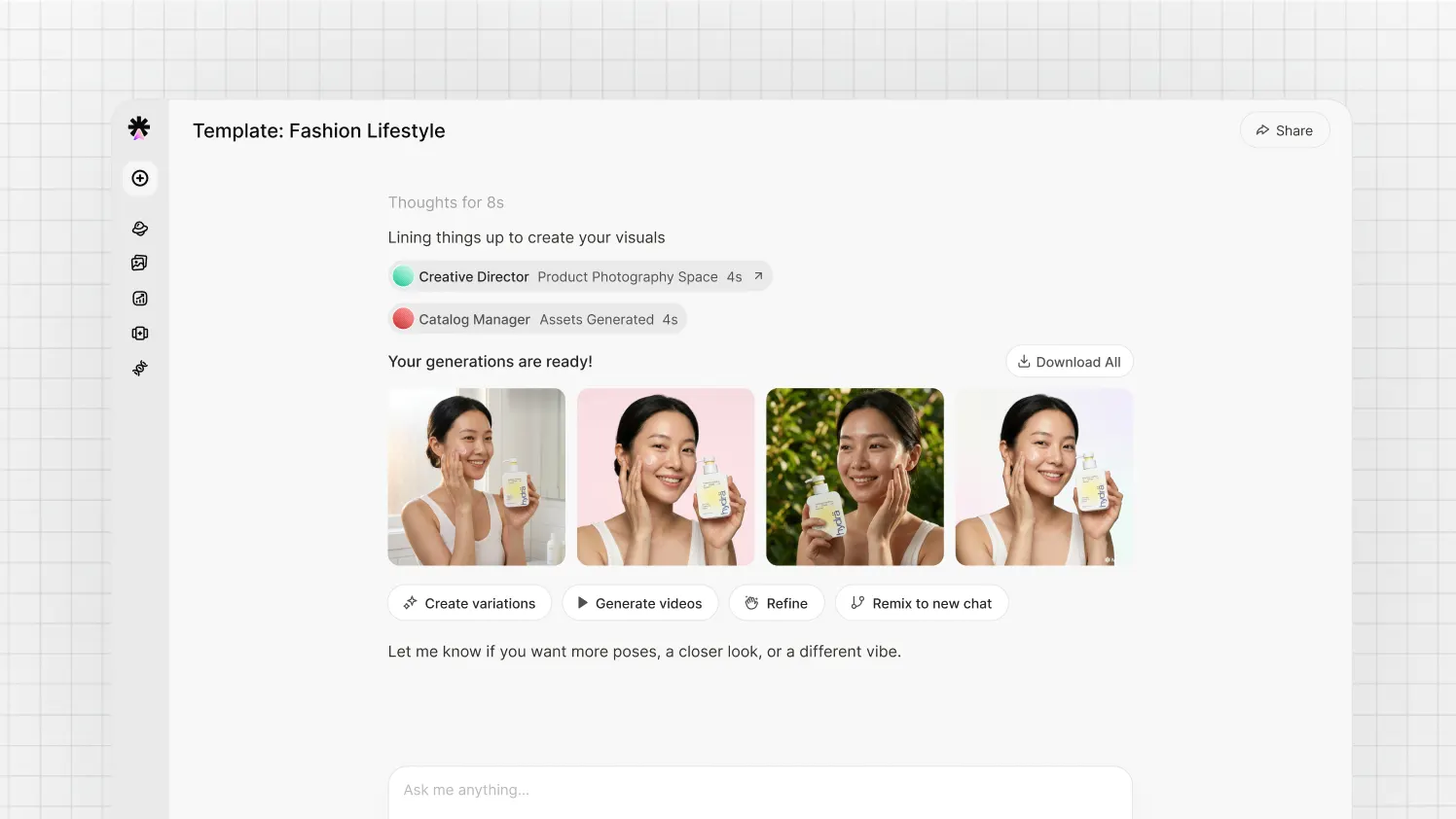
ShopOS approaches the problem from a different angle. Rather than solving one content problem well, it is built as an operating system for the entire ecommerce content and commerce workflow.
The distinction is meaningful. And the proof is in how it actually works.
Most platforms give you a tool. ShopOS gives you a team. It runs on eight specialised AI agents, each built for a distinct function within a fashion ecommerce operation. This is not a generic “ask AI anything” interface. Each agent is trained to do one job exceptionally well.
That is a full ecommerce marketing and operations team, running 24/7, at a fraction of what hiring or retaining those functions independently would cost.
Beyond the agent layer, ShopOS has a specific set of creative capabilities built for fashion ecommerce:
These are not generic capabilities. Each one maps directly to a specific problem that fashion ecommerce teams face in content production.
Every piece of content ShopOS generates is drawn from your Brand DNA: a stored layer of guidelines, colour palettes, fonts, example imagery, tone of voice, and style references that you upload once and that every agent and generation pulls from. New team members, new channels, new campaigns: all of it stays on-brand without manual oversight on every output.
For fashion brands where visual consistency is a core part of brand equity, this is not a nice-to-have. It is the feature that determines whether AI-generated content actually represents the brand or just fills a brief.
This is not theoretical. ShopOS has been deployed by fashion and retail brands, and the results are documented.
A fashion and apparel brand reported 40 percent faster campaign turnaround after adopting ShopOS. Rahul Gupta, Global VP and Head at Tower, described the platform as an extended creative team: “From content creation to ideation, helping us deliver catalog imagery, social visuals, and high-performance ad videos.” Ranjit Babu, CEO at Hardlines, noted that ShopOS generated dynamic influencer and UGC content, product page imagery, and infographics at a pace his team could not match internally. Satyen Momaya, CEO at Celio, a fashion brand, described the impact on operations as immediate and measurable.
These are not anonymous reviews. They are named, titled executives at real brands, which is the standard of proof that actually matters when evaluating a platform.
ShopOS makes this explicit on their own site. A typical ecommerce brand running separate functions externally is spending somewhere between 9,000 and 17,000 dollars per month across creative agency, performance agency, email and retention management, and catalog management. ShopOS consolidates those functions into a single squad with a single invoice. The math is not subtle.
For a growing DTC fashion brand, that is the difference between scaling and staying still.
The tools covered in this article sit at different points in the fashion ecommerce workflow. The right framework for evaluating them is not “which one is best” but “which problem am I actually solving.”
If the primary need is creative exploration at the campaign or design level, tools like Midjourney, Higgsfield, or Runway ML serve that well. They are built for creative teams with the skills to operate them effectively.
If the need is solving a specific ecommerce problem, whether product photography at scale, visual search, or catalog tagging, the ecommerce-specific platforms like Pomelli, Syte, and Vue.ai are more appropriate starting points.
If the need is to stop managing five separate tools and build a single, integrated content and commerce operation, ShopOS is the more logical choice. It is the only platform in this category built from the ground up for ecommerce, with commerce workflows and channel integrations at the core rather than bolted on.
The AI in fashion retail industry is moving fast. The brands that will hold a meaningful advantage over the next two years are not the ones that use the most AI tools. They are the ones that build the most coherent AI-powered operation.
One tool for images. Another for video. Another for copy. Another for performance.
At some point, your team ends up managing the tools instead of running the brand.
ShopOS brings the creative and commerce workflow together, with specialist agents working from the same brand context.
Replace the Tool Stack With One AI Operation. Book a Demo
AI in fashion retail refers to the application of artificial intelligence across the full fashion ecommerce and retail value chain. This includes product design visualisation, catalog photography, customer personalisation, demand forecasting, ad creative production, visual search, and customer support automation. It is not limited to image generation, though that is the most visible application.
The answer depends on the specific problem. For image generation at a creative level, Midjourney and Adobe Firefly are well-established. For ecommerce-specific photography and catalog work, Pomelli and PhotoRoom are practical options. For brands that need a fully integrated content and commerce platform with native Shopify, Meta, and Google integrations and a full squad of specialised AI agents, ShopOS is the most purpose-built option available for fashion ecommerce.
Midjourney and Higgsfield are creative tools. They produce high-quality images and video from prompts, but they are not connected to ecommerce workflows, catalog data, or performance signals. ShopOS is an ecommerce operating system. It generates content, manages brand consistency through Brand Memory, runs specialised agents across creative, performance, SEO, email, Shopify operations, and finance, and integrates natively with Shopify, Meta, and Google. The use cases are related but not the same.
No. AI tools are arguably more valuable for small and mid-size DTC fashion brands than for large enterprises. Large brands have the budgets for studios, photographers, and large content teams. Smaller brands do not. AI tools in fashion retail reduce the cost and time of content production significantly, which narrows the resource gap between large and small operators.
Solving one problem at a time without considering integration. Brands that pick up a separate tool for photography, another for ad copy, another for product descriptions, and another for customer support end up with a fragmented stack that requires significant manual coordination. The most effective AI implementations in fashion ecommerce connect content generation, asset management, and channel performance in one workflow.
For content production, results are immediate. AI tools produce product images, ad creatives, and copy in minutes rather than days or weeks. For downstream outcomes like conversion rates and return rate reduction, the timeline depends on implementation, but brands using integrated platforms like ShopOS have reported a 40 percent reduction in campaign turnaround time within weeks of adoption.
Start with the highest-volume, highest-cost content problem. For most fashion ecommerce brands, that is product photography. The cost and time required to produce catalog-quality imagery at scale is significant, and it is the area where AI delivers the clearest and most immediate return. Once that layer is in place, extending into ad creative, personalisation, and support automation builds naturally on top of it.
ShopOS is an AI-native content and commerce platform built for ecommerce and DTC brands. Explore the full squad of agents and start building your AI-native operation at shopos.ai.

