

 ChatGPT
 Perplexity
 Claude
 Gemini
 Grok
Grok
Consider a fairly typical D2C brand doing around $2M in annual revenue.
The stack is familiar: Shopify for the store, Klaviyo for email, Triple Whale or GA for analytics, Meta and Google ad managers, a design tool, a landing page builder, a few connector tools, maybe a CRO product. 15 to 20 tools in total, each good at one narrow thing, none of them talking to each other very well.
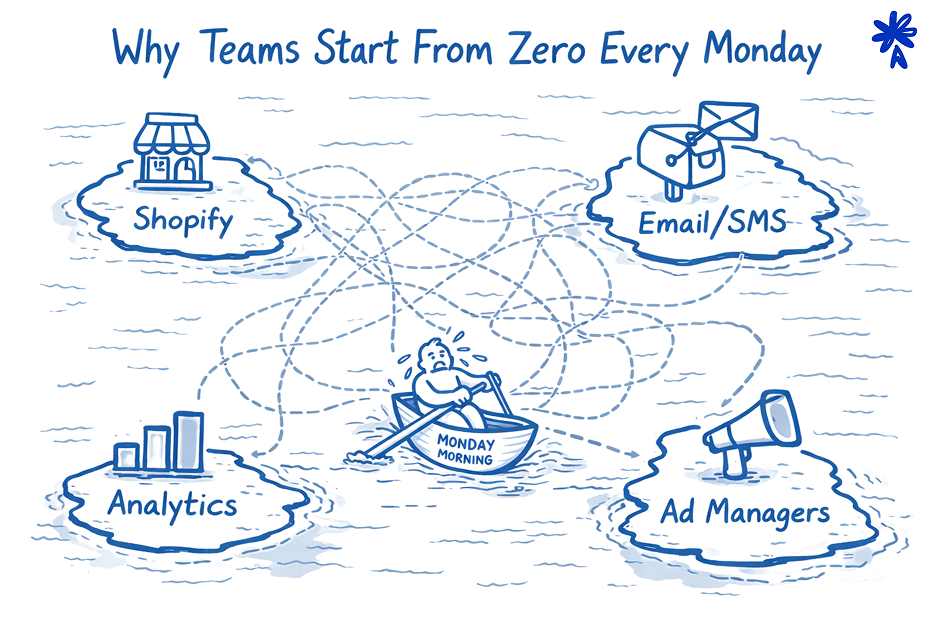
The team is small but not tiny. 4 to 6 people. Someone owns paid media. Someone handles creative. Someone updates the store. Someone looks at performance and reporting. Titles vary, but the workflows are remarkably consistent.
A week looks like this:
Monday starts with dashboards. Revenue, ROAS, CAC, conversion rate. Data is pulled from multiple tools and reconciled manually. The team discusses what happened last week and why.
Tuesday through Thursday is execution. New creatives are produced. Product pages are tweaked. Campaigns are launched. Emails are scheduled. Everything moves forward based on the best judgment and limited time.
Friday is review. Some things worked. Some didn’t. Notes are taken. Everyone agrees to “keep an eye on it.”
The following Monday, the cycle starts again.
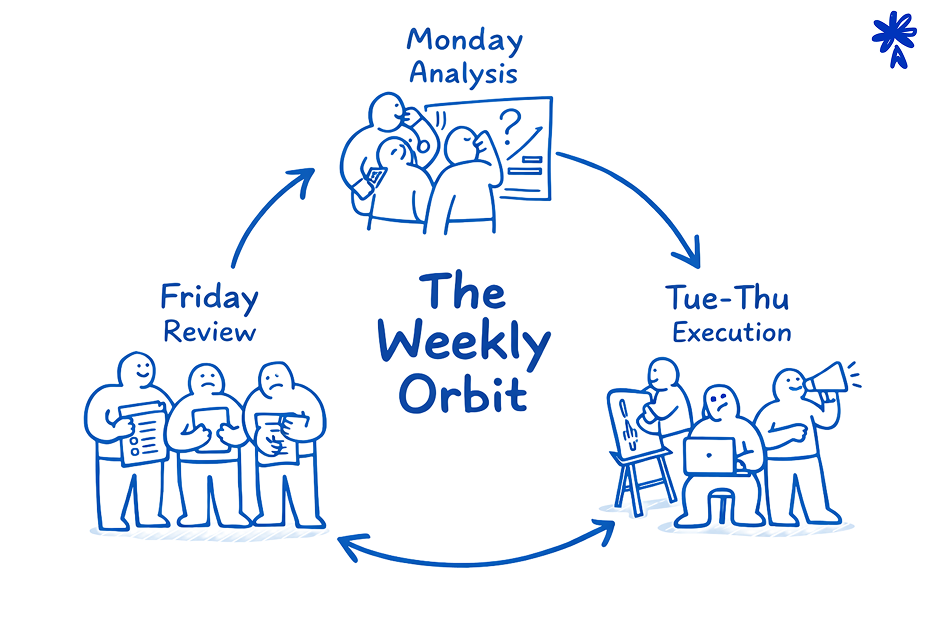
There is activity every week. There is effort. There is even learning in the human sense. But structurally, almost nothing carries forward. The store itself does not become meaningfully smarter. The same decisions are revisited. The same mistakes reappear. Improvement is fragile and dependent on specific people remembering what happened last time.
As the brand grows, this doesn’t get easier. It gets harder. More SKUs, more channels, more edge cases. The usual response is to add more people to manage the complexity that never actually decreases.
This feels like an eCommerce problem.
It isn’t.
It’s a symptom of something much larger happening to the concept of work itself.
The Broader Pattern Behind the Breakdown
There’s a growing body of thinking that explains why modern work feels increasingly inefficient, brittle, and misaligned with outcomes.
One useful way to frame it is this:
From a purely economic perspective, the optimal number of employees for any company is zero.
This isn’t a moral claim. It’s a structural one.
Companies exist to deliver products or services in exchange for money. They don’t exist to create jobs. Founders hire people because they cannot execute all the required work themselves. Employment is a workaround for a constraint: there is more work to be done than a small group of builders can handle alone.
That constraint is what produced the modern economy. Founders hire employees. Employees earn wages. Wages circulate. The system sustains itself.
What’s changed is the constraint.
For the first time, technology can take on large portions of intellectual work itself – not just isolated tasks, but judgment, iteration, pattern recognition, and execution. The work no longer has to pass through humans to move forward.
At the same time, companies are becoming far more conscious of the gap between what large workforces cost and the value they reliably produce. Coordination overhead, communication loss, and manual repetition eat away at efficiency long before individual performance becomes the issue.
Seen through this lens, three forces are converging:
- Zero employees is economically optimal in theory
- Workforce ROI is increasingly questioned in practice
- AI now makes replacement of intellectual execution plausible at scale
This isn’t about cruelty or ideology. It’s about incentives finally aligning with capability.
And in eCommerce, this convergence shows up in a very specific way.
What This Means for Commerce, Specifically
eCommerce is dominated by workflows that are repetitive, judgment-based, and feedback-driven:
- Create creative
- Deploy it
- Measure performance
- Adjust based on results
- Repeat
If a founder could design pages, generate creatives, run campaigns, and analyze results simultaneously and continuously, they would not need a team to execute those loops. Every hire exists because there is more execution required than one person can handle.
That’s force one.
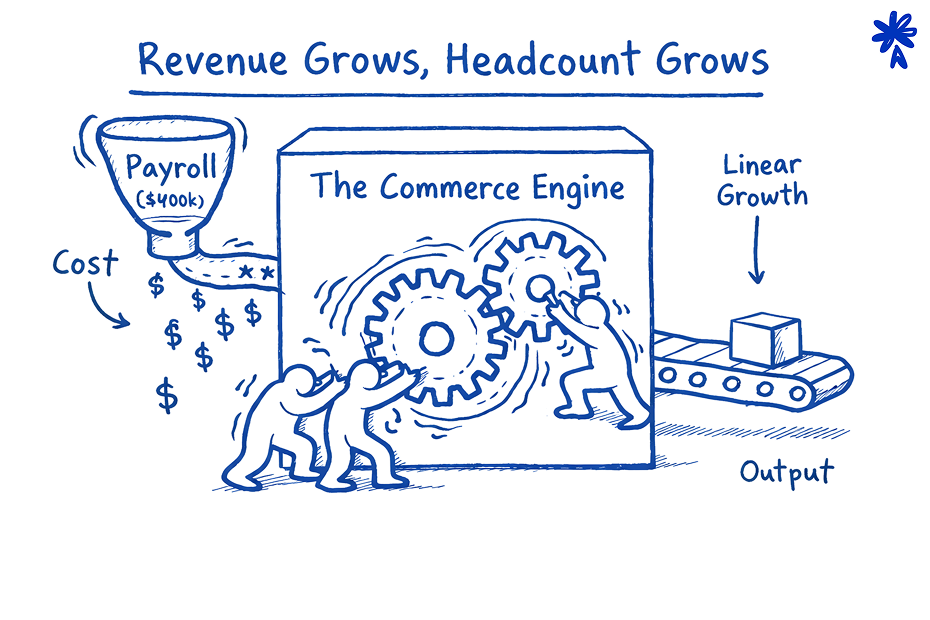
Force two is cost. A modest team of four to six people earning $60–80K annually represents $240K–$480K in payroll, before benefits. Add $20–50K per year in tooling. For that spend, what is the output?
Mostly manual execution. Work that resets weekly. Learning that does not compound. Efficiency that does not improve over time.
Revenue grows, but headcount grows with it. Costs scale linearly because the system itself does not learn.
Force three is the inflection point. Unlike earlier automation which replaced isolated tasks, modern AI can replace iteration itself. It can generate creative, evaluate outcomes, adjust strategy, and try again without fatigue. For the first time, the execution layer of eCommerce operations can be systematized.
The key insight is this:
The constraint for D2C brands was never “we need people.”It was “we need continuous execution and optimization.”
AI doesn’t just make people faster. It removes the need for people to be the execution layer at all.
A Competitive Reset Is Already Underway
This creates a structural split in how brands operate.
Manual-execution brands:
- Pay teams to run repetitive workflows
- Reset learning weekly
- Grow by adding headcount
- See margins compress as revenue scales
AI operating system brands:
- Execute and optimize continuously
- Accumulate learning week over week
- Grow without proportional headcount
- Improve margins as systems get better
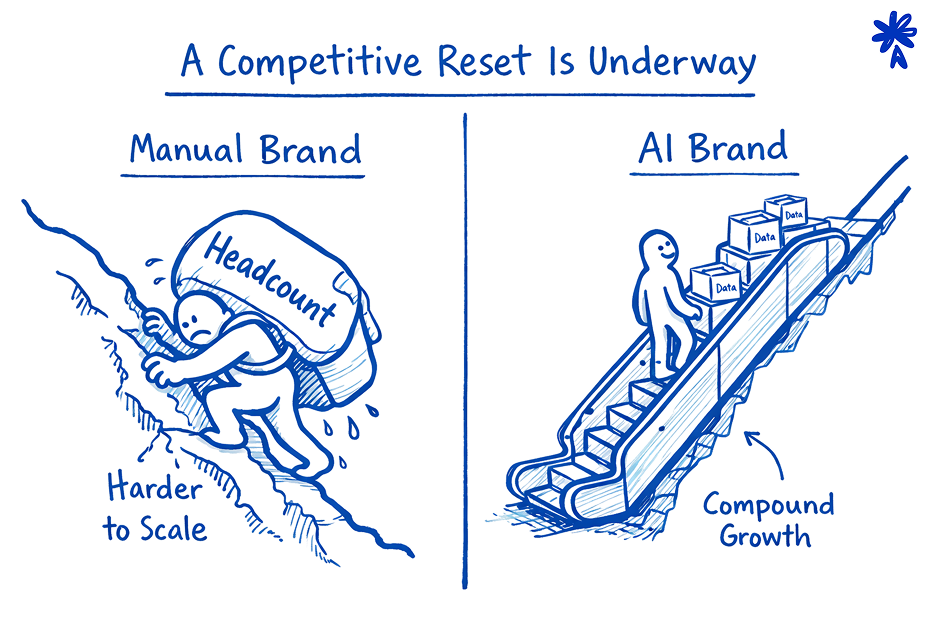
Timing matters here. Brands adopting AI operating systems now aren’t simply moving faster. They’re building compounding advantages. After 20 or 30 weeks, they’re no longer competing on the same plane.
Competing against a store with months of accumulated system-level learning is not like competing against a slightly better team. It’s like competing against an organization that never forgets.
ShopOS as Infrastructure, Not Ideology
ShopOS exists to serve this transition.
It is not a tool to help humans work faster. It is an operating system for stores that need to learn continuously.
AI agents inside ShopOS generate product images, design pages, deploy campaigns, analyze performance, and iterate automatically. Changes go live. Outcomes are measured. The system updates its behavior based on what works for your brand.
The loop closes:
generate → deploy → measure → learn → improve → repeat
In the early weeks, the system behaves like any other AI tool. Over time, it develops brand-specific understanding: which visuals convert, which layouts perform, which strategies fatigue. Eventually, it proposes strategies that a human team would not think to try, not because it’s creative in the human sense, but because it has seen more cycles than any team could.
The business model reflects this reality. The platform is free: models, workflows, hosting, analytics. We charge only when value is created:
- Refine: expert human review when stakes are high
- Revenue share: a percentage of revenue directly driven by AI-optimized elements
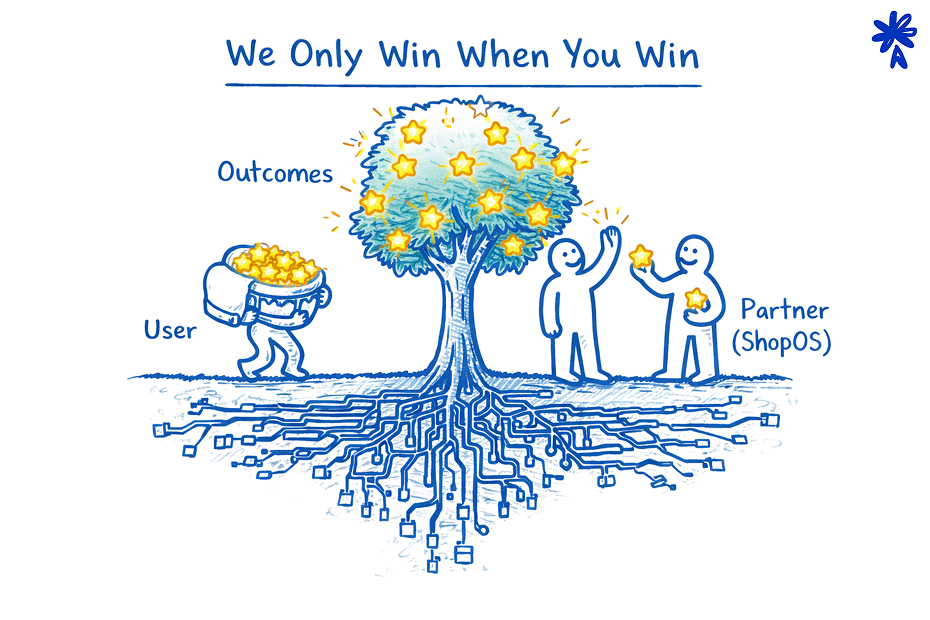
If nothing improves, nothing is charged. We participate only in outcomes.
The Transition and What Comes After
This shift will be disruptive. Not overnight, but faster than most organizations are comfortable with.
Miessler offers several reasons for cautious optimism.
First, many of the jobs being displaced were not deeply fulfilling. Anthropologist David Graeber famously described large swaths of modern work as “bullshit jobs” – roles defined more by coordination, reporting, and ritual than by meaningful creation.
Second, even rapid technological change unfolds unevenly. Adoption takes time. Regulation slows things. This is not a cliff where half the workforce disappears in a year.
Third, what comes after has the potential to be better. The same systems that remove repetitive execution can create abundance – freeing people to focus on judgment, taste, strategy, and building things that actually matter.
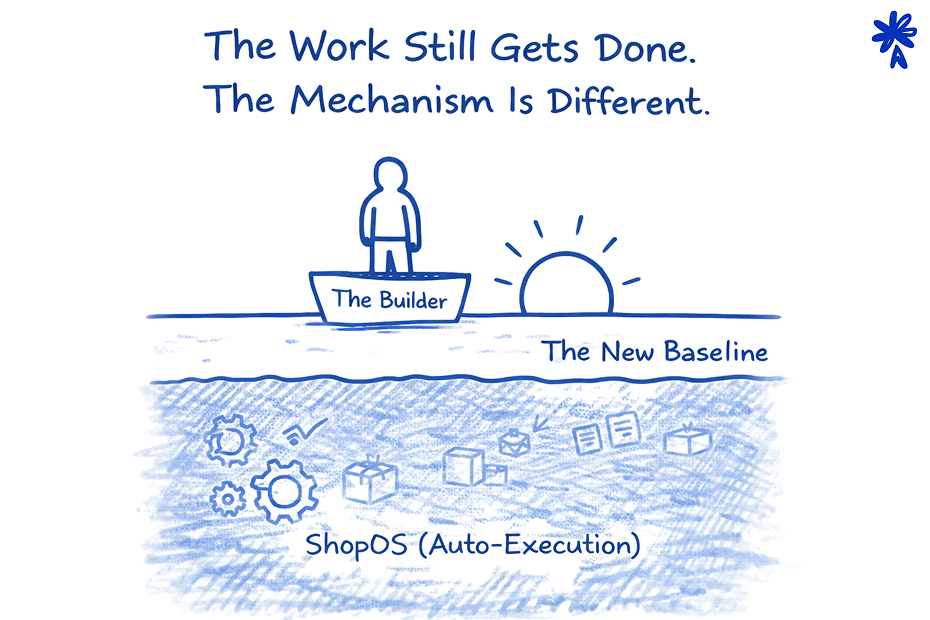
In eCommerce specifically, the work does not vanish. Stores still need products, storytelling, and positioning. What disappears is the requirement for large teams to execute the same workflows over and over again.
The New Baseline
The constraint that created knowledge – work employment is dissolving – not because of ideology, but because technology finally allows builders to build without large execution teams.
For eCommerce, this means that stores which learn continuously will define the next era. Manual workflows will feel increasingly antiquated. Early adopters will compound advantages that late movers cannot easily recover.
ShopOS is infrastructure for that transition. Not a hero. Not a saviour.
Just the operating system for stores that need to learn automatically – because that is becoming the baseline.
The work still gets done.
The mechanism is different.
Further Reading
This article builds on Daniel Miessler’s essays “The End of Work” and “The Bubble Is Brand Labor.” His analysis of employment and incentives informed our thinking about what is happening in eCommerce specifically. The originals are available here.