
AI for Ecommerce·Sep 14, 2026
TL;DR: Rankings have come loose from traffic. AI answers now ...

TL;DR: Rankings have come loose from traffic. AI answers now sit above the results and absorb a large share of clicks, so an ecommerce SEO agency reporting only on position is reporting a proxy. What still pays is catalog crawlability, product page depth, and being the source engines quote.
Key takeaways
An ecommerce SEO agency has three jobs, and they are worth listing in descending order of neglect. Make the catalog technically crawlable. Make product and category pages genuinely useful. Make the brand quotable by the engines that now answer the query before anyone reaches a website at all.
The first two are old work done badly at most stores. The third is new and barely staffed anywhere.
Order matters because the third depends on the first two. An engine cannot cite a page it cannot crawl or parse, which is why citation work that starts with content usually stalls.
A large share of searches now end without anyone visiting a website, which is the shift that broke ranking reports as a measure of anything. A randomized field experiment with 1,065 US desktop Chrome users, run between January and February 2026 by researchers at the Indian School of Business and Carnegie Mellon, found AI Overviews cut organic clicks on triggered queries by 38% and pushed zero-click searches from 54% to 72% (Search Engine Journal).
The effect was strongest when the answer sat at the top of the page, which happened 85% of the time.
Sit with what that means operationally. A brand can hold position three, keep its ranking report green all quarter, and lose a third of the traffic that position used to deliver. Nothing in the report explains where it went.
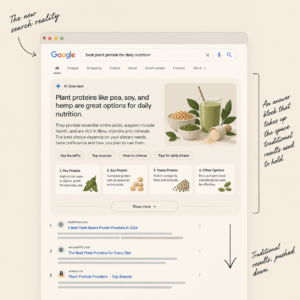
The unglamorous half still works, plus the citation work most ecommerce SEO agency retainers skip entirely. Neither is exotic. Both are simply distributed differently from where agency hours have traditionally gone, which is why an audit can look thorough and still miss where a catalog is actually losing ground.
Technical health is the first. Commerce sites generate crawl problems content sites never face: filter and sort combinations creating near-infinite URLs, thin variant pages, out-of-stock products left indexable, and collection pages duplicated by sort order.
Product page depth is the second, and it feeds the third. Pages answering real questions with specifics get quoted. Pages carrying a manufacturer description do not.
Citations are the third: being present and quotable where engines draw from, which is frequently not your own site. Review platforms and comparison content carry disproportionate weight.
Measure an ecommerce SEO agency on revenue and citations rather than positions, because positions no longer predict either. Four metrics cover it, and a firm that cannot produce all four is reporting on what is easy to collect rather than on what moved. Ask for them in the first month, not the sixth.
What is share of answer? Share of answer is the percentage of tested prompts in a category where an engine names your brand. It is the answer-era equivalent of share of voice, and it moves independently of rankings.
The citation metric is the one most agencies cannot yet supply, and it predicts the next two years. AI referrals convert at a rate 60% higher than non-AI traffic and generate 53% more revenue per visit (Adobe Analytics).
ShopOS tracks citation status across ChatGPT, Perplexity, Gemini, and Claude, prompt by prompt, on the GEO and SEO agent. Two published outcomes show the range: 0 to 17 of 18 buyer prompts in 90 days for one brand, and 19 of 20 plus all 12 competitor prompts reclaimed in three months for another (case studies). Both are apparel brands, which is worth stating rather than implying the pattern is proven everywhere.
For most brands under significant scale, the answer is yes, because an ecommerce SEO agency and a media team are fighting over the same bottleneck. Both need product pages that convert. Both need content. Both fail when the catalog is wrong, and splitting them across vendors means two firms optimizing slices while nobody owns what happens after the click.
The counter-argument is real and worth stating. Specialists go deeper, and a dedicated technical SEO firm will out-audit a generalist every time.
Scale decides it. Large catalogs with genuine technical complexity justify a specialist. Most mid-sized stores do better with one owner of the whole loop.
A good ecommerce SEO agency runs an audit, then repair, then build, in that order and not in parallel. Month one is diagnosis: crawl the catalog, compare indexed against intended, check speed, and baseline both rankings and share of answer. Nothing gets published in that month that the audit has not justified.
Month two is repair. Indexation problems, thin pages, and slow templates come first, because they cap everything built afterwards.
Month three starts the compounding work, and results from it land in months four through nine. Agree that timeline at the start rather than discovering it in month five.
Any ecommerce SEO agency promising ranking movement inside 30 days is describing luck or an account with obvious existing errors. Want a baseline before hiring? The free tier includes citation tracking on a small prompt set.
Yes, but the return arrives differently. The clicks that do come through convert better, and the work that earns citations is largely the work that earned rankings: crawlable pages, useful content, third-party credibility. What changes is measurement. A brand judging the investment on organic sessions alone will conclude SEO is dying, while one also tracking how often engines name it will see where the value moved.
Commerce introduces problems content sites never face. Filter and sort parameters generate enormous numbers of near-duplicate URLs, variants create thin pages at scale, out of stock items need a policy, and seasonality reshapes demand quarterly. A general agency often applies a blog-and-backlinks playbook that touches none of it. Ask how they handle out of stock products and filter URLs. The answer sorts candidates in a minute.
Technical fixes can move things within weeks because you are removing a brake rather than building an engine. Content and citation work realistically compounds over six to nine months. Expect early wins from indexation and speed, a flat-looking middle stretch, then acceleration once the catalog and citation program mature together. Budget at least two quarters before judging the investment fairly.
Neither, as usually framed. Bought links carry risk with declining returns, and citations are not purchasable. What works is being genuinely present where your category gets discussed: review platforms, comparison content, trade press, community threads. That earns links and citations together. It is slower than buying and it survives both algorithm updates and answer engines, which is the whole point.
More than it used to. Duplicate manufacturer text gave you thin pages before. Now it also makes you unquotable, because an engine has no reason to cite the tenth site carrying identical words. Rewriting descriptions for your highest-traffic products with genuine specifics is among the highest-return tasks available to most catalogs, and it lifts conversion independently of search.
More than most brands assume, particularly content. Someone who knows the product writes better product copy than an agency writer, and answering real customer questions is the most valuable content work there is. Where in-house teams struggle is technical diagnosis, catalog-scale implementation, and consistency over months. A sensible split has you owning product knowledge and a partner or platform owning the technical layer and the cadence.
A specific ranking position, a date for it, or a traffic number before seeing the account. All three sit outside anyone’s control, and such promises tend to be kept through tactics that create risk later. Be wary too of anyone who does not mention AI answers, because a plan built on click forecasts is modeled on a results page that no longer exists.
For the platform-specific version of this work, see the Shopify SEO agency page.

