
AI for Ecommerce·Sep 14, 2026
TL;DR: Shopify creates a specific set of SEO problems that ...

TL;DR: Shopify creates a specific set of SEO problems that generic audits miss: the same product served at several URLs, thin variant pages, apps slowing every template, and catalog data going stale. A Shopify SEO agency should fix the platform layer before writing a word of content.
Key takeaways
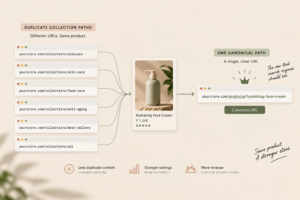
A Shopify SEO agency spends its first month on the defaults the platform set for you, several of which work against search. Shopify generates product URLs inside collection paths as well as at the canonical product path. It publishes variant pages carrying near-identical content. It lets any app inject scripts into every template, whether that template uses the app or not.
None of it is a flaw exactly. It is a default that needs managing, and nobody tells a new store owner that.
Generic audits miss it because they scan for universal issues, and these look normal to a crawler configured for content sites. The familiar outcome: a brand pays for an audit, receives a competent document about title tags, and still has a catalog splitting its own signals.
A Shopify SEO agency should tackle four problems in roughly this order, and each is a platform behavior rather than a content shortfall. That distinction matters because content work built on top of an unfixed platform layer under-performs for reasons nobody traces back correctly six months later.
None of it needs a rebuild. All of it is configuration and template work, which is why progress should be visible inside the first month rather than promised in six.
Enough that a Shopify SEO agency fixes it before writing content, and the cause is almost always apps rather than hosting. Stores accumulate weight steadily as apps get installed for a campaign and never removed, and around 53% of mobile visitors abandon a page taking longer than three seconds to load (Queue-it, citing Google).
The audit that matters is boring, and any Shopify SEO agency can run it in an hour. List every installed app, check which inject scripts globally, confirm each is still in use by someone.
Most brands find two or three apps loading on every page for a feature used on one. Removing them is faster and cheaper than any content project, and it lifts rankings and conversion together.
Theme choice compounds what a Shopify SEO agency has to undo. A heavy theme with hero video and multiple carousels starts at a disadvantage no image compression recovers.
Product data drift costs money in two places at once, and almost no Shopify SEO agency audit covers it. Descriptions go stale after a product changes. Variant data breaks. Out of stock SKUs keep running in Meta and Google feeds, quietly collecting clicks for items that cannot be bought by anyone who clicks them.
A Shopify SEO agency should own this. Search loses because thin, outdated pages stop earning. Paid loses because spend goes to products that cannot convert.
The failure mode is forgetting rather than incompetence, so scheduled checking is the only reliable fix. ShopOS runs Catalog Health and SKU Quadrant routines on a schedule, with out-of-stock enforcement pulling unavailable SKUs from ads, three stock status modes, a fallback percentage, and an impact preview before any bulk change applies. That sits with the performance marketing agent rather than in an SEO tool, which is arguably where it belongs.
Yes, and on Shopify the product data work does double duty, which makes it the rare task worth doing twice over. The same structured, specific information that helps a shopper decide is what an answer engine quotes. A randomized field experiment found AI Overviews cut organic clicks on triggered queries by 38%, with zero-click searches rising from 54% to 72% (Search Engine Journal).
What is share of answer? Share of answer is how often an engine names your brand across a set of category prompts. It is tracked prompt by prompt and moves independently of rankings.
For a Shopify SEO agency the practical work is unglamorous. Replace manufacturer descriptions with real specifics, add structured data properly rather than trusting whatever the theme ships, and put the details shoppers ask about on the page as text.
That last point catches a lot of stores. Ingredient lists, sizing, and usage instructions rendered as graphics are invisible to the engines deciding what to recommend. ShopOS tracks citation status across ChatGPT, Perplexity, Gemini, and Claude and publishes content to close the gaps, with the method in its generative engine optimization work.
A Shopify SEO agency should deliver a diagnosis and platform fixes rather than a content calendar, and the difference is visible in what actually shipped. A reasonable first month covers a crawl against the product feed, a canonical and variant audit, an app and speed review, a catalog data check, and a baseline of rankings and share of answer.
Deliverables should include changes shipped, not only findings documented.
If month one produces a slide deck and a list of blog titles, the platform layer has been skipped and the content will under perform later for reasons nobody connects back to this decision.
Where a brand only needs the technical layer fixed, a specialist contract beats a broader engagement. Where the catalog itself is the problem, the free tier shows you its state in an afternoon.
Shopify makes products reachable through collection paths as well as the canonical product path, so the same item exists at several addresses. It is harmful when canonical are not set deliberately, because ranking signals split across duplicates instead of consolidating. Most themes handle it reasonably by default, but customization and apps break it frequently with no visible symptom. Check explicitly rather than assuming your theme got it right.
Usually not. Variants differing only by size or color rarely justify separate indexable pages, since each carries near-identical content and competes with its siblings. The exception is a variant with genuinely distinct demand that people search by name, such as a specific flavor or formulation. A product line where one variant has its own following has a case. Nine colorways of the same item does not.
The count matters less than what each loads. Ten apps injecting nothing into the storefront cost nothing, while three adding global scripts can noticeably slow every page. List installed apps, identify which add front-end code, and confirm each is still used. Brands routinely find apps installed for a campaign two years ago still loading on every page view, which is free speed sitting unclaimed.
It works, with limits worth knowing. The structure is flat and the URL pattern fixed, which makes deep topical hierarchies awkward compared with a purpose-built CMS. For most brands that is fine, because the content earning links and citations tends to be a modest number of substantial pieces rather than a large library. If you genuinely need hundreds of nested articles, a headless setup becomes worth the complexity.
Only partly. Metadata, content, and some structured data can be handled through the admin or apps, but canonical logic, template speed, and variant rendering usually need theme edits. Anyone promising meaningful technical improvement without theme access is either overstating what they can do or planning to install apps to work around it, which often makes speed worse. Agree on theme access and a staging setup before starting.
Almost always redirects, and almost always the long tail rather than the obvious pages. Teams map top URLs carefully and lose the deep catalog: discontinued products, old collection paths, posts with different slug patterns. Crawl the previous site’s indexed URLs, compare against the new structure, and redirect anything with links or traffic. Move quickly, because recovery gets harder the longer errors persist.
Ask a candidate how they handle collection URL duplication and variant indexation. A specialist answers immediately with specifics about canonical configuration. A generalist describes duplicate content in the abstract. Neither answer disqualifies anyone, but it tells you where the first month goes. Large catalogs with aging themes get more from a specialist. A clean store with a content gap can do well with a strong generalist.
For the platform-agnostic version, see the ecommerce SEO agency page.

