

 ChatGPT
 Perplexity
 Claude
 Gemini
 Grok
Grok
D2C brands spent years chasing Google rankings, fixing technical SEO issues, building blogs, and improving product pages to win organic traffic.
That system still matters. But the search journey has changed.
A shopper today may ask ChatGPT for the best protein snack, ask Perplexity to compare skincare brands, or depend on Gemini to shortlist products before visiting a website.
That shift has created a new visibility problem.
A brand can rank on Google and still stay absent from AI-generated recommendations. This is where generative engine optimization for D2C brands becomes important.
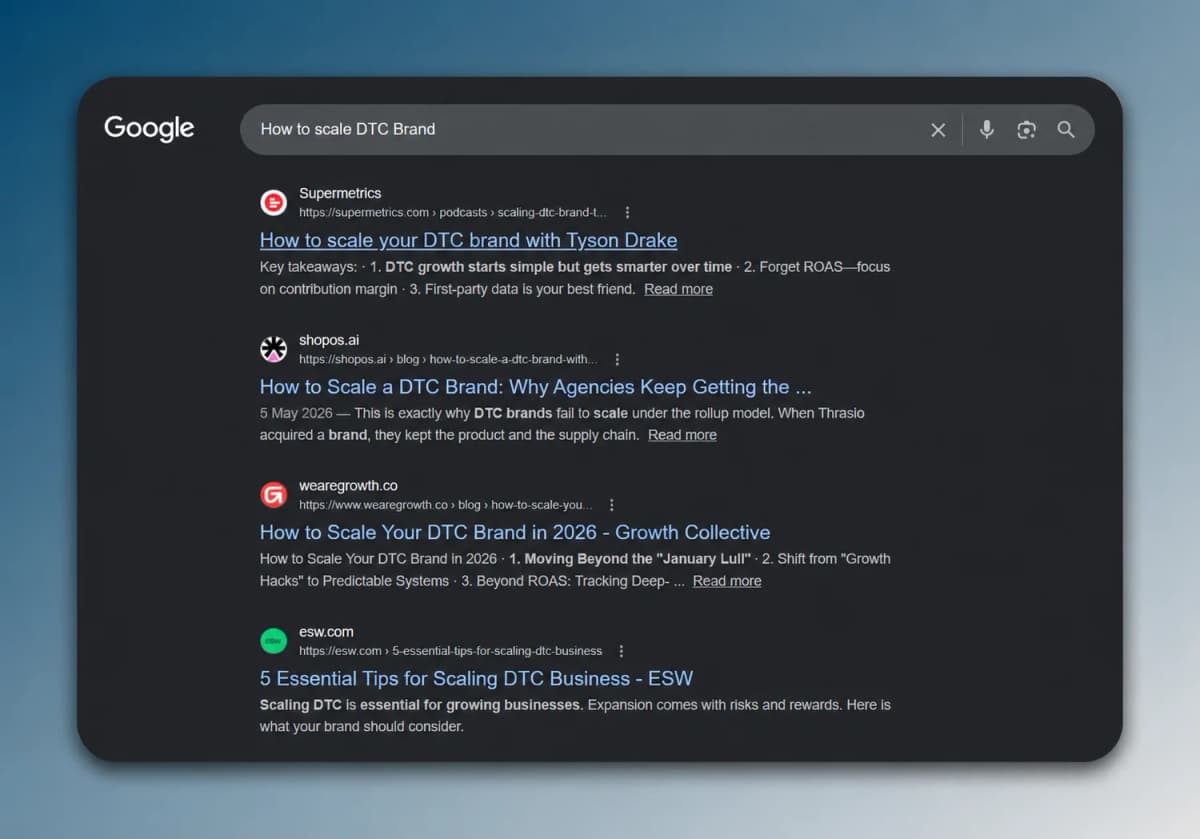
SEO helps a brand rank. AEO helps a brand answer. GEO helps a brand get cited, mentioned, and recommended inside AI search experiences.
For D2C marketers, this difference matters because organic traffic is becoming harder to protect.
Zero-click searches, AI Overviews, marketplace discovery, social search, and AI assistants are changing how shoppers find products.
In many categories, organic visibility is becoming harder to protect because buyers are no longer depending only on Google results before making purchase decisions.
Generative engine optimization for D2C brands is not replacing SEO or AEO. It is adding a new layer of visibility where AI engines decide which brands deserve to be included in the answer.
Later in the blog, we will also look at where tools like Big Head by ShopOS fit into this shift, especially for D2C brands trying to understand whether AI engines are citing, skipping, or misreading their brand.
GEO vs SEO vs AEO
SEO (Search Engine Optimization) helps your website rank on search engines like Google.
AEO (Answer Engine Optimization) helps your content answer user questions directly through snippets, FAQs, voice search, and answer boxes.
GEO(Generative Engine Optimization) helps your brand get cited, mentioned, and recommended inside AI-generated answers on platforms like ChatGPT, Perplexity, Gemini, and AI Overviews.
For D2C brands, the difference is simple: SEO wins search rankings, AEO wins direct answers, and GEO wins AI citations.
A strong SEO, AEO, and GEO strategy helps ecommerce brands stay visible across traditional search, answer engines, and AI-led product discovery.
Answer Engine Optimization vs Search Engine Optimization: What Makes AEO Different?
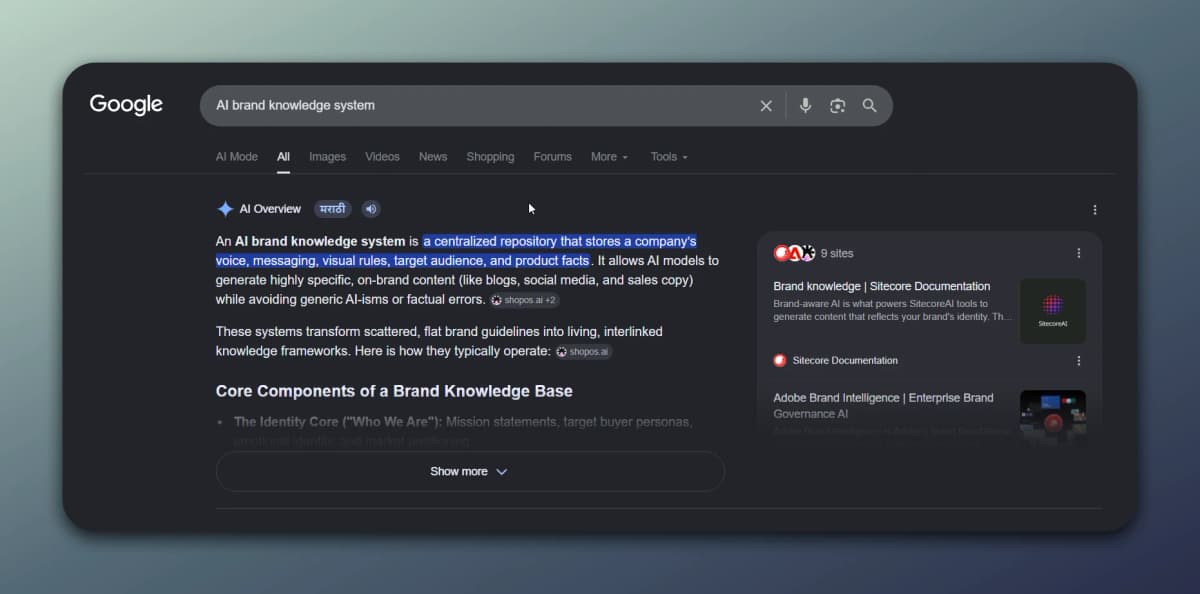
AEO, or answer engine optimization, focuses on making content clear enough to be selected as a direct answer. It is commonly used for featured snippets, voice search, FAQ results, People Also Ask boxes, and AI-style responses that need short, structured answers.
The difference in answer engine optimization vs SEO comes down to intent.
SEO is designed to help a page rank.
AEO is designed to help a specific answer get extracted.
For example, a skincare brand may write a blog around “How often should you use vitamin C serum?” SEO would look at the full article, keyword structure, backlinks, and ranking potential.
AEO would focus on whether the answer is clear, concise, structured, and easy for Google or an answer engine to pull into a direct response.
So, answer engine optimization vs SEO is not about replacing one with the other. It is about understanding that ranking a full page and extracting a direct answer are two different visibility goals.
AEO works best when the content includes:
- Clear definitions
- Question-led headings
- Short direct answers
- FAQs
- Step-by-step explanations
- Schema markup
- Simple language that matches user intent
For D2C brands, AEO helps capture shoppers who are asking practical buying questions. But AEO still focuses heavily on answering the question. GEO goes a step further by asking whether AI engines trust your brand enough to mention it.
What Is Generative Engine Optimization for D2C Brands?
Generative engine optimization for D2C brands is the process of improving a brand’s visibility inside AI-generated answers.
It helps AI engines understand your brand, trust your content, and cite your website or brand when shoppers ask commercial, category, or product-related questions.
For ecommerce teams, generative engine optimization for ecommerce is becoming important because shoppers are using AI tools to research what to buy.
They may ask:
- Which clean beauty brands are best for dry skin?
- Which Shopify brands sell sustainable activewear?
- What are good alternatives to a popular skincare product?
- Which protein powder brand is better for beginners?
In these moments, the brand that gets mentioned earns attention before the shopper even lands on Google. That is the power of generative engine optimization for D2C brands.
GEO is not just about adding more content. It is about making sure AI engines can understand what your brand sells, who it serves, why it is credible, and where it fits in a buyer’s decision.
For D2C brands, that means your website, product content, FAQs, reviews, social proof, and third-party mentions should tell a clear and consistent story.
Generative Engine Optimization vs Traditional SEO: Why the Rules Just Changed
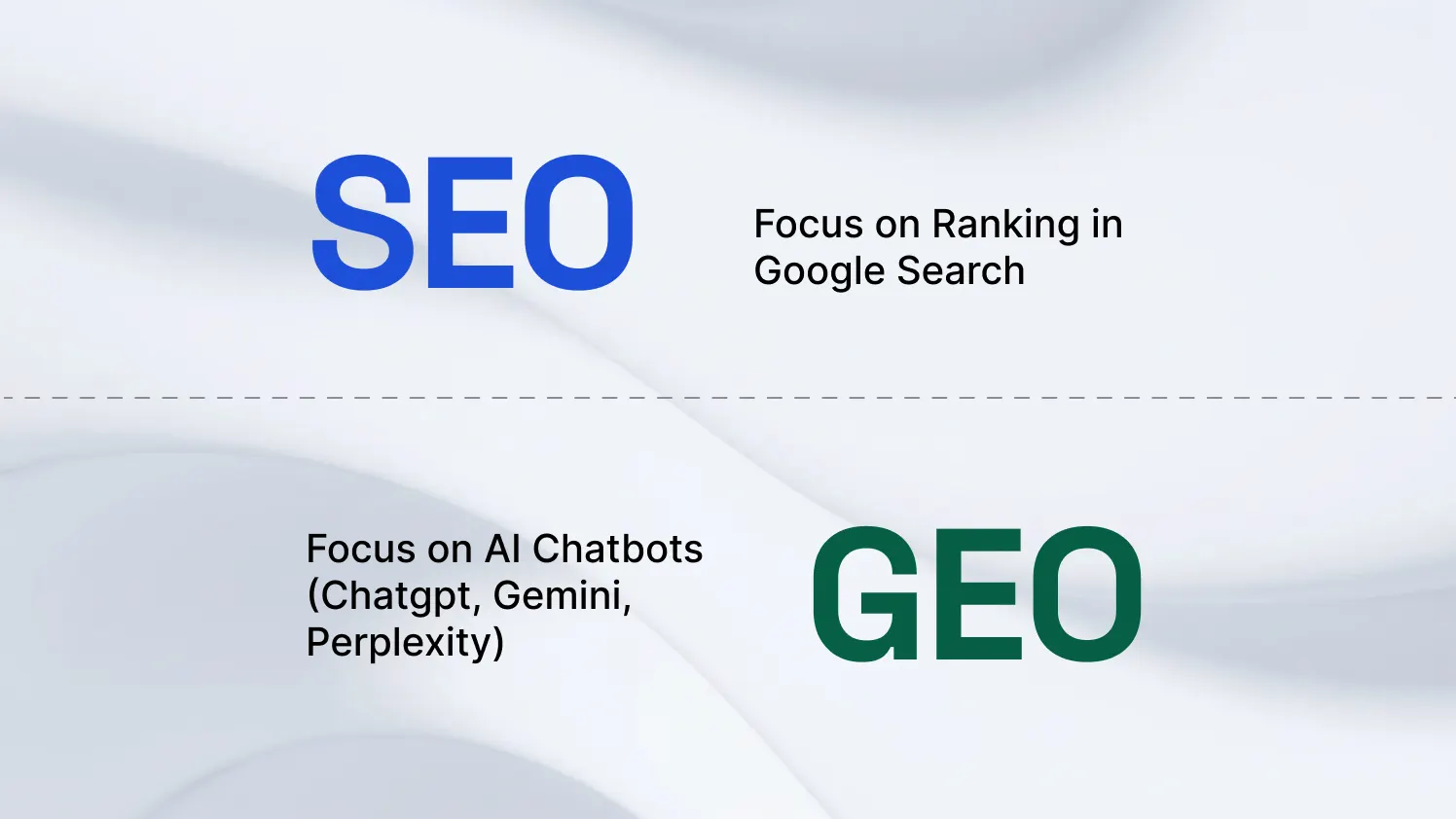
The biggest difference between GEO and traditional SEO is the destination.
Traditional SEO tries to win the click. GEO tries to win the citation.
In SEO, your brand competes for a ranking position. In GEO, your brand competes for inclusion inside an AI-generated answer. That changes how D2C brands should think about content visibility.
With traditional SEO, a brand may create a category page, optimize it for keywords, build backlinks, and track its ranking position.
With GEO, the same brand also needs to ask whether AI engines can clearly understand what the brand sells, who it serves, why it is credible, how it compares with other brands, and what proof supports its claims.
This is where generative engine optimization vs traditional seo becomes a practical conversation.
Traditional SEO rewards pages that satisfy search engine ranking signals.
GEO rewards brands that are easy for AI systems to understand, verify, and reference.
The difference in generative engine optimization vs SEO is also tied to measurement. SEO teams track rankings, clicks, impressions, and organic traffic.
GEO teams need to track AI mentions, prompt visibility, citation frequency, competitor mentions, and the quality of answers where the brand appears.
For D2C brands, generative engine optimization vs traditional seo also changes the content brief. A traditional SEO brief may focus on keywords, search volume, title tags, and backlinks. A GEO-focused brief also looks at entity clarity, answer depth, source quality, product proof, and whether the content can support an AI citation.
A D2C brand can have strong SEO and still have weak GEO if:
- Its product benefits are vague
- Its brand positioning is inconsistent across platforms
- Its content lacks direct answers
- Its website has limited structured data
- Its category expertise is thin
- Its third-party mentions are weak
- Its claims are unsupported
- Its content does not match real buyer questions
- Its store is not easy for AI crawlers to understand
These gaps show where the GEO ranking factors AI engines trust are missing, such as clarity, credibility, structured content, entity strength, proof, and relevance to real buyer questions.
This is why generative engine optimization for D2C brands matters now. D2C teams need to stop thinking only in terms of keywords and start thinking in terms of citations, entities, authority, and buyer questions.
GEO vs AEO: Are They the Same Thing?
GEO and AEO are connected, but they are not the same.
AEO helps your content become the answer. GEO helps your brand become part of the recommendation.
For example, if a user asks, “What is the best fabric for summer activewear?” AEO helps your content provide a clean answer.
But if the user asks, “Which D2C activewear brands are good for summer workouts?” GEO decides whether your brand is visible enough to get mentioned.
That is the main difference in generative engine optimization vs AEO.
AEO focuses on answer clarity. GEO focuses on brand citation, entity strength, and AI visibility.
AEO usually works at the content level. GEO works at the brand ecosystem level.
For D2C brands, both matter. AEO helps you answer product questions. GEO helps you get cited by ChatGPT, Perplexity, Gemini, and other AI-led discovery platforms when shoppers ask what to buy.
This is why generative engine optimization for D2C brands works best when it is layered over a strong AEO and SEO foundation.
AEO makes the answer clear. SEO makes the page discoverable. GEO makes the brand easier for AI engines to trust and cite.
SEO vs AEO vs GEO: The Real Difference for D2C Brands
This is the easiest way to understand SEO vs AEO vs GEO without treating them as three disconnected marketing trends.
| Area of Difference | SEO | AEO | GEO |
| Full form | Search Engine Optimization | Answer Engine Optimization | Generative Engine Optimization |
| Main goal | Rank higher in search results | Provide direct answers | Get cited in AI-generated answers |
| Main platform focus | Google, Bing, search engines | Featured snippets, voice search, People Also Ask, answer boxes | ChatGPT, Perplexity, Gemini, Claude, AI Overviews |
| Main success metric | Rankings, clicks, impressions, organic traffic | Answer visibility, snippet ownership, FAQ visibility | AI citations, brand mentions, AI visibility score |
| Content style | Keyword-led and topic-led content | Question-led, direct, structured answers | Entity-rich, source-backed, citation-worthy content |
| Best use case | Getting users to website pages | Answering specific user questions | Getting brands recommended by AI engines |
| Brand impact | Improves discoverability | Improves answer ownership | Improves AI-led trust and recommendation visibility |
| D2C example | Ranking for “best collagen powder” | Answering “What does collagen powder do?” | Getting listed when users ask “Which collagen brands should I try?” |
This is the clearest way to understand SEO vs AEO vs GEO.
SEO brings visibility on search pages. AEO wins direct answers. GEO builds AI citation visibility.
For ecommerce teams, the real goal is not to choose one over the other.
The goal is to build a connected visibility system where SEO helps pages rank, AEO helps content answer, and GEO helps AI engines recommend the brand.
How SEO, AEO, and GEO Work Together for D2C Brands
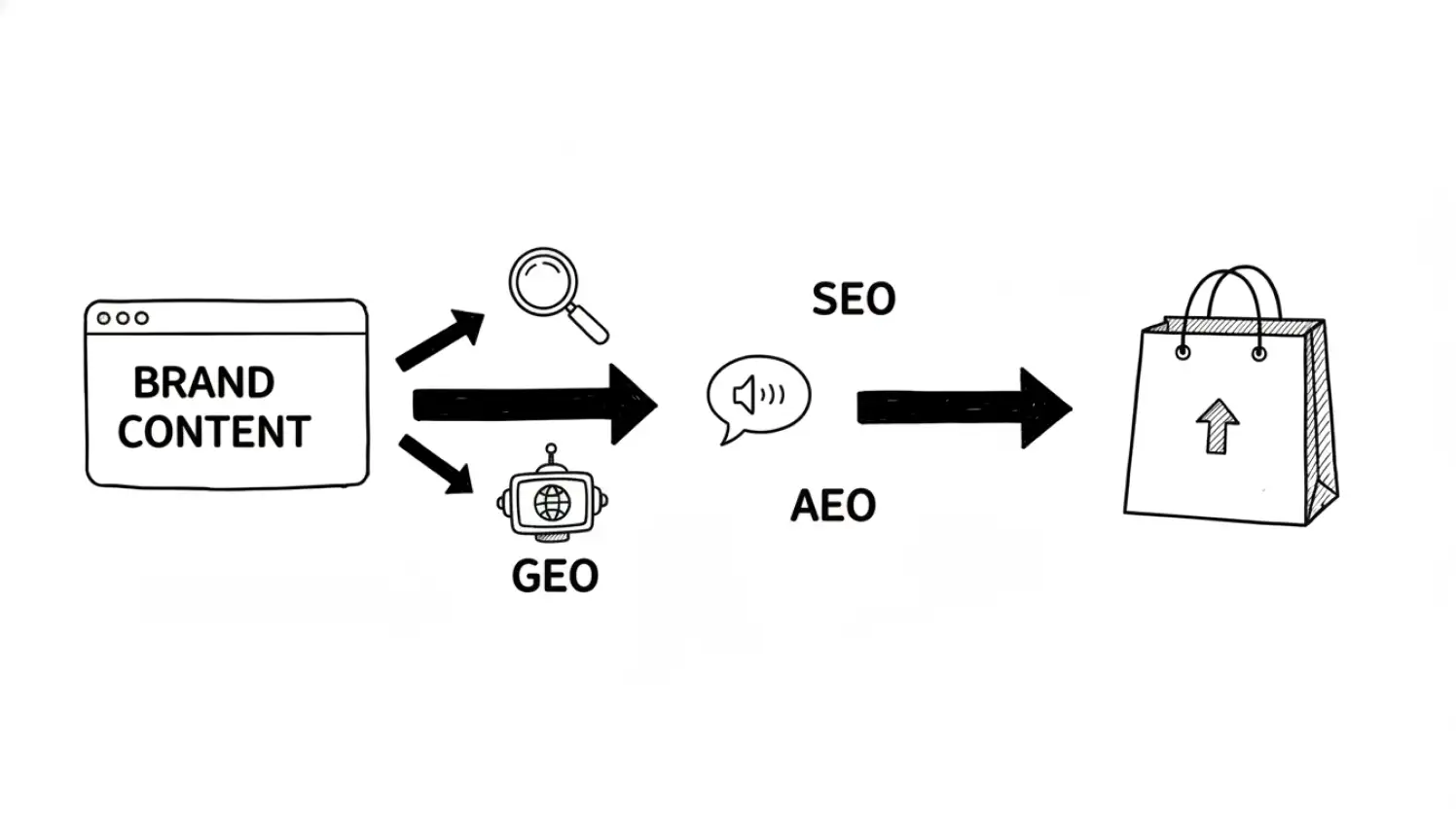
A strong AEO GEO SEO strategy should not treat these three as separate checklists. The best approach is to build content that ranks, answers, and gets cited.
SEO gives D2C brands a discoverable base. It helps search engines crawl, understand, and rank important pages.
AEO makes that content easier to extract into direct answers. It helps brands structure definitions, FAQs, comparisons, and explanations in a way that matches how people ask questions.
GEO adds the next layer. It focuses on whether AI engines can understand the brand well enough to cite it in AI-generated answers. That means the brand needs clear positioning, strong entity signals, useful content, proof-backed claims, and consistency across owned and external sources.
Together, these three create a stronger visibility system.
SEO helps shoppers find the page.
AEO helps them get a direct answer.
GEO helps the brand appear in AI-led product discovery before the shopper even reaches the website.
This is also where generative engine optimization for D2C brands becomes more strategic. It is not only about writing more content. It is about understanding how search engines, answer engines, and AI engines interpret the brand at different stages of discovery.
Why Measurement Changes in GEO
Traditional SEO measurement is built around rankings, impressions, clicks, traffic, and conversions.
GEO measurement is different because a shopper may see a brand inside an AI answer without clicking immediately.
For many ecommerce teams, the concern is no longer only that rankings are moving. The bigger concern is that DTC organic traffic is down or becoming harder to attribute as shoppers discover brands through AI answers, social search, marketplaces, review platforms, and direct recommendations.
That is why GEO measurement needs to look beyond clicks and show whether the brand is appearing inside AI-led discovery moments.
That makes AI visibility harder to measure through classic SEO reports alone.
For D2C brands, GEO measurement needs to look at questions such as:
- Is the brand appearing in AI-generated answers?
- Is the brand being described accurately?
- Are competitors appearing more often?
- Which prompts trigger brand mentions?
- Are AI engines citing the brand or ignoring it?
- Is the brand visible across different AI-led discovery platforms?
This step is important because generative engine optimization for D2C brands cannot be judged only by traffic.
A brand may influence a shopper through an AI answer, a later branded search, a direct visit, or a comparison journey that does not show up neatly in standard SEO dashboards.
Instead of assuming that rankings tell the full story, D2C teams need to understand where their AI visibility is strong, where it is weak, and where the brand is missing from category-level conversations.
Where Big Head Fits in a D2C Brand’s GEO Strategy
For D2C brands, the real challenge is not only understanding GEO. The harder part is knowing how the brand appears inside AI-led product discovery.
That is where Big Head by ShopOS fits into the GEO layer. It gives ecommerce teams a way to move from theory to measurement by checking AI visibility, prompt gaps, and citation performance across AI-led discovery platforms.
A D2C brand may already have SEO traffic, product pages, blogs, and social proof.
But if AI engines do not cite the brand when shoppers ask category-level questions, that brand is invisible in a growing part of product discovery.
Generative engine optimization for D2C brands helps close that gap.
This is where a GEO agent for ecommerce like Big Head by ShopOS can help D2C brands understand whether they are being found, skipped, or cited inside AI-generated answers.
Get your GEO score with Big Head by ShopOS, a GEO AI agent for ecommerce, and see where your brand shows up in AI search.
Ranking Well Doesn’t Mean AI Can See You
Your SEO report may look healthy.
Your brand can still be missing from the answers buyers are getting from ChatGPT, Gemini, and Perplexity.
Big Head shows you the visibility your traditional search report cannot.
Book a Demo to See Big Head in Action
What D2C Brands Should Do Next
The next search shift is not about choosing one model over another. D2C brands need a system where search visibility, answer visibility, and AI citation visibility work together.
For D2C brands, this is the real shift.
Your content should not only ask, “Can this rank?” It should also ask, “Can this answer a buyer question?” and “Can this help AI recommend our brand?”
Generative engine optimization for D2C brands brings those questions together. It helps ecommerce teams think about visibility across search engines, answer engines, and generative engines as one connected system.
Once the difference between SEO, AEO, and GEO is clear, ecommerce teams can move into a more practical GEO workflow for content structure, prompt tracking, AI visibility, and citation improvement.
In 2026, visibility is not only about being found. It is about being selected.
FAQ
What is the difference between SEO VS AEO VS GEO?
SEO helps a website rank on search engines like Google. AEO helps content answer user questions directly through snippets, FAQs, voice search, and answer boxes. GEO helps brands get cited, mentioned, and recommended inside AI-generated answers. For D2C brands, SEO wins rankings, AEO wins answers, and GEO wins AI citations.
Why is generative engine optimization for D2C brands important in 2026?
Generative engine optimization for D2C brands is important because shoppers are now using AI tools to compare products, discover brands, and shortlist what to buy. A brand may have strong Google rankings but still remain absent from ChatGPT, Perplexity, Gemini, or AI Overviews. GEO helps ecommerce brands improve their chances of being included in those AI-led discovery moments.
Is GEO replacing SEO for ecommerce brands?
No, GEO is not replacing SEO. SEO still helps ecommerce websites rank, drive organic traffic, and build discoverability. GEO adds another layer by helping AI engines understand, trust, and cite the brand. The stronger approach is to use SEO, AEO, and GEO together instead of choosing only one.
What is the difference between answer engine optimization vs SEO?
The difference between answer engine optimization vs SEO is that SEO focuses on helping a full web page rank in search results, while AEO focuses on helping a specific answer get selected. SEO is built around rankings, clicks, and organic traffic. AEO is built around direct answers, snippets, FAQs, and answer-led visibility.
How is generative engine optimization vs SEO different?
The difference in generative engine optimization vs SEO comes down to the outcome. SEO focuses on ranking pages in search results. GEO focuses on getting a brand cited inside AI-generated answers. SEO tracks rankings, clicks, and impressions, while GEO looks at AI mentions, prompt visibility, citation tracking, competitor mentions, and brand presence across AI engines.
How is generative engine optimization vs AEO different?
Generative engine optimization vs AEO is different because AEO focuses on answering a question clearly, while GEO focuses on getting a brand included in AI recommendations. AEO works at the answer level. GEO works at the brand visibility level. For example, AEO may help answer “What is collagen?” while GEO may help a collagen brand appear when someone asks, “Which collagen brands should I try?”
How is generative engine optimization vs traditional SEO different?
Generative engine optimization vs traditional SEO is different because traditional SEO is built to win rankings and clicks, while GEO is built to win AI citations and brand mentions. Traditional SEO asks whether a page can rank. GEO asks whether an AI engine can understand, trust, and cite the brand when shoppers ask product-related questions.
How can D2C brands build an AEO GEO SEO strategy?
A strong AEO GEO SEO strategy starts with SEO pages built around buyer intent. Then, those pages should include direct answers, FAQs, schema, comparison blocks, and simple explanations for AEO. For GEO, brands should strengthen entity signals, product proof, third-party mentions, reviews, AI-ready content, and citation tracking so AI engines can understand and recommend the brand.
Where does Big Head by ShopOS fit into GEO?
Big Head by ShopOS fits into GEO by helping ecommerce brands understand how they appear inside AI-led product discovery. It helps D2C brands look beyond rankings and start measuring whether their brand is being cited, skipped, or compared inside AI-generated answers.