

 ChatGPT
 Perplexity
 Claude
 Gemini
 Grok
Grok
Generative Engine Optimization for Ecommerce. Your ecommerce brand may rank on Google and still be invisible inside AI search.
That sounds uncomfortable, but it is already happening. A shopper may skip the usual search results and ask ChatGPT, Perplexity, or Google AI Overviews for a direct recommendation. Instead of opening ten tabs, they may ask one question and trust the answer they get.
For example:
- Which skincare brand is good for oily skin in humid weather?
- What are the best protein powders for beginners?
- Which D2C fashion brands make premium basics?
- Which Shopify stores sell sustainable home decor?
If your brand does not show up in those answers, you may lose the buyer before they ever reach your website.
That is why generative engine optimization for ecommerce matters now. Traditional SEO helps your pages rank in search results. GEO helps your brand become part of AI-generated answers. It makes your product pages, category pages, FAQs, reviews, blogs, and brand content easier for AI systems to retrieve, summarize, trust, and cite.
For growing ecommerce teams, generative engine optimization for ecommerce is becoming the bridge between classic SEO and AI-led product discovery. It helps brands prepare for the way shoppers now ask detailed, conversational questions before buying.
This guide is built for ecommerce and D2C brands that want to improve AI search visibility. It explains how GEO works, how to optimize content for generative AI search engines, what mistakes to avoid, how to measure performance when clicks are limited, and how Big Head by ShopOS helps brands build a repeatable GEO system.
Generative engine optimization for ecommerce is the process of improving ecommerce content so AI search engines can understand, cite, and recommend a brand in AI-generated answers. It helps D2C and Shopify brands show up when shoppers ask product, category, comparison, or buying-intent questions across platforms like ChatGPT, Perplexity, and Google AI Overviews.
GEO Rewrites the Rules of Search for Ecommerce Brands
For years, search was mostly about ranking and clicks. You optimized a page, earned a position on Google, and hoped the shopper clicked through.
AI search changes that journey.
Now, the answer may appear before the click. A shopper may ask an AI engine for the “best clean beauty brands for sensitive skin” and receive a short summary with brand names, product suggestions, and supporting sources. That answer can shape what they search next, what they compare, and which brand they trust.
This is why GEO for ecommerce brands is different from traditional SEO. The goal is no longer only to appear in search results. The goal is to become one of the trusted sources AI engines use when generating answers.
For ecommerce brands, this changes the role of almost every content asset.
A product page is no longer just a conversion page. It is also a source of product facts.
A category page is no longer just a product grid. It becomes a buying guide that shows what your brand should be known for.
A FAQ section is no longer filler content. It can directly answer the same questions shoppers ask inside AI tools.
A review is no longer only social proof. It can become a trust signal that supports how AI systems interpret real customer experience.
Let’s say you run a D2C skincare brand. Your old SEO goal may have been to rank for “vitamin C serum.” Your GEO goal is wider. You want AI engines to connect your serum with beginner routines, dull skin, lightweight texture, morning use, and review-backed proof.
That is a very different content brief.
Generative engine optimization ecommerce strategy is about building enough clarity, proof, and context across your digital presence so AI engines know when your brand deserves to be mentioned.
In practical terms, generative engine optimization for ecommerce pushes brands to explain products the way buyers actually think. It is not only about rankings. It is about giving AI engines enough trustworthy context to recommend your brand in the right moment.
How Generative Engines Work: What Ecommerce Marketers Must Understand
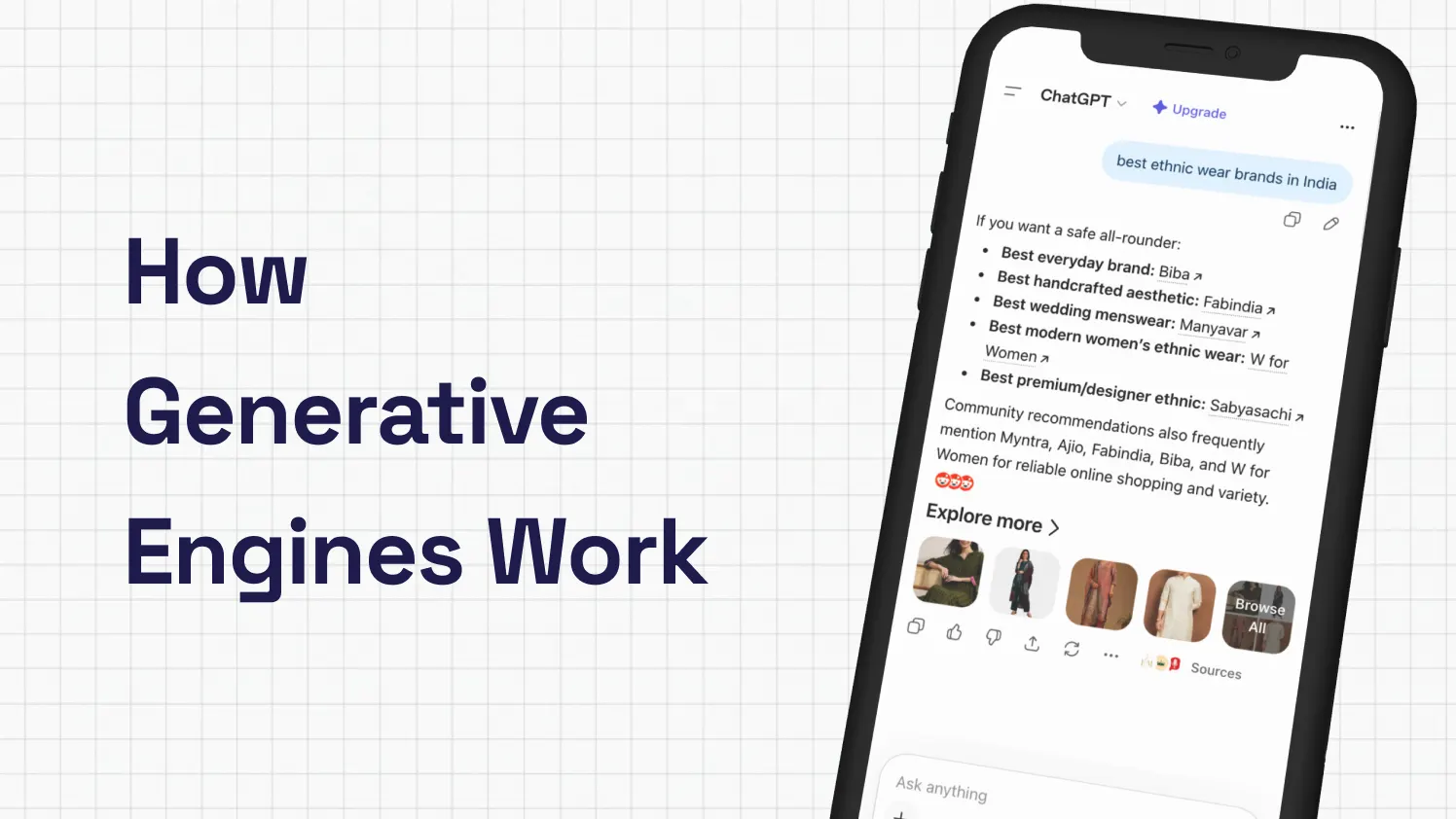
Generative AI engines do not simply match one keyword to one page. They interpret the question, retrieve relevant information, compare sources, summarize useful details, and then generate an answer.
For ecommerce marketers, the important point is this:
AI engines read your broader digital footprint, not just your homepage.
That footprint can include your product pages, category pages, FAQs, product schema, reviews, marketplace listings, creator content, PR mentions, YouTube videos, Reddit discussions, social media content, and third-party articles.
When a shopper asks, “What is the best moisturizer for oily skin?” an AI engine may look for signals across many places. It may check if your product page explains skin type. It may look for reviews that mention oily skin. It may compare ingredient information, product use cases, expert mentions, and brand reliability.
If your content is thin, scattered, or vague, the AI engine may choose a competitor with clearer information.
This is where many ecommerce brands struggle. Their websites are designed to look good, but they are not always designed to be machine-readable or answer-ready.
For example, a Shopify apparel brand may have beautiful product photography, but the product page may only say:
“Premium oversized tee made for everyday comfort.”
That sounds nice, but it does not give AI engines much to work with.
A stronger product page would explain fabric weight, fit type, styling use cases, wash care, shrinkage details, seasonality, customer review themes, size guidance, and how the tee compares with regular-fit options.
That extra context helps shoppers make better decisions. It also gives AI engines more reasons to connect the product with a relevant answer.
Generative engine optimization for Shopify works the same way. Shopify stores need product descriptions, collection pages, FAQs, reviews, schema, and internal links that clearly explain what the brand sells, who it serves, and why its products are worth recommending.
This is also why generative engine optimization for ecommerce cannot sit only with the blog team. It needs input from product, merchandising, customer support, SEO, social, and brand teams because AI engines read the full story around the store.
In simple words, AI search rewards brands that make their expertise easy to understand.
How to Optimize Content for Generative AI Search Engines
AI search optimization for ecommerce brands starts with a simple shift: stop thinking only in keywords and start thinking in shopper prompts.
A keyword may be “vegan protein powder.”
A real AI search prompt sounds more like this: “What is the best vegan protein powder for beginners who want smooth texture and no bloating?”
That prompt tells you much more. The shopper cares about taste, digestion, texture, and beginner suitability. A basic keyword-led page may miss those details, but a GEO-ready page should answer them clearly.
This is where generative engine optimization for ecommerce becomes practical. Your content needs to show what your product is, who it is for, what problem it solves, and why it deserves to be mentioned in an answer.
Map real shopper questions before writing content
The best GEO content starts with real customer intent. Before creating new pages, look at the questions shoppers already ask before buying.
You can find these questions in:
- Customer support chats
- Product reviews
- Website search data
- Social media comments
- Marketplace Q&A sections
- Return reasons
- Competitor reviews
- Reddit and community discussions
For example, a skincare brand may find questions like:
- Can I use this serum every day?
- Is this moisturizer good for acne-prone skin?
- Can I use this product with retinol?
A fashion brand may find questions like:
- Does this run oversized?
- Is the fabric suitable for summer?
- Will this shrink after washing?
These questions should become FAQs, product page sections, category page content, buying guides, and comparison articles. This is one of the most important generative engine optimization best practices because AI engines need direct, specific answers to match user prompts.
Add direct answer blocks
AI engines prefer clear, extractable information. Every important ecommerce page should include short answer blocks before deeper explanations.
For example:
Question: Is this sunscreen good for oily skin?
Direct Answer: This sunscreen is suitable for oily skin because it has a lightweight, non-greasy texture and is designed for daily use in humid weather.
After that, you can explain the ingredients, texture, usage routine, customer reviews, and application tips.
This format helps both shoppers and AI engines. Shoppers get quick clarity. AI engines get a cleaner answer to interpret and cite.
Make product pages easier for AI engines to understand
Product pages are often the biggest missed opportunity in generative engine optimization ecommerce work. Many ecommerce brands invest heavily in visuals but keep the actual product explanation too thin.
A GEO-friendly product page should clearly explain:
- Who the product is for
- What problem it solves
- How and when to use it
- What makes it different
- Key ingredients, materials, or features
- Size, fit, taste, texture, or usage guidance
- Customer review highlights
- FAQs
- Shipping, returns, and trust signals
- Structured data
This makes the page more useful for shoppers and gives AI engines stronger context to connect your product with relevant prompts. It also makes generative engine optimization for ecommerce more useful for actual buyers because the same details that help AI engines also help shoppers make faster decisions.
Strengthen category pages with buying guidance
Category pages should do more than display products. They should help shoppers choose.
A clean skincare category page can explain skin types, ingredient choices, routine steps, and how to pick the right product. A premium basics category page can explain fabric quality, fit, styling use cases, durability, and care instructions.
This matters because AI search often works at the category level. Shoppers may ask for the best brands or products in a category before they search for a specific product name.
Strong category content improves GEO for ecommerce brands because it helps AI engines understand where your brand fits in the broader buying conversation.
Use structured data and clear page formatting
Structured data helps search engines and AI systems understand your content more clearly. Ecommerce brands should use schema where relevant, especially Product, Review, FAQ, Organization, Article, and Breadcrumb schema.
Good formatting also matters. Use clear H2s and H3s, short paragraphs, bullets, FAQs, comparison tables, and internal links. This supports SEO, AEO, and GEO because the content becomes easier to scan, extract, and understand.
This is also where GEO vs SEO vs AEO becomes easier to understand: SEO supports rankings, AEO supports direct answers, and GEO supports visibility inside AI-generated recommendations.
Build proof beyond your website
AI engines may look beyond your own pages when evaluating your brand. Reviews, creator mentions, PR coverage, comparison articles, marketplace listings, YouTube reviews, and community discussions can all support AI search visibility for ecommerce brands.
So your GEO work should not live only on your website.
Strong generative engine optimization strategies connect owned content, social proof, third-party mentions, and technical structure into one consistent visibility system.
If you want to get cited by ChatGPT, your brand needs two things: clear owned content and credible external proof.
Step-by-Step GEO Playbook for Ecommerce and D2C Brands
A strong GEO workflow needs structure. Here is a practical playbook ecommerce and D2C brands can follow. These steps combine generative engine optimization strategies with practical content actions your team can repeat across products, categories, and campaigns.
Step 1: Map shopper prompts
Start by listing the questions your ideal customers may ask AI engines.
Break them into stages:
| Buyer Stage | Example Prompt | Content Needed |
| Awareness | What is the best skincare routine for oily skin? | Educational guide |
| Consideration | Which clean beauty brands are good for sensitive skin? | Category guide |
| Comparison | Vitamin C serum vs niacinamide serum: which is better? | Comparison page |
| Purchase | Is this serum safe for daily use? | Product FAQ |
| Retention | How should I use this product in my routine? | Post-purchase guide |
This helps you move beyond keyword lists and think like a real shopper.
Step 2: Check current AI visibility
Search your target prompts across AI platforms and record what appears.
Track:
- Is your brand mentioned?
- Are competitors mentioned?
- Which sources are cited?
- Is your brand described correctly?
- Are important benefits missing?
- Which prompts show no brand visibility?
This gives you a baseline for AI search visibility for ecommerce brands. It also helps you understand where generative engine optimization for ecommerce can create the fastest improvement, especially when high-intent prompts already exist but your brand is absent.
Step 3: Audit your content
Review the pages that shape product discovery: product pages, category pages, comparison content, FAQs, and educational guides.
Ask:
- Does this page answer real buying questions?
- Is the content specific or generic?
- Are claims supported by proof?
- Does the page include FAQs?
- Is product information clear?
- Is the page internally linked?
- Is structured data added where needed?
This audit helps ecommerce teams identify key GEO ranking factors, such as clear product information, structured data, helpful FAQs, internal links, review proof, third-party mentions, and answer-ready content.
It also shows where your content is strong and where AI engines may struggle.
Step 4: Build missing answer assets
Once you find gaps, create content that answers those gaps directly.
Useful assets include:
- Buying guides
- Product comparison pages
- Category explainers
- Use case pages
- Ingredient or material explainers
- FAQ sections
- Customer review summaries
- Founder or expert explainers
For example, if AI engines mention competitors for “best organic snacks for kids,” your food brand may need a stronger category guide, parent-focused use cases, nutritional details, FAQs, and review-backed proof.
Step 5: Strengthen trust signals
AI engines need confidence. Trust signals help.
When DTC organic traffic is down, brands often look only at rankings and traffic reports. But in AI search, visibility also depends on whether your brand has enough proof across the web to be trusted, cited, and recommended.
Add proof such as customer reviews, ratings, certifications, awards, expert quotes, creator reviews, press mentions, ingredient transparency, and clear shipping or return information.
For D2C brands, trust is often the difference between being mentioned and being ignored.
This works naturally because it connects the keyword to the real problem: organic search decline and AI search visibility.
Step 6: Track citations and competitor mentions
GEO is not complete after publishing. You need to track whether AI engines start mentioning your brand.
Monitor brand mentions, competitor mentions, citations, prompt coverage, answer accuracy, sentiment, cited pages, and missed opportunities.
This is where generative engine optimization tools become useful. Manual checks can work at the beginning, but growing brands need a repeatable system.
The best geo tools help teams track prompts, citations, competitor visibility, and answer accuracy without relying on scattered screenshots or one-time manual searches.
Step 7: Update and repeat
AI search changes over time. Competitors publish new content. Models update. Customer questions shift.
Review GEO performance regularly and update your content based on what you find.
That is why generative engine optimization for ecommerce should be treated as an ongoing content and visibility program, not a one-time technical checklist.
How to Measure GEO Performance When AI Search Does Not Show Clicks
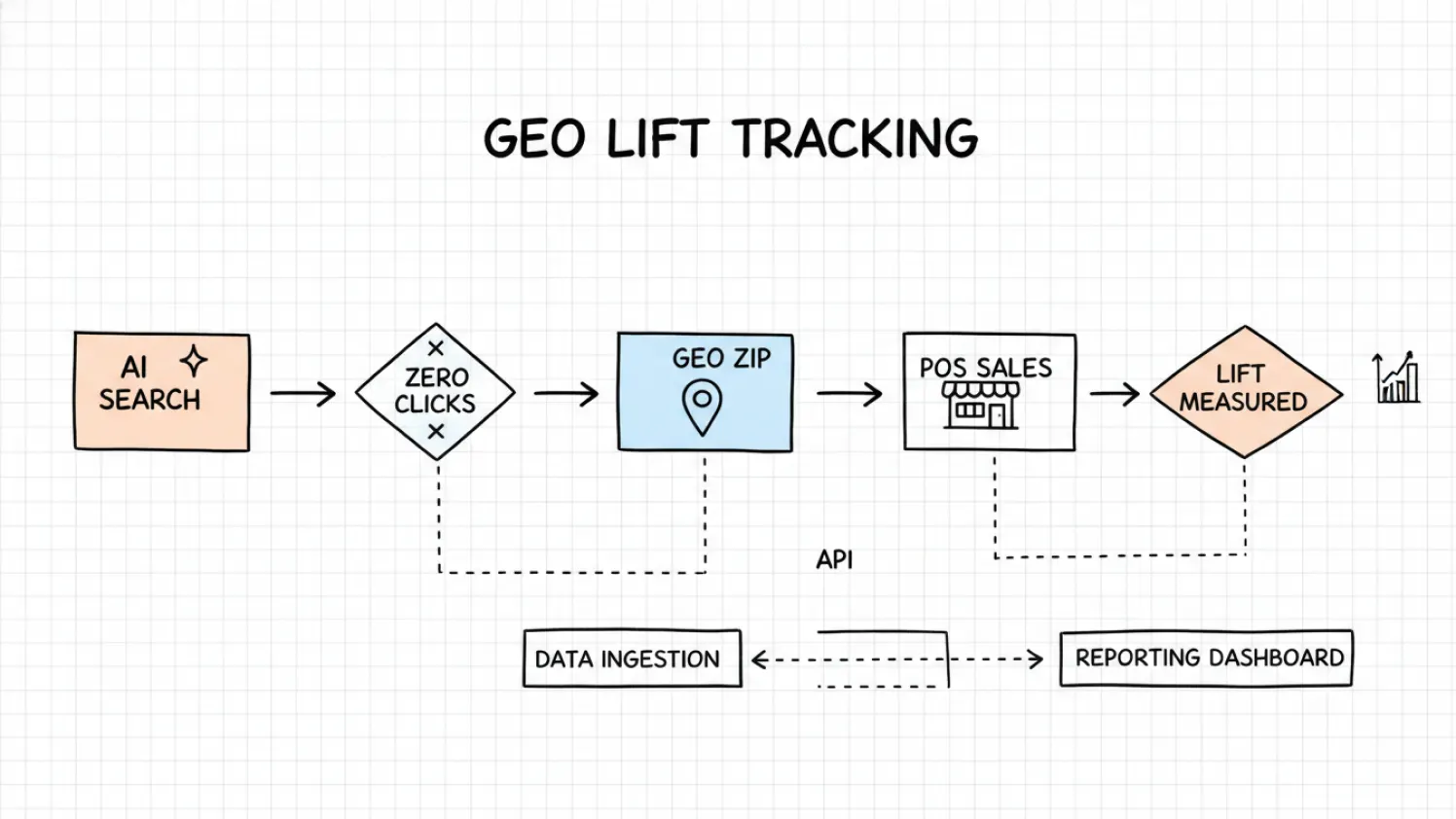
Measuring GEO is tricky because AI search does not always behave like traditional search.
In SEO, you can track rankings, impressions, clicks, traffic, and conversions. In AI search, the buyer may see your brand inside an answer but not click immediately. They may search your brand later, visit directly, or compare you elsewhere.
So GEO measurement needs a broader view. The goal is simple: understand whether your brand is becoming more visible, more accurate, and more trusted inside AI-generated answers.
This is how AI is changing brand discovery: shoppers may see, compare, and remember a brand inside an AI answer before they ever visit the website.
Track where your brand appears in AI answers
Start with a fixed list of prompts your shoppers may ask.
For example:
- Best D2C skincare brands for sensitive skin
- Best protein powder for beginners
- Best Shopify brands for sustainable fashion
- Best organic snacks for children
- Best running shoes for everyday walking
Check whether your brand appears in these answers across ChatGPT, Perplexity, Google AI Overviews, and other AI-led discovery platforms.
Track which competitors appear instead
GEO is competitive. If AI engines mention your competitors and skip your brand, that tells you something useful.
Look at which competitors appear most often, which prompts they appear for, what pages support their mention, how the AI engine describes them, and what type of content they seem to own.
This gives ecommerce teams a clear content improvement path. Maybe your competitor has stronger category pages. Maybe they have better FAQs. Maybe they have more third-party mentions. The point is to learn what AI engines are trusting.
Track citations and source quality
A brand mention is useful. A citation is stronger.
Check whether AI engines cite your product pages, category pages, blogs, FAQs, reviews, or third-party mentions. If your own pages are being cited, that means your content is becoming more useful for AI answers.
This is where generative engine optimization tools become helpful. They can track AI mentions, citations, competitor visibility, and prompt gaps more consistently than manual searches.
Track accuracy of brand mentions
Visibility alone is not enough. Your brand also needs to be described correctly.
Ask:
- Is the AI engine mentioning the right products?
- Is it explaining your category correctly?
- Is it capturing your main differentiator?
- Is it missing key benefits?
- Is it using outdated or weak information?
If the answer is unclear, your content may need stronger product positioning, better FAQs, or clearer category pages.
Track supporting business signals
AI search may influence shoppers before they click. So ecommerce brands should also watch signals like branded search growth, direct traffic, product page engagement, returning visitors, add-to-cart movement, assisted conversions, and customer survey responses.
For ecommerce brands, GEO measurement should answer one question: are AI engines understanding and recommending the brand more clearly over time?
That is why tools like Big Head by ShopOS matter. They help brands move from guessing to tracking, so teams can see where they appear, where competitors appear, and what content needs to improve next.
Common GEO Mistakes Ecommerce Brands Should Avoid
GEO is still new, so many brands approach it with old SEO habits. Here are the mistakes to avoid.
Mistake 1: Treating GEO like keyword stuffing
Repeating keywords will not make AI engines trust your brand. Your content needs meaning, structure, and proof.
Use the primary keyword naturally, but focus on answering real questions. Generative engine optimization for ecommerce works best when the keyword supports helpful content instead of interrupting the reading experience.
Mistake 2: Ignoring product pages
Many brands optimize blogs but leave product pages thin. That is a big miss.
Product pages are often the most important source of product facts. They should clearly explain use cases, benefits, materials, ingredients, sizing, reviews, and FAQs.
Mistake 3: Leaving category pages empty
A category page with only products is not enough for GEO.
Add buying guidance, category education, product comparison support, FAQs, and internal links. Category pages can help AI engines understand what your brand should be known for.
Mistake 4: Writing generic FAQs
Weak FAQs sound like this:
“Why choose our brand?”
Strong FAQs sound like this:
“Is this moisturizer suitable for oily skin?”
“Can I use this protein powder daily?”
“Does this fabric shrink after washing?”
Specific questions are far more useful for shoppers and AI engines.
Mistake 5: Tracking only clicks
If you only track website clicks, you may miss early AI influence. Track mentions, citations, prompt visibility, competitor appearances, and answer accuracy.
Mistake 6: Ignoring third-party proof
Your website matters, but AI engines may also look at reviews, creator content, PR mentions, and external discussions. A strong GEO strategy needs both owned content and external validation.
This is one of the most overlooked generative engine optimization best practices for ecommerce brands, because AI visibility often depends on how consistently the brand is understood across multiple sources.
Does Social Media Affect AI Citations?
Yes, but not always directly.
Social media may not work like traditional SEO links, but it can help build the larger brand context that AI engines may use to understand your products.
For ecommerce and D2C brands, social content often shows products in real-life use. A creator video, customer comment, founder post, product demo, or YouTube review can explain things your product page may not cover fully.
For example, a D2C fashion brand may say its trousers are “office-friendly.” But if customers and creators repeatedly show how they style those trousers for work, travel, and weekend wear, that adds useful context around the product.
Social content can support GEO when it is aligned with generative engine optimization strategies and built around real buyer education. It works best when it is product-specific, educational, consistent with website claims, based on real customer questions, supported by reviews or creator proof, and connected to category conversations.
So, does social media help brands get cited by ChatGPT?
It can support the journey, especially when social content creates searchable product conversations, reinforces brand positioning, and matches the claims on your website.
But social media alone is not enough. It should work with product pages, category pages, blogs, FAQs, reviews, and third-party mentions.
What GEO Can and Cannot Do for Brands
GEO can help ecommerce brands improve how AI engines understand and mention them. It can strengthen visibility, improve content quality, and help brands compete for AI-led product discovery.
It can help brands improve AI search visibility, build stronger product and category content, increase brand mentions in AI answers, improve citation potential, track competitor visibility, find prompt gaps, strengthen answer accuracy, and support SEO strategy.
But GEO is not magic.
It cannot guarantee instant citations. It cannot replace good products. It cannot fix weak customer trust. It cannot make AI engines recommend a brand without clear product value, proof, and consistency.
AI search is changing continuously. New competitors appear. Customer prompts evolve. AI answers shift. Content becomes outdated.
That is why GEO for D2C brands should be treated as an ongoing visibility system, not a one-time content update.
How Big Head by ShopOS Helps Brands Improve AI Search Visibility

The playbook above shows what ecommerce teams need to do. Big Head by ShopOS helps turn that process into a repeatable system.
Most brands know how they perform on Google. But they do not always know how they appear inside ChatGPT, Perplexity, Google AI Overviews, or other AI-led discovery platforms.
That creates a new blind spot.
Big Head closes that gap by acting as a GEO Agent for ecommerce teams. It helps brands understand where they appear, where competitors appear, which prompts matter, and what content needs to be improved.
Instead of guessing, ecommerce teams can build a clearer workflow for AI search visibility.
Audit AI visibility across key prompts
The first step is understanding where the brand stands today. Ecommerce teams need to know if their brand is being mentioned, ignored, or misrepresented across important AI search prompts.
For example, a skincare brand may want visibility for prompts around oily skin, sensitive skin, daily sunscreen, or beginner routines. A supplement brand may want visibility for prompts around protein, gut health, recovery, or daily nutrition.
Find prompt gaps worth creating content for
Many ecommerce brands miss the exact questions shoppers are typing into AI engines. These are often more specific than traditional keywords.
A keyword may be “running shoes.” An AI prompt may be “What are the best running shoes for long workdays and flat feet?”
Big Head helps uncover these prompt gaps so teams can create content around real AI search behavior, not assumptions.
Compare competitor visibility in AI answers
If competitors are showing up more often in AI answers, brands need to know why. Are competitors being cited because they have stronger category pages? Better FAQs? More third-party mentions? Clearer product positioning?
This competitor view helps ecommerce teams understand where they are losing visibility and what kind of content needs to be improved.
Improve content that AI engines can cite
Once the gaps are clear, ecommerce teams can improve product pages, category pages, FAQs, comparison content, and educational guides. The goal is to make content more useful, more specific, and easier for AI engines to cite.
This matters for brands trying to get cited by ChatGPT because AI engines need clear, trustworthy, and well-structured information before they can confidently mention a brand in an answer.
Monitor GEO progress over time
GEO is ongoing. AI answers change, competitors publish new content, and customer prompts evolve. Brands need to monitor performance regularly instead of treating GEO as a one-time optimization task.
Big Head helps ecommerce teams keep track of visibility shifts, prompt coverage, citation progress, and competitor movement over time. For teams comparing generative engine optimization tools, this ongoing visibility layer is what turns GEO from guesswork into a measurable workflow.
For brands trying to improve AI search visibility for ecommerce brands and build a repeatable GEO workflow, Big Head by ShopOS becomes the control center. It supports generative engine optimization for ecommerce by helping teams see what AI engines mention, what they miss, and which content actions can improve visibility.
The playbook is simple:
Audit visibility. Find gaps. Improve content. Track citations. Repeat.
That is how ecommerce brands move from hoping AI engines mention them to actively building toward AI search visibility.
Find out where your ecommerce brand appears in AI search. Run a free Big Head audit today.
Your GEO Playbook Isn’t Finished Until You Can Measure It
You can improve product pages, add FAQs, build comparison content, and strengthen trust signals.
But the real question is: did your AI visibility actually move?
Big Head shows you what changed, where you are still missing, and which prompts deserve your attention next.
Book a Demo to See Big Head in Action
Final Takeaway
AI search is becoming a new product discovery layer.
Shoppers are asking AI engines what to buy, which brands to compare, what ingredients to trust, which products fit their needs, and which options are worth considering.
For ecommerce and D2C brands, this is a big shift.
Generative engine optimization for ecommerce helps brands prepare for that shift by making content clearer, more structured, more useful, and more trustworthy for AI engines. When done well, generative engine optimization for ecommerce gives shoppers better answers and gives AI engines stronger reasons to cite the brand.
The brands that win will not only write more content. They will build content systems that answer real shopper questions, prove product value, track AI visibility, and keep improving over time.
Big Head by ShopOS helps ecommerce brands do exactly that. It gives teams a way to audit AI visibility, find prompt gaps, monitor competitors, improve citable content, and track progress across AI search engines.
If the next search battle happens inside the answer, ecommerce brands need to make sure they are part of that answer.
Frequently Asked Questions
What is generative engine optimization for ecommerce?
Generative engine optimization for ecommerce is the process of improving ecommerce content so AI search engines can understand, cite, and recommend a brand in AI-generated answers. It includes product pages, category pages, blogs, FAQs, reviews, comparison pages, and structured data.
Why is GEO important for ecommerce brands?
GEO is important because shoppers are starting to use AI search engines for product discovery and recommendations. If an ecommerce brand appears in AI answers, it can earn visibility earlier in the buying journey.
How can ecommerce brands get cited by ChatGPT?
Ecommerce brands can improve their chance to get cited by ChatGPT by creating clear product pages, strong category content, useful FAQs, comparison guides, review-backed proof, and consistent brand information across trusted sources.
What are the best generative engine optimization strategies for ecommerce?
The best generative engine optimization strategies include mapping shopper prompts, improving product pages, strengthening category pages, adding direct answer blocks, building comparison content, using structured data, and tracking AI citations over time. For ecommerce brands, these generative engine optimization strategies work best when they are connected to real product questions and category-level buying intent.
What are generative engine optimization best practices?
Generative engine optimization best practices include writing clear answers, using specific product language, adding FAQs, supporting claims with proof, improving internal links, using structured data, and keeping brand messaging consistent across channels. The strongest generative engine optimization best practices also include updating old SEO pages so they answer AI-style prompts more clearly.
What are generative engine optimization tools?
Generative engine optimization tools help brands track AI mentions, citations, prompt visibility, competitor presence, and content gaps across AI search platforms. Big Head by ShopOS is one such GEO Agent built for ecommerce and D2C brands. The right geo tools make it easier to measure progress and decide which content should be improved next.
Is generative engine optimization for Shopify different?
Generative engine optimization for Shopify follows the same GEO principles but applies them to Shopify product pages, collection pages, blogs, FAQs, reviews, and schema. Shopify brands should focus on making product and category information clear, detailed, and easy for AI engines to understand.
Does social media help GEO for D2C brands?
Social media can support GEO for D2C brands by reinforcing product education, creator proof, customer conversations, and brand consistency. It works best when social content aligns with website content, reviews, FAQs, and category messaging.