
AI for Ecommerce·Sep 12, 2026
TL;DR: Brands hire a Shopify marketing agency for two reasons: ...

TL;DR: Brands hire a Shopify marketing agency for two reasons: ad creative runs dry, and the catalog drifts out of date. ShopOS handles both with AI agents you approve before anything ships. Free tier included, paid plans from $19 a month, and a sales call only if your catalog is large enough to need one.
Two problems bring brands to a Shopify marketing agency, and they arrive in the same month. Ad creative runs dry faster than the team can replace it, and the product catalog drifts out of date across the store and the ad feeds. Almost everything else on an agency proposal is downstream of those two.
Picture the Tuesday it usually starts. The media buyer says performance is sliding and asks for fresh creative. The founder checks the folder and finds four assets, two of which have been running since March.
Neither problem is a strategy gap, whatever a Shopify marketing agency proposal implies. Both are throughput gaps, which is what most Shopify marketing agency proposals quietly assume away.
That distinction decides whether a retainer helps. A retainer buys a fixed number of hours. If the shortage is output, paying more per hour does not produce more output.
Most creative fails and nobody can pick the winners in advance, which is the single fact that should shape how a Shopify marketing agency gets briefed. A 2026 benchmark of 368 creatives across 15 brands and 48.4 million impressions found that 80% never reach 100,000 impressions, while the top 10% absorb 68% of total spend (Interconnections).
The median creative in that study ran 18 days and delivered 10,665 impressions before it stopped mattering. Cost per acquisition rose 19.6% by the 500,000 impression mark.
So winners are rare, and the ones you find decay while you watch them. A brand testing four concepts a month is buying four tickets in a raffle where roughly one in ten pays out.
ShopOS treats that as a production problem rather than a talent one. Monica, the Creative Director agent, generates product images, video, and edits from 1K to 4K, with the credit cost shown on the button before anything commits. The Derby Jeans engagement is the clearest published example: 2,000+ images and 30 videos, enough to retire a monthly shoot calendar.
The honest limit is judgment. Generation produces options, and someone still decides which ones are any good. That editing step is where most AI creative falls over, and it is why nothing publishes without your approval.

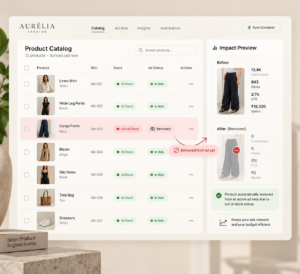
The catalog decays quietly, and it costs money in a place with no dashboard flags, which is half of what a Shopify marketing agency is rarely measured on. Out-of-stock SKUs stay live in ad feeds. Descriptions go stale after a product changes. Variant data drifts until a customer complains or conversion sags.
A Shopify marketing agency rarely fails here through incompetence. It is that nobody owns remembering to check.
A brand we would recognize finds this the expensive way: a discontinued SKU keeps collecting clicks for three weeks because it was never pulled from the Meta feed. Nothing broke. Nobody was told.
Gavin, the Performance Marketing agent, covers that ground directly: products, SKU configuration, ad templates, and the catalog feed. SKU configuration includes out-of-stock enforcement, three stock status modes, a fallback percentage, and an impact preview showing what a change does before it happens.
Five routines run on a schedule rather than when someone remembers: ROAS Performance Digest, Fatigue Detection, Daily Audit, Catalog Health, and SKU Quadrant. The point is not that any single routine is clever. It is that the checking is done by something that never forgets.
For most brands now the answer is yes, because a growing share of product discovery finishes inside an answer rather than on a results page. A randomized field experiment with 1,065 US Chrome users, run by researchers at the Indian School of Business and Carnegie Mellon, found AI Overviews cut organic clicks on triggered queries by 38% and pushed zero-click searches from 54% to 72% (Search Engine Journal).
What is AI visibility? AI visibility is whether an answer engine names your brand when someone asks it for a recommendation in your category. It is tracked prompt by prompt, and no ad account reports it.
Big Head, the GEO and SEO agent, tracks citation status across ChatGPT, Perplexity, Gemini, and Claude, prompt by prompt, with cited or not cited status and a tier. Two published results show the range available: one brand moved from 0 to 17 of 18 buyer prompts in 90 days, another won 19 of 20 and reclaimed all 12 competitor prompts in three months (case studies).
Both of those brands sell apparel. Saying so matters, because the mechanism is category-neutral and the published proof is not yet.
ShopOS holds a brand’s visual rules in one place, then generates against them. Brand memory stores palette, tone, model direction, product details, and the things a brand will never show. Spaces turn a product into scene-specific shots without booking a studio. Loops repeat what worked across a catalog.
Practically, a supplement brand working with the ShopOS Shopify marketing agency sends product shots for three new SKUs on Monday. By Wednesday there are lifestyle sets, PDP images, and ad variations sized for each placement, all matching the brand rules already loaded into the system.
Brand safety is where founders push back, and they are right to. In beauty and supplements, an image that misrepresents what ships is a returns problem and a trust problem at once. Everything ShopOS generates goes through client approval before it runs, and brand memory exists specifically so a generated model shot does not drift from the real product.
Here is the trade-off stated plainly: ShopOS is a poor fit for a brand whose creatives depends on a signature photographer’s eye. Some brands sell that look, and software will not replicate it. Those brands should keep their photographer and use ShopOS for volume formats around the hero work.
The whole loop, or the coordination cost eats the gains. A Shopify marketing agency that owns only creative hands the integration problem straight back. ShopOS runs creative production, paid media, retention, store operations, and AI visibility as one function, because splitting them across a creative shop, a media buyer, and a Shopify developer puts the integration work back on a founder who does not have time for it.
Store operations belong in that list for a reason people underrate. Creative that sends traffic to a slow PDP with weak copy wastes the spend that produced it.
Discovery has also moved, and it is not a future problem. AI-referral traffic to US retail sites grew 62% year over year in July 2026, converts at a rate 60% higher than non-AI traffic, and generates 53% more revenue per visit, from Adobe Analytics data covering more than a trillion visits (Digital Commerce 360).
What is AI visibility? AI visibility is how often an answer engine names a brand when a shopper asks for a recommendation in its category. It gets measured per prompt rather than per keyword. It does not appear in any ad account.
For supplements and beauty, this is already the buying path. A 5W AI Communications study published in August 2026 tested more than 80 beauty prompts across ChatGPT, Claude, Perplexity, Gemini, and Google AI Overviews, and found 47% of consumers say they prefer AI-recommended products over traditional advice (BeautyMatter). Four ingredient-transparent brands took roughly 22% of all skincare citations in that test. ShopOS measures this monthly for every brand it runs, and the generative engine optimization work for ecommerce explains the method.
Less than a Shopify marketing agency retainer, and the numbers are published rather than quoted after a discovery call. ShopOS starts free with 500 credits, then runs $19 a month on Pro, $99 on Growth, and $199 on Business, where Business adds Human Refinement and 100 tracked GEO prompts. Credits work across all four agents.
For scale, one in-house ecommerce marketing manager averages $114,481 a year in the US (Salary.com). That hire cannot shoot, edit, buy media, and maintain a catalog at once, which is how most brands end up with both a salary and a retainer.
A Shopify marketing agency retainer still wins in two cases. A brand that needs direction more than output, and a brand whose creative depends on one photographer’s eye. Software will not replicate a look that is the product.
| Metric / Feature | In-house team | Freelancers | ShopOS |
|---|---|---|---|
| Time to first output | 2 to 4 months | 2 to 3 weeks | Days |
| Creative volume | Capped by headcount | Capped by budget | Capped by approval time |
| Cost per additional asset | High | High | Near zero |
| Who coordinates | You | You | ShopOS |
| Store operations | Separate hire | Separate freelancer | Included |
| AI visibility | Rarely covered | Rarely covered | Measured monthly |
ShopOS suits brands where catalog size and release cadence make production volume the constraint, rather than brands in any particular category. It runs on Shopify, WooCommerce, BigCommerce, or any platform with an API, alongside Meta and Google. Amazon Seller Central is listed as coming, so treat it as unavailable when planning.
In practice, that means two people keep finding it useful. Performance marketers whose testing is capped by creative supply, and ecommerce managers whose product content is permanently a week behind.
It does not suit teams wanting an inventory or ERP system, a standalone PIM, or a general image generator with no commerce context. It will not replace a strategist either. Agents own execution, and direction stays with you.
Start on the free tier if you would rather see output than read about it. Book a call if catalog scale means SKU configuration and feed management are the actual problem.
ShopOS sells execution capacity through AI agents rather than billing for human agency hours. While a traditional agency caps output based on headcount, ShopOS delivers additional creative assets at near-zero incremental labor cost. In exchange, ShopOS relies on client approvals for quality control, making an agency retainer safer only if your team lacks review time.
ShopOS uses Brand Memory to prevent creative drift by scanning your store URL to automatically enforce your visual rules, tone, and brand guidelines. Every AI generation tests against this stored brand profile, and no asset publishes without explicit client approval. First passes on unique visual identities may require minor initial adjustments during the approval step.
ShopOS covers products, SKU configuration, ad templates, and ad feed management. Core functionality includes automated out-of-stock enforcement to prevent wasted ad spend, three stock status modes, fallback percentages, and impact previews before changes apply. Scheduled routines—such as Catalog Health and SKU Quadrant—automatically audit and report catalog drift.
ShopOS integrates with Shopify, WooCommerce, BigCommerce, Meta, Google, and custom setups via API. Amazon Seller Central is currently listed as coming soon. Note that the store manager agent (Richard) is Shopify-specific, whereas the creative, performance, and GEO agents function across all supported platforms.
Mandatory approval gates prevent agents from executing price changes, bulk updates, or publishing content without user permission. Credit costs are clearly displayed before committing any generation task, and automated background routines report actionable insights rather than taking autonomous action on consequential assets.
While published case studies currently focus on apparel brands, ShopOS mechanisms are completely category-agnostic. Catalog hygiene, creative production volume, ad feed maintenance, and generative engine optimization (GEO) apply universally. Brands outside apparel can test their specific inventory risk-free via the free tier.
Client data is strictly protected, encrypted via TLS 1.2+, and never used to train underlying LLM models. Non-enterprise plans maintain a 30-day retention window with granular asset access controls. Full enterprise agreements are available for legal teams requiring custom data protocols.

