
 ChatGPT
 Perplexity
 Claude
 Gemini
 Grok
Grok
A customer films herself unboxing your new sneakers, posts it on TikTok, and her 4,200 followers watch every second. No script. No production budget. No studio.
That 47-second clip drives more sales than your $8,000 campaign shoot.
This is UGC video. And most brands still don’t have a system for it.
What UGC Video Actually Is
UGC video is user-generated content video. Real customers, fans, or organic creators film themselves using your product and share it publicly. Unboxings, fit checks, reviews, before-and-afters, hauls.
The defining quality: no brand control over the content.
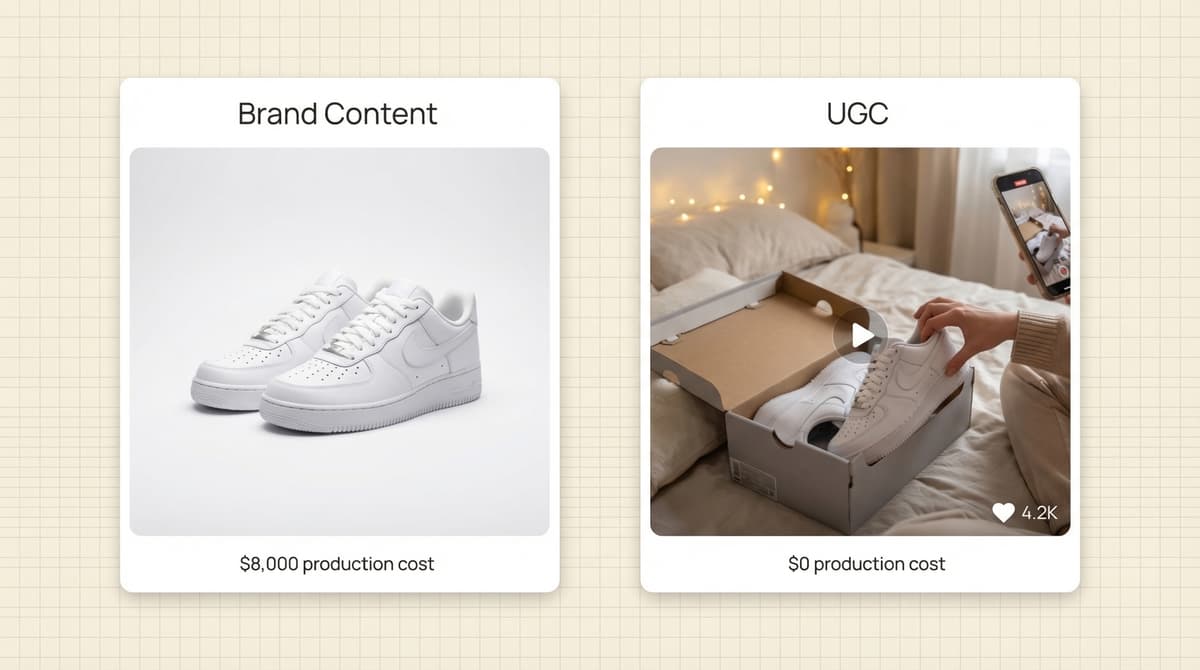 UGC video covers a wide range. A micro-influencer reviewing your serum. A customer demoing your kitchen gadget. A shopper walking through a try-on haul. The format is short, native to the platform, and personal.
Brand content is polished, controlled, scripted. UGC video is raw, spontaneous, and filmed in someone’s actual bedroom. That rawness is why it converts.
The Numbers
79% of consumers say UGC influences their buying decisions, according to data from Bazaarvoice, Taggbox, and Wisernotify.
UGC video outperforms brand video on almost every engagement metric:
| Metric | UGC vs. Brand Content |
| Engagement on TikTok | UGC performs 22% better than brand content |
| Click-through rate | UGC ads generate 4x higher CTR |
| Cost-per-click | 50% lower CPC compared to traditional ads |
| Product page conversion | Up to 161% increase with UGC vs. without |
| Brand engagement on TikTok | UGC drives 60% of all brand engagement |
The global UGC platform market reached $7.1 billion in 2025, growing at 29.7% CAGR toward $43.87 billion by 2032. Brands are building infrastructure around UGC, not just experimenting.
Despite all this, only 16% of brands have a dedicated UGC strategy. Most are leaving it on the table.
Why UGC Video Works in Ecommerce
The core driver is trust. 92% of consumers trust peer recommendations over branded advertising (Nielsen). When a real person shows your product in their actual life, it signals something a polished ad cannot.
Three specific mechanisms drive UGC video conversions:
Visual Proof
In fashion and apparel, customers want to see how the product moves, fits, and looks in real conditions. Studio shots show the product. UGC shows the product being lived in. Over 66% of people decide to buy clothes based on reviews and comments from other users.
Reduced Return Anxiety
Fashion is the most-returned category in US ecommerce at 25% of all online returns. UGC video showing fit, drape, and scale against a real body reduces the uncertainty that causes returns.
Discovery
70% of Gen Z and 68% of millennials say UGC videos help them discover new products. TikTok Shop integrations convert better than static product feeds because UGC creates discovery loops that static listings cannot.
Types of UGC Video
| Type | Format | Best For | Why It Works |
| Unboxing | Customer films the moment of opening | Premium or gift-ready products | High emotional charge, strong shareability |
| Try-on hauls | Creator shows multiple products, compares fit/color/texture | Fashion and beauty | Volume coverage, comparison context |
| Review/demo | Creator speaks to camera about experience | High-consideration products | Educational, high purchase-intent signal |
| UGC-style ads | Brand-produced video mimicking organic UGC aesthetic | Paid distribution | Combines authenticity signals with distribution control |
| Before-and-after | Transformation narrative over time | Beauty, skincare, fitness | Highest-trust story format in social commerce |
UGC-style ads deserve a closer look. They often outperform both traditional ads and organic UGC for specific ROAS targets. The reason: they combine the visual language of authenticity with paid distribution control. Brands can A/B test hooks, calls-to-action, and product angles while maintaining the lo-fi feel that audiences trust.
Platform Performance
| Platform | UGC Strength | Algorithm Dynamics | Best Video Format |
| Most engaging UGC (28% of ecommerce marketers) | Rewards native, unpolished formats. Over-edited UGC underperforms | Reels, 15-30 seconds | |
| Second highest (23% of marketers) | Broad reach, older demographics | Shared reviews, testimonials | |
| TikTok | Third (19%), but highest organic reach per post | Rewards watch time and completion rate. Start mid-action, skip preamble | 10-45 seconds, genuine reactions |
| YouTube | Fourth (17%), but strongest long-tail discovery | Review videos with specific product names rank for years | 2-10 minute detailed reviews |
TikTok clips between 10-45 seconds see the highest completion rates. The algorithm pushes content that hooks immediately and delivers a genuine reaction.
YouTube UGC creates durable traffic. Review videos with specific product names get discovered for years after posting. For search-driven purchases (skincare ingredients, tech specs, sizing questions), YouTube is the long-tail engine.
Building a UGC Video Strategy: Five Steps
Most brands treat UGC as a bonus they hope appears. Brands with results build systems.
Step 1: Define Your Ask
50% of consumers want guidelines when creating UGC. Give creators a clear brief: what product feature to highlight, what emotion to convey, what format works on your preferred platform. Specificity increases both submission rate and content quality.
Step 2: Incentivize at Scale
Post-purchase email sequences are the highest-converting ask. “Film your experience for 10% off your next order” works better than most brands expect. Hashtag campaigns with giveaway mechanics generate volume.
Step 3: Build Rights Acquisition Into the Workflow
Brands need permission to repurpose UGC in paid advertising. Rights management platforms handle consent, moderation, and attribution automatically.
| Platform | Function |
| Bazaarvoice | Rights management, content syndication, review collection |
| Yotpo | UGC collection, rights, reviews, loyalty integration |
| Flowbox | Visual UGC curation, rights management, shoppable galleries |
Step 4: Map UGC to Product Coverage Gaps
Most brands have UGC for bestsellers and hero products. The real conversion opportunity sits in the long tail: products with no customer video content. Visitors land on those pages and bounce.
Filling coverage gaps requires active creator seeding, not waiting.
Step 5: Embed UGC on PDPs
Shoppable UGC galleries on product pages drive 10-25% conversion lift and 15-40% longer dwell time compared to pages with only studio imagery. The content doesn’t need to live only on TikTok.
The highest-conversion placement for UGC is the product page. Social is discovery. The PDP is conversion.
UGC Video and AI: The 2026 Picture
Organic UGC has a fundamental limitation: coverage. A brand with 5,000 SKUs cannot rely on customer videos to cover every product, every variant, every colorway.
The brands winning in 2026 run both tracks simultaneously: UGC for trust, AI video for coverage.
AI-generated video fills the gaps where no customer content exists. Human voices provide credibility. The two formats reinforce each other.
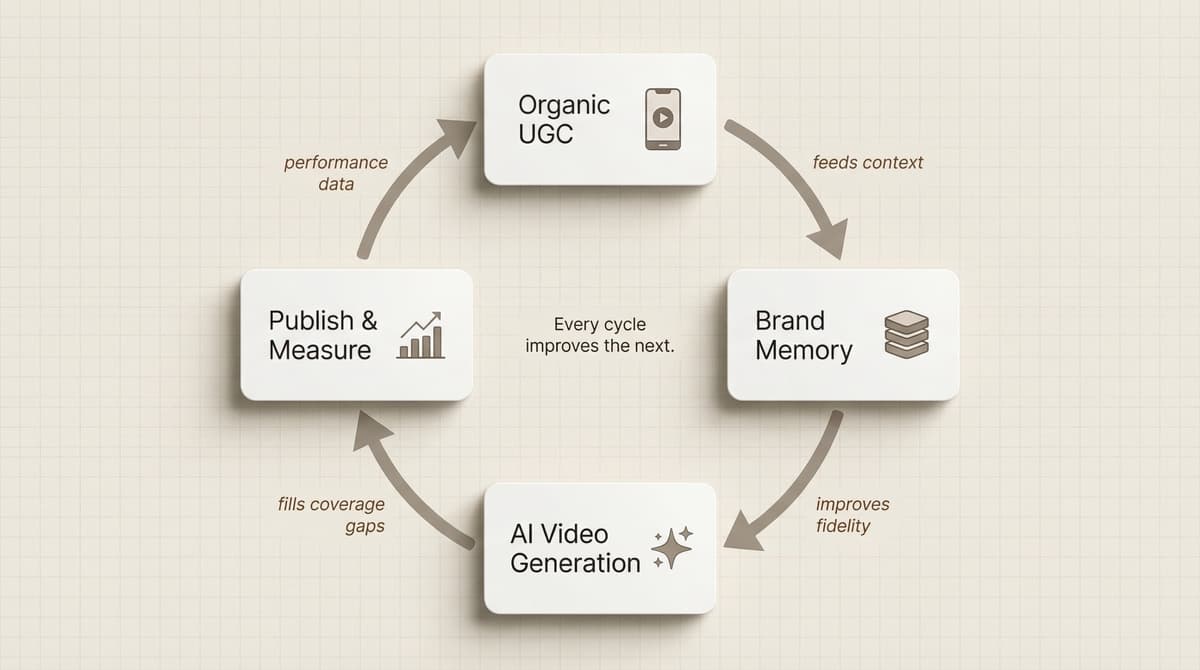
- ShopOS Spaces handle this synthesis.
- Brand Memory stores the visual and voice identity.
- Creative loops generate AI-assisted video assets for SKUs with no customer content.
- Organic UGC, when captured, feeds back into the context graph, improving future generation fidelity.
The result is a learning system that gets better as both inputs grow.
What Most Brands Get Wrong
Chasing volume over relevance. A hundred UGC videos featuring an influencer with zero fit affinity for your brand generate noise. Match creators to your actual customer profile.
Collecting but never activating. Only 16% of brands have a dedicated strategy. Most UGC gets reposted on social but never reaches the highest-conversion placement: the product page.
Treating UGC as free content instead of performance data. Every UGC video tells you something about how customers experience your product. The language they use, the features they highlight, the comparisons they make. That’s brand intelligence. Brands that treat UGC as a data source compound their advantage over time.
Start Here
Identify your top 20 SKUs by traffic. Check how many have at least one customer video on the product page. For every SKU without one, build an acquisition plan. That’s your conversion opportunity.


