

 ChatGPT
 Perplexity
 Claude
 Gemini
 Grok
Grok
Key takeaways
- The four types are not points on a scale. They solve unrelated problems.
- A build shop and an operating partner can quote similar monthly numbers for entirely different work.
- Diagnose with three checks before shopping: conversion by source, creative volume, and who is coordinating.
- If nobody has asked about your margin, you are being sold activity rather than outcomes.
What are the four kinds?
The label Shopify agency covers four businesses that share almost nothing. Build shops develop and migrate stores. Design studios shape how the store looks and how buying feels.
Channel specialists run one function well, usually paid media, email, or SEO. Operating partners run the whole marketing function, catalog and store work included.
All four use the same words on their websites, and the proposals read similarly until you check what actually gets delivered each month.
The mismatch that follows is predictable. A brand with flat revenue hires a build shop, gets a genuinely better theme twelve weeks later, and still has flat revenue. Nobody did anything wrong.

How do you diagnose which you need?
Three checks take under an hour and prevent most of the wasted quarters in Shopify agency hiring. Run them before you read a single proposal, because a diagnosis you make yourself is the only one nobody is selling you. Each check points at a different type, and the answers rarely agree with your first instinct.
Conversion by source. If paid traffic converts far worse than email or organic, the problem is targeting and creative rather than the store. If every source converts poorly, the store is the suspect.
Creative volume. A brand shipping four ad concepts a month has a production ceiling, not a media buying problem. The benchmark is stark: 80% of Meta creatives never reach 100,000 impressions, and the top 10% absorb 68% of spend (Interconnections). Four concepts are four attempts at a one-in-ten hit rate.
Who is coordinating? If a founder spends hours a week briefing separate vendors and reconciling their reports, the gap is ownership rather than capability. No specialist fixes that by being better at their slice.
Why are operating partners more common now?
Tight margins punish slow production and multi-vendor overhead in exactly the same way, which is why the operating model has spread. Blended acquisition cost reached $318 per customer in 2026 from $274 three years earlier, with median return on ad spend at 2.04 and the median public DTC brand at a negative 2.4% operating margin (Value Add VC).
There is a second pressure that is newer and sits awkwardly across the old boundaries. Discovery is moving into AI answers, and that work needs product data, content, and technical structure at once.
What is AI visibility? AI visibility is whether an answer engine names your brand when someone asks for a category recommendation. It is tracked prompt by prompt, and no advertising report shows it.
AI-referral traffic to US retail sites grew 62% year over year in July 2026 and converts at a rate 60% higher than non-AI traffic (Adobe Analytics). A channel specialist optimizing one slice has nowhere natural to put it.
What about the catalog nobody is watching?
Catalog drift is the quiet line item, and it belongs in the diagnosis because it wastes budget before anyone sees a creative. While attention sits on ad performance, out-of-stock SKUs keep running in feeds, descriptions go stale after a product changes, and variant data breaks in ways no dashboard surfaces until conversion sags.
Very few Shopify agency proposals name catalog and feed hygiene as scope. Ask directly whether it is included, and who checks it on which day.
Platforms handle this differently from retainers because the checking runs on a schedule rather than on someone’s memory. ShopOS runs Catalog Health and SKU Quadrant routines alongside ROAS and fatigue monitoring, with out-of-stock enforcement pulling unavailable SKUs from ads, and an impact preview before any bulk change applies. It sits with the performance marketing agent.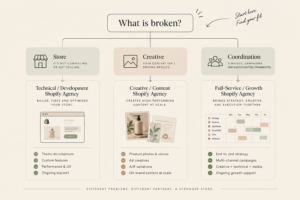
What should you check before signing a Shopify Agency?
Five things before signing with any Shopify agency, none of which appear in a pitch deck. Ask all five in one call and the answers will sort a shortlist faster than any comparison spreadsheet, largely because most firms have not rehearsed them and you will hear them think.
- The last three stores, not the best three. Portfolios are curated and often old.
- Who does the work. Some firms sell senior attention and staff junior delivery.
- What they refuse. No qualification bar means capacity, not judgment.
- What leaves with you. Accounts, assets, and documentation should be yours.
- How losses get reported. Wins-only reporting is not reporting.
Two answers should stop a Shopify agency conversation. Anyone promising a revenue lift before seeing the account is guessing, and anyone who never asks about margin is optimizing a number that may not help the business.
When is a Shopify agency the wrong answer?
A Shopify agency is the wrong answer more often than agencies admit, and three cases come up so regularly they are worth naming before you start shopping. Getting this right saves a quarter, and getting it wrong is the most expensive ordinary mistake in ecommerce hiring.
A defined project. A migration, one campaign, or a page that ships this month suits a freelancer or a build shop. Retainers are poor value for finite work.
A capable existing team. With a growth lead and a designer in place, one specialist for the specific gap usually beats handing over the function.
A production shortage rather than a skills shortage. If the bottleneck is how much creative and catalog work gets done, test a platform first. ShopOS starts free with 500 credits, then $19 to $199 a month. Start free, or book a call if catalog scale makes feed and SKU work the real problem. Book a call.
FAQ
What is the difference between a Shopify agency and a Shopify Partner?
Shopify Partner is a program, not a type of firm. Agencies, freelancers, and developers can all be Partners, and a directory listing confirms they work on the platform and meet a basic bar. It says nothing about which of the four types they are or whether they are good at your specific problem. Use the directory to confirm a firm exists, then do the diagnosis separately, because the listing will not do it for you.
One agency or several specialists?
It depends on who absorbs the coordination. Specialists can beat a generalist on any single channel, but somebody has to brief them, reconcile reporting, and decide what happens when creative is working, and the catalog is not. At most brands that somebody is the founder, and those hours are worth more elsewhere. One owner of the loop usually wins on total cost even while losing on individual channels.
How long should we commit?
Three months minimum for marketing work, shorter for defined build projects. Month one is audit and setup, month two produces real output at volume, month three is where patterns become readable. Committing to twelve months upfront is rarely necessary, and a firm that requires it should explain precisely what takes that long. Platforms sidestep the question, since a monthly plan can be canceled after a fortnight if the output is wrong.
We already have a developer we trust. Then what?
Keep them. Development and growth are different skills, and a developer who knows your theme is genuinely valuable. What matters is a clear boundary between who owns the code and who owns the numbers, plus a direct line between them rather than everything routing through the founder. Most friction in this setup comes from an undefined boundary, not from either party being bad at their job.
How do You compare proposals that look nothing alike?
Normalize to output and ownership. Ask every firm the same four questions: monthly creative volume, who owns catalog and feed work, what reporting contains, and what kind of brand they turn away. Incomparable proposals resolve fast once you know what gets made each month and who is accountable when something breaks. Fee is the last thing to compare, not the first.
Do Shopify agencies handle AI search visibility?
A minority do, and it is worth asking rather than assuming. The work crosses channel boundaries, so it falls between the stools at firms organized by function. A good test question is how they would find out whether ChatGPT currently recommends your brand in your category. Specific answers are rare. Vague ones are common, and the difference tells you a lot about the next year.
What size brand does this make sense for?
The threshold is workload rather than revenue. Enough catalog, release frequency, and channel activity that marketing is a permanent function rather than a series of projects. Below that, focused freelancers deliver more per pound, and a free or low-cost platform tier covers production without a commitment. There is no penalty for revisiting the question once the catalog grows.
Comparing platform-agnostic options? The ecommerce marketing agency page covers the broader version of this decision.