
AI for Ecommerce·Sep 17, 2026
TL;DR: The GEO vs SEO debate is mostly a false ...

TL;DR: The GEO vs SEO debate is mostly a false fight. Both need crawlable, genuinely useful pages. SEO wins you clicks from search results, while GEO wins you mentions inside AI answers, and GEO leans harder on trusted outside voices. Fix broken SEO first, then add GEO where buyers ask AI for advice.
Key takeaways
A marketing lead gets the dreaded question in a tense Monday meeting. “Should we stop doing SEO and switch everything to GEO?”
The room goes quiet. Everyone looks at them, waiting nervously.
They have one tight budget and a nagging fear of betting wrong. If that feels painfully familiar, this page is for you. The GEO vs SEO choice is far less scary once you see how much the two share, and exactly where they split.
SEO helps your pages win rankings in search results so people click through. GEO helps your brand get named and cited inside AI answers from tools like ChatGPT and Perplexity. The honest difference in GEO vs SEO is the scoreboard. One tallies positions and visits, the other tallies recommendations.
The work underneath overlaps a lot, which is good news. Both need fast, crawlable pages and genuinely helpful content, as ShopOS explains in its guide to answer engine optimization.
Where they split is trust. SEO can win with a strong site. GEO often needs other people talking warmly about you too, because AI engines feel safer repeating what many trusted sources say.
That’s why some proud brands feel blindsided and hurt. They rank well, yet AI answers ignore them completely.
What is zero-click search? A zero-click search ends without the searcher visiting any website. The answer appears right on the results page, often inside an AI summary, so your site quietly misses the visit.
More than most sales pitches honestly admit. On Google, the overlap is nearly total, since Google says its AI features need no special optimization. On other AI engines, SEO is still the foundation. But GEO vs SEO work splits on prompt testing and outside mentions, which pure SEO programs rarely prioritize.
Google is refreshingly honest about it. To appear as a supporting link in its AI features, “a page must be indexed and eligible to be shown in Google Search with a snippet,” its guidance says (Google Search Central). In other words, normal search eligibility.
That’s a huge relief for stretched teams. You don’t need a painful, expensive rebuild for AI.
Here’s how the shared and separate work breaks down:
| Area | SEO | GEO |
|---|---|---|
| Main goal | Rank and earn clicks | Get named and cited in AI answers |
| Scoreboard | Rankings, traffic, conversions | Prompts won by engine, AI referral revenue |
| On-site work | Technical health, content, internal links | The same, plus answer-first sections and plain-text facts |
| Off-site work | Backlinks | Mentions in reviews and community threads |
| Speed of change | Months | Weeks on live search, slower on training memory |
The GEO vs SEO overlap is strongest on-site. The gap is widest off-site, where honest, earned mentions matter more than links.
Because the old click math is breaking. When AI answers sit on top of results, fewer people scroll and click, which hurts SEO traffic even when rankings hold steady. Meanwhile, shoppers who come from AI answers often show up eager to spend. The GEO vs SEO question is really about protecting revenue as behavior shifts.
The evidence is sobering, even a little frightening, for anyone who trusts rankings. A randomized field experiment with 1,065 US participants in early 2026, led by Indian School of Business and Carnegie Mellon University researchers, found organic clicks fell 38% on queries that triggered AI Overviews. Zero-click searches rose from 54% to 72% (Search Engine Journal).
Picture that in your own dashboard. Your ranking holds at position three, your report looks healthy, and a third of your clicks quietly vanish. Nothing looks broken. Yet revenue feels weaker every month, and nobody can explain why.
There’s a genuinely hopeful side. Adobe found AI referral visits to US retail sites converted 60% better than other traffic in July 2026 (Digital Commerce 360). Fewer visitors, but better, more eager ones.
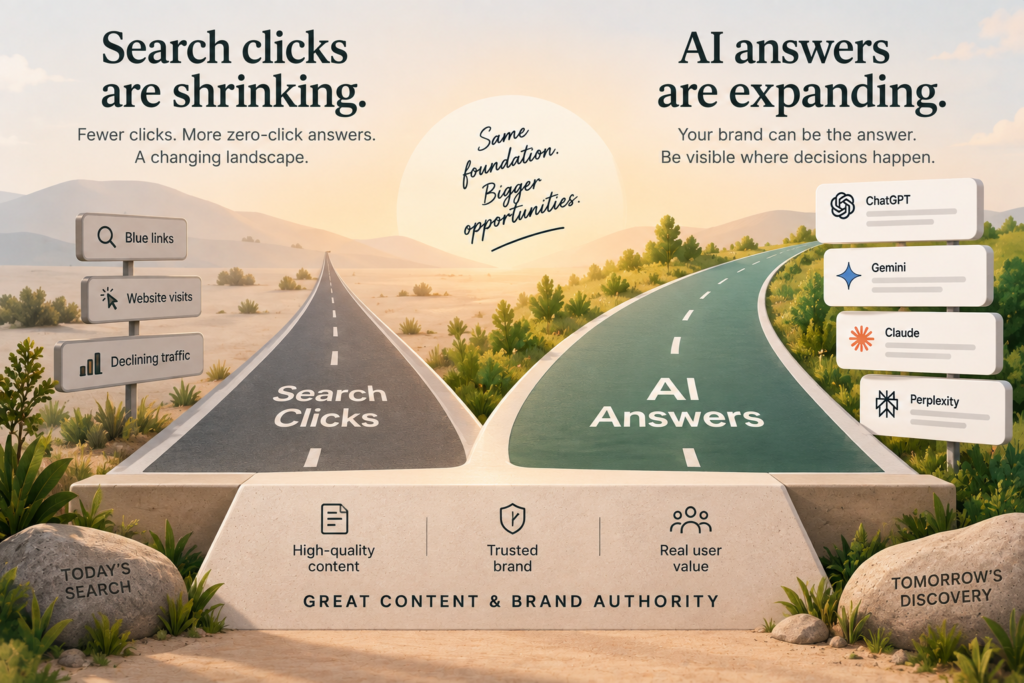
GEO needs work most SEO programs skip. That means testing real buyer prompts on each AI engine and earning mentions on sites AI trusts. It also means sections that answer one hard question clearly. A brand can have excellent SEO and still feel invisible in AI answers if nobody else talks about it credibly.
A ShopOS case study shows how painful and surprising that gap can be. A Mumbai sneaker brand had 40+ press mentions, a Domain Authority of 42, and 200+ ranked keywords. Yet it appeared in just 1 of 20 buyer prompts across four AI engines (ShopOS case study).
Good SEO hadn’t failed it. It simply wasn’t built for this new, unforgiving GEO vs SEO scoreboard.
After 90 days of answer-focused content and community seeding, plus a few niche authority citations, the same brand reached 19 of 20 prompts. That’s the GEO-only work, done on top of a healthy SEO base, and the win was dramatic.
The GEO extras, in order of payoff:
Split it by weakness, not by fear or trend. If your site has technical problems or thin pages, SEO comes first, because GEO can’t fix a broken foundation. If your SEO is healthy but AI answers ignore you, shift meaningful effort to GEO. Most healthy stores should run both, with GEO growing each quarter.
Here are four common situations and an honest starting split:
These are starting points, not rigid rules. Your category and your real buyers matter more than any template.
The worst choice is abandoning SEO in a panic, and it’s painfully common. AI engines still pull from pages that search engines can find. Cut SEO too hard, and GEO quietly starves, which hurts everyone.
If your SEO foundation is broken and needs serious work first, the honest guide to choosing an ecommerce SEO agency covers what that fix should include.
Measure each honestly on its own scoreboard, then connect both to real revenue. SEO metrics are familiar, like rankings and organic conversions. GEO metrics track prompts won per engine, rival prompts reclaimed, and AI referral revenue. Reviewing GEO vs SEO results together each month stops one channel from hiding the other’s problems.
Keep one honest, simple monthly view:
| Question | SEO answer | GEO answer |
|---|---|---|
| Are you visible? | Rankings for target keywords | Prompts naming you, by engine |
| Are you winning? | Share of clicks | Prompts reclaimed from rivals |
| Is it paying off? | Organic revenue | AI referral revenue |
Tracking GEO by hand is stressful and error-prone. Answers change between runs, and four engines multiply the painful work.
Big Head, the ShopOS GEO and SEO agent, keeps both scoreboards in one calm, clear place. It watches four AI engines prompt by prompt and publishes pages where you’re losing, but only after you approve them. That’s the technical product doing the heavy lifting, so a small, busy team isn’t stuck choosing between channels.
For an honest, step-by-step review of where you stand, try ShopOS’s guide to running an AI visibility audit. If you want the deeper definitions, read the existing SEO, AEO, and GEO explainer for D2C brands. If you’d rather hand the hard work off, learn what separates a strong generative engine optimization agency from a weak one.
Want an honest baseline before you risk moving any budget? Run your store URL through the free tier for a first honest look at your AI visibility. Running a large catalog? Book a call: Book a call.
No, and that fear causes bad decisions. GEO builds on SEO, because AI engines still rely on pages they can find and trust, but the scoreboard is changing. You now need to track AI answers alongside rankings, not instead of them. Brands that drop SEO usually weaken both.
Not well. GEO without a healthy site is like earning great word of mouth for a shop with a locked door, which is painful to watch. Mentions help AI trust you, but engines still need crawlable pages with clear facts. Fix the foundation first, then add GEO work on top.
It depends on the gap you’re closing. SEO fixes on a broken site can be expensive but finite. GEO is often ongoing, since it needs steady content and genuine mentions. Software lowers GEO costs a lot by handling tracking and production, which used to eat hours.
GEO can move surprisingly fast on engines that search the live web, sometimes within weeks. SEO rankings usually take months. In a published ShopOS case study, a brand went from 1 to 9 of 20 buyer prompts after the first month. Training-based AI memory still changes slowly.
They matter less than you might expect, and genuine mentions matter more. Links still help search engines find and trust you, which feeds AI answers indirectly. But for AI engines, being discussed genuinely across reviews and forums often carries more weight than a pile of links.
Pick your ten most important product pages and fix them for both channels at once. Add clear specs and honest FAQs under question-shaped headings. Then test ten real buyer prompts on AI engines. That single effort improves SEO and GEO together, which is the smartest, least stressful use of limited time.

