
AI for Ecommerce·Sep 25, 2026
TL;DR: Ad creative testing is how you find out, with ...

TL;DR: Ad creative testing is how you find out, with real proof, which ads make people buy. The painful mistake is changing several things at once and trusting a lucky week. Test one variable, give each version a fair budget, and decide your winning metric before launch. Then keep the tests coming, because winners never last forever.
Key takeaways
A hopeful performance marketer launches three new ads on a Tuesday. By Thursday, one is crushing it. Everyone cheers, relieved.
She doubles the budget. By the next week, results sink. By the week after, the ad is barely breaking even.
The team argues, frustrated. Was it the hook, the offer, or pure luck?
Nobody knows, because all three ads changed several things at once. That frustrating fog is what good ad creative testing clears. It turns lucky guesses into honest, repeatable wins.
Ad creative testing is the practice of comparing versions of an ad to learn which elements drive real results, like purchases or sign-ups. You change one thing, show each version to a fair audience, and measure the difference. Done well, ad creative testing tells you why an ad won, not just that it won.
There are two very different kinds, and mixing them up causes costly confusion.
Why does this matter so much? Because creative carries far more weight than most busy teams dare to assume. Nielsen’s research with Nielsen Catalina Solutions found creative quality contributes as much to a brand’s in-market success as all other factors combined (Nielsen).
What is a creative variable? A creative variable is one element of an ad you deliberately change in a test, such as the hook or the offer. Change only one, or you’ll honestly never know what caused the result.
Because ad platforms now quietly handle much of the targeting themselves. Meta’s delivery system decides who sees what, so your creative is one of the few strong levers left in your hands. Ad creative testing is how you pull that lever with confidence instead of hope. Guessing wastes budget fast.
Meta’s engineering team made the dramatic shift clear. It rebuilt its ad retrieval system to support what it called “exponential ad creatives growth” (Engineering at Meta).
The same report shared two striking, hopeful results. Advertisers using Advantage+ creative saw a 22% increase in ROAS. Businesses using image generation saw a 7% increase in conversions.
Here’s the uncomfortable takeaway. Your competitors can now produce far more ads than before. If you test three ads a month while they test thirty, they’ll find winners faster, and you’ll keep paying for tired creative.
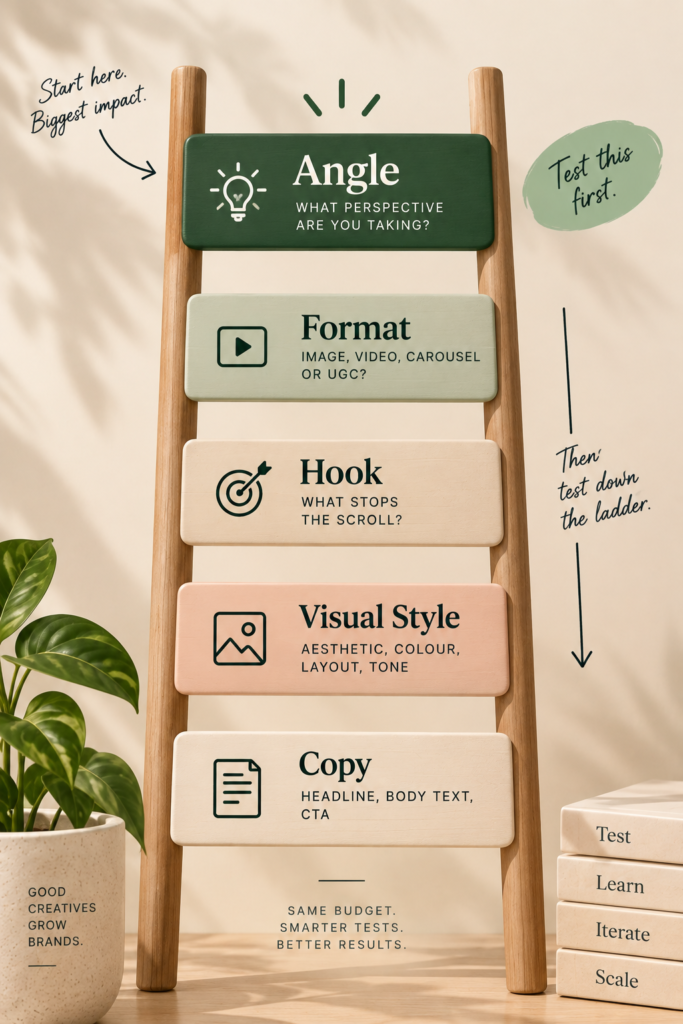
Test the big, risky ideas before the small details. The concept or angle usually matters most, then the format and the hook, while visuals and copy come last. Starting with button colors feels productive but rarely moves real revenue. Smart ad creative testing climbs from big bets to fine polish.
A practical order, from biggest, boldest impact to smallest:
This order is an honest opinion, not a law. But it saves painful weeks. A brilliant headline can’t rescue a weak angle.
Each test should answer one clear, brave question. For example: “Does a problem-first angle beat a product-first angle for our best seller?” If your question needs the word “and,” split it into two tests. The ShopOS guide to AI ads for ecommerce brands covers how teams adapt one idea across channels once a winner is found.
Change one variable, split audiences so they don’t overlap, and give each version an equal budget. Decide your success metric and minimum run time before launch. Meta’s built-in A/B testing handles the audience split for you. A fair setup is what makes ad creative testing trustworthy instead of a lucky coin flip.
Meta describes its split testing as a way to “test different advertising strategies on mutually exclusive audiences.” It divides audiences automatically so groups don’t overlap, and its guidance is refreshingly firm: “Select only one variable per test” (Meta for Developers).
Budget is where most hopeful tests quietly fail. Meta notes that “tests with larger reach, longer schedules, or higher budgets tend to deliver more statistically significant results.” Underfunded tests produce misleading noise that looks like real signal.
A simple, honest way to size your budget, suggested by AppsFlyer, is to multiply your cost per acquisition by the number of conversions you want. Here’s an example. Say your cost per purchase is $40, and your team wants 25 purchases per version before trusting a result. Two versions need roughly $2,000 in total.
Set those simple rules before launch, in writing, while everyone is calm:
Writing it down feels tedious. It also stops the exciting, dangerous habit of calling winners too early.
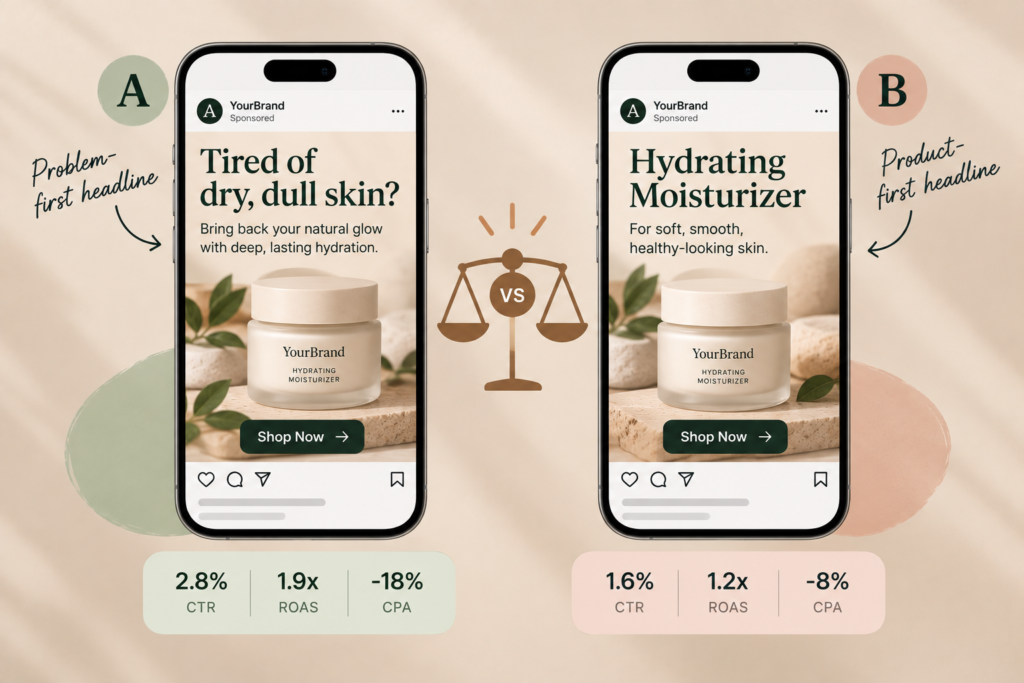
Judge results against the metric you chose before launch, and only after the test reaches its minimum spend. Early numbers swing wildly, so resist the urge to call a winner on day two. When a version wins clearly, record why you think it won. Ad creative testing only compounds when the lessons get written down.
Early metrics like click-through rate are useful warning lights. They’re not the final verdict. An ad can win clicks and still painfully lose on purchases.
A calm, honest way to read results:
Keep a simple ad creative testing log, even when you’re tired. Record the question and the result, plus your honest guess at why. Six months later, that log is worth more than any single winning ad.
Sadly, winners don’t last. Once an ad scales, performance usually fades as audiences see it again and again. Spotting that decline early is a separate job, covered in the ShopOS guide to AI ad monitoring.
Match the platform to the real problem you have. Meta’s built-in A/B testing runs fair live tests for free, while creative analytics tools spot patterns across many ads. Survey pre-testing suits big brand campaigns. Production platforms solve the most painful bottleneck of all: not having enough good variants to test.
Here’s an honest comparison. Meta’s own split testing documentation is the best free place to start:
| Option | What it solves | Honest limits |
|---|---|---|
| Meta’s built-in A/B testing | Fair live tests with no audience overlap | You still need the variants, and results only cover Meta |
| Creative analytics tools, like Motion | Patterns across many live ads | They analyze creative, they don’t make it |
| Survey pre-testing, like Kantar or System1 | Brand reactions before launch | Slower and pricier, and survey panels don’t buy your product |
| Production platforms, like ShopOS | A steady supply of on-brand variants to test | They feed your tests rather than replacing the testing itself |
For ad creative testing, most growing brands need two of these, not one. A trusted testing method plus a reliable way to produce variants covers most real needs.
The painful truth is that tools rarely fail first. Supply does. Teams run out of fresh, good creative, so testing slows down, and the whole program quietly stalls.
ShopOS solves the painful supply side of ad creative testing. Monica, its creative agent, produces product images and video at volume, while Brand Memory keeps every variant on brand. Gavin watches performance on a schedule. You approve outputs before they ship, so faster production never means losing control of quality.
Production is where ShopOS genuinely earns its keep. The Monica agent creates images and video up to 4K resolution, and shows the credit cost on the button before you commit. That makes it realistic to build five fresh angles for one product instead of one tired, hopeful ad.
The volume is real, and it’s a relief for small teams. One published ShopOS engagement with Derby Jeans produced more than 2,000 images and 30 videos (ShopOS case studies).
On the measurement side, Gavin’s scheduled routines include a ROAS Performance Digest and Fatigue Detection, so tired winners get flagged early, before they quietly drain budget. Those scheduled routines are included from the $99 Growth plan upward.
One honest limit worth knowing: ShopOS doesn’t replace Meta’s statistical test. Run the fair test in Meta, and let ShopOS keep the pipeline of variants full.
Want to see how fast you can build test variants? The free tier includes 500 credits. Testing at scale across a big catalog? Book a call: Book a call.
Long enough to reach the minimum spend or conversions you set before launch, not a fixed number of days. Rushed tests often crown lucky, false winners. Meta notes that longer schedules and higher budgets tend to produce more statistically significant results. As a rule of thumb, a full week helps smooth out weekday swings.
Start from your real cost per purchase. Multiply it by the number of purchases you want per version, then by the number of versions. If that total feels painfully high, test fewer versions or bigger ideas. Underfunded tests waste money twice, because they produce answers you can’t trust.
Usually two to four versions of one variable, which keeps things simple. More versions split the budget thinner and slow down every result. If you have many ideas, run them as a sequence of small, clear tests. Each honest answer then shapes the next question, which beats one giant, confusing test.
A/B testing changes one variable and compares versions directly, so the cause of a win is refreshingly clear. Multivariate testing changes several variables at once to find the best combination. It needs far more traffic and budget to be reliable, so most ecommerce brands get better answers from simple A/B tests.
Yes, and that’s genuinely exciting news. AI simply makes producing variants faster and cheaper, while the testing rules stay the same: one variable and fair budgets. The real advantage is volume. When making a new angle takes hours instead of weeks, you can test far more ideas per quarter.
Celebrate briefly, then scale it gradually. Write down why you think it won, and use that lesson to design the next test. Watch its performance closely, because winners fade as audiences see them repeatedly. Keep new variants ready, so you’re never stuck while a tired winner burns budget.

