

 ChatGPT
 Perplexity
 Claude
 Gemini
 Grok

Key takeaways
- A good video ad agency quotes a price per ad and a monthly count of variants, because a vague retainer hides the real cost and breeds waste.
- Vendor benchmarks put performance video ads at $100 to $500 and polished brand films at $1,000 to $16,000, so know which one you are buying and avoid a costly mix-up.
- Vertical video with sound is the safe default for short-form feeds, and Meta reports 2X higher delivery for campaigns that follow its Reels basics. Ignore them at your own risk.
- AI makes variants fast and cheap, but a person must watch every cut before it runs. Fast without care is risky.
Picture a tense Thursday launch built around one hero film. It looks lovely on day one. By day four the numbers sag, the feed has moved on, and nobody has a second cut ready.
That quiet panic is what a good video ad agency prevents. It makes the hero film, and also the sharper cuts you need when the first one gets tired. This guide covers fair pricing, the process, and the paperwork to demand in writing, so you never feel stuck.
What does a video ad agency do?
A video ad agency plans, makes, and tests the short video ads that paid channels run, and fixes what fails. It writes the brief, builds a bold concept, shoots or generates the footage, edits every cut, and delivers every size. The best ones read the results and make the next batch sharper.
Video ad production is only half the job, and the easy half. The other half is the loop: launch, learn, and remake before the creative goes stale. An agency that stops at delivery leaves you stuck with one tired ad and a hard question.
Four jobs sit inside the hard work:
- Brief and concept: a clear goal, a sharp audience, and one bold idea.
- Production: a live shoot, stock footage, or AI-made scenes, whichever fits the budget best.
- Edit and versions: every clean cut, length, and size each placement needs.
- Testing: a clear read on what won, and a faster next round.
Stills and social posts are a different job, covered in the content creation agency guide. Mix-ups are costly, so do not pay for the wrong one.
Weak ads waste money. Strong ads win it back.
How much does a video ad agency charge per ad?
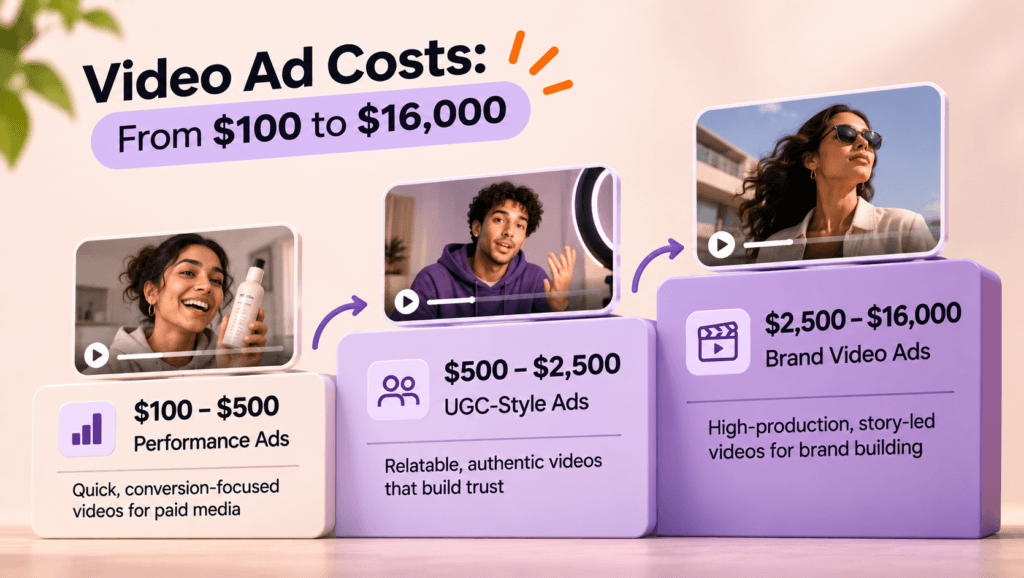
A polished brand video costs $1,000 to $16,000, while a performance video ad costs about $100 to $500, says Sovran’s 2026 benchmark. A UGC creator video averages about $198. The spread is wild. These are vendor figures from March 2026, so treat them as a rough, honest map, not a promise.
Turnaround moves with price. Sovran lists 1 to 5 days for performance ads, 3 to 7 days for UGC, and a slow 3 to 6 weeks for brand video. Slow is painful when a trend is hot.
Tool prices look tiny. The same report lists AI video tools at $1 to $5 per ad, then warns that subscription fees leave out staff time, revisions, and extra credits. Cheap per ad is not cheap per winner, and hidden costs sting. Cheap can be costly, and costly can be fair.
ShopOS scopes video work in three simple ways: inside a yearly agency plan, as one campaign, or as a single service by project or by month. The first call sets the scope, so no bill shock arrives later. Ask any video ad agency for a price per ad, never per hour, and watch for vague answers. Honest scoping feels easy, and vague scoping feels risky.
How many video ads should a video ad agency make each month?
Ask for a hard number, in writing. Sovran lists 15 to 40 variations a month for a performance agency, against 2 to 5 for a full-service brand agency, in its agency comparison. These are vendor figures, but the gap is real. More variants give you more chances to find a winner before the feed gets tired.
More is not always better. Every variant needs enough spend to be read fairly. If the budget is thin, ten variants each get a whisper, and you learn nothing. That is a painful, wasteful way to test.
Size the batch to the budget. Test the opening first, then the offer, then the format. Change one thing at a time, or the result is a guess you cannot trust. Slow and steady wins the test.
How does a video ad agency work from brief to delivery?
Amazon Ads lists ten steps in video ad production, from the creative brief and concept through script, storyboard, shoot, and edit to music licensing, localization, and delivery. Ask your video ad agency which steps it owns, and which it quietly hands off. Hidden handoffs are where good work gets lost.
Ten steps sounds heavy, and it is. That is why a clear brief matters most. A good brief is sharp and fits on one page: the goal, the audience, the offer, the proof, and the one thing to remember.
Ask for dates, not hope. A first cut by a set day, one round of notes, and a final by a second day keeps both sides calm and the launch safe. Panic breeds mistakes, and calm teams ship better ads.
Volume shows what a strong, tight process can do. Derby Jeans shipped 30 collection launch videos next to a huge catalog of 500+ products, as its Derby case study reports. Real proof beats a polished pitch.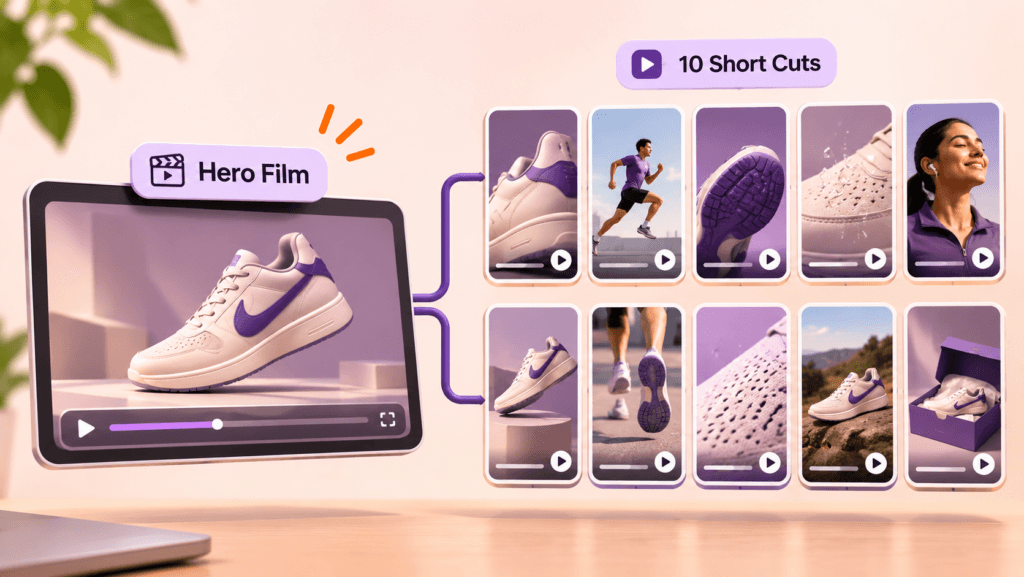
Which formats should a video ad agency deliver?
Vertical video with sound is the safe default for short-form feeds. Meta’s own guidance recommends 9:16 video with audio, kept inside the safe zone, and notes that most Instagram Reels views are sound on. Ask your video ad agency to deliver every ad in the sizes and lengths each placement needs, with no messy crops.
Silent ads lose fast.
Meta also reports that campaigns following its Reels creative essentials saw a notable 2X higher delivery to the Reels placement, in a sample of 4M campaigns from March to May 2024. This is Meta’s own trend data, so read it as a strong hint, not a guarantee, and stay careful.
The opening matters more than length. A weak opening loses the viewer fast. Ask for one master film plus short cuts, so a single idea fits every placement without a fresh, costly shoot.
Should a video ad agency use a live shoot, AI, or both?
Use a live shoot when the face, the place, or the feeling is the product. Use AI when the job is volume: more cuts, more sizes, more versions of one idea, fast. Most brands do best with both, a human-led hero film plus AI-made variants. Ask your video ad agency to price each path honestly.
Van Heusen Inner-wear shows the upside. ShopOS turned three shoot days into a massive 50,000 unique assets, giving 10,000 retailers each a festive ad set in their own shop’s name, as the Van Heusen case study explains. Without AI, that job would have been a slow, costly nightmare.
AI has limits. Generated footage can drift on product details, and a small error repeated across thousands of ads is a real risk. A person must watch every cut before it runs, and a good agency says who does that, in writing.
Trust people with the hero film. Trust AI with the volume, and check it twice.
How does a video ad agency handle talent, music, and usage rights?
Rights are where video ad production turns costly by surprise. Sovran’s data shows rights quietly adding 30% to 50% to a UGC video, and 100% to 150% for perpetual rights. That jump can sting. Ask your video ad agency to list talent, music, and paid-media rights, with dates, before the shoot starts and not after the fight.
Ownership is a separate question, and a vague contract is a risky one. Under 17 U.S.C. § 101, work made for hire reaches commissioned work only in listed categories, and only with a written agreement signed by both sides. Treat this as general information, not legal advice, and have counsel review the contract before you sign, since the stakes are high.
Put five clear lines in the contract:
- Talent: who is on camera, for how long, and in which regions, with no vague terms.
- Music: the license, the term, and what happens when it ends, since a lapse is a risk.
- Paid media: whether the footage is safe to run as an ad.
- Source files: whether you get the editable project or are stuck with the final cut.
- Re-edits: who may cut the film again, and at what fair price.
A missing term is a quiet, costly trap.
How should you measure a video ad agency’s results?
Measure video ads by what they truly change: cost per purchase, ROAS, and how long a cut lives before it fades. View counts feel good, but they do not pay for the next batch. At Derby Jeans, ROAS climbed 114% and production costs dropped 40% once production moved to ShopOS, per the Derby results.
Track four honest numbers for every batch:
- Cost per purchase: the honest price of one sale.
- ROAS: revenue for each dollar of ad spend, the real test.
- Fatigue: days until a cut stops working and goes stale.
- Cost per winner: variant spend divided by the variants that beat your control, the number that shows real waste.
Cannot get these numbers from your video ad agency? Then you are buying on hope, and hope is no metric. Views flatter, and sales tell the truth. Ask to see a real sample report on the first call.
When is a video ad agency the wrong choice?
A video ad agency is the wrong choice when you have no clear offer, no budget to test, or no way to track a sale. A great film cannot fix a weak product page. It is also wrong when one in-house editor already makes every cut you need. Fix those problems first, then hire help.
A smart hire solves a clear problem. If you want a creator-style clip, start with the UGC video guide for ecommerce and dodge an expensive mistake. Real creators often win on trust, and they can cost less than a brand film.
Still unsure? Book a call for a second opinion on your ads. Bring one favorite ad you already run, and ShopOS will talk through how to build more like it.
FAQ
How much does a video ad cost?
A performance video ad runs about $100 to $500, a UGC creator video averages about $198, and a polished brand video runs $1,000 to $16,000, per Sovran’s 2026 benchmark. These are vendor figures, not guarantees. Hidden rights fees and extra rounds can hurt, so get a clear price per ad in writing, and never trust a verbal quote.
What are the top video marketing agencies?
Rankings shift with budget and goals, so a ranked list can mislead. Shortlist three agencies instead, and trust proof over polish. Check for recent proof in your category, a price per ad, a monthly variant count, and written usage rights. Give each the same sample brief, then compare the answers honestly, side by side.
What is video ad production?
Video ad production is the full, hard work of making a video ad, from brief and concept to script, shoot or AI generation, edit, and delivery in every size a placement needs. Strong production also plans the remakes, because a winning cut fades and the next one must be ready.
How many video ads should I test at once?
Size the batch to your budget, because a thin budget makes weak, noisy tests. Sovran lists a fast 15 to 40 variations a month for performance agencies and 2 to 5 for brand agencies. Change one thing at a time, so you can trust what you learn.
Who owns the video ads an agency makes?
The contract decides, and a quiet contract is a risky one. Work made for hire needs a listed category plus a signed writing, so otherwise get an assignment or license on paper. Talent and music carry their own licenses and are a common blind spot, so confirm every term before launch.
Can AI make video ads?
Yes, AI can make many of the variants fast and cheap, from new cuts to new sizes. It still needs a person to direct the idea and check each cut for costly errors in product details. The best setup pairs a human-led hero film with AI-made versions.


