
 ChatGPT
 Perplexity
 Claude
 Gemini
 Grok

Key takeaways
- CAC is total acquisition cost divided by new customers, and only first-time buyers truly count.
- Ad spend alone makes CAC look cheap and safe. Creative, tools, fees, and discounts all hurt too.
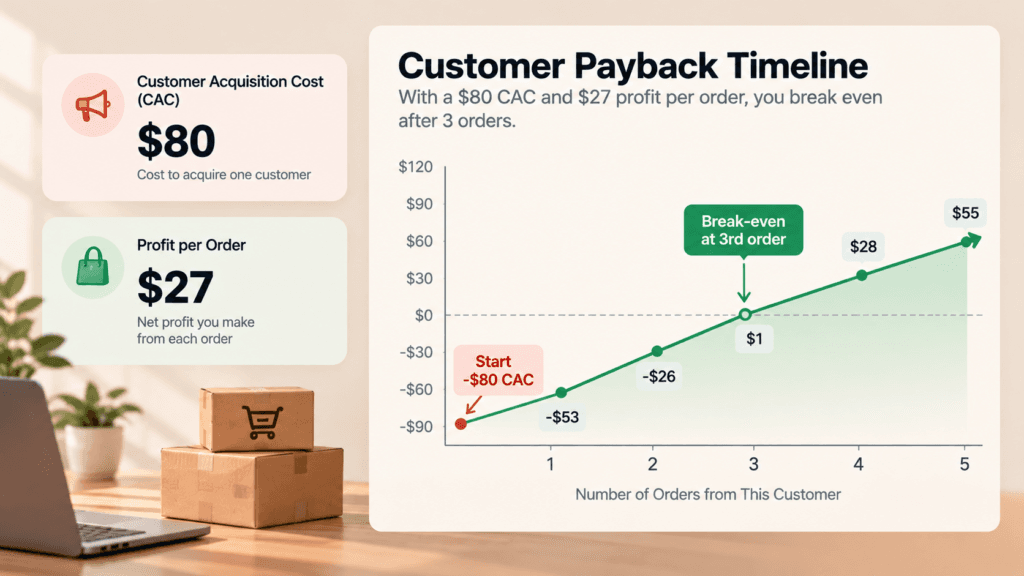
- An $80 CAC with $27 of profit per order needs about three orders to pay back, so the first sale loses money.
- A good CAC is relative. Your margin and repeat rate decide what you can safely afford.
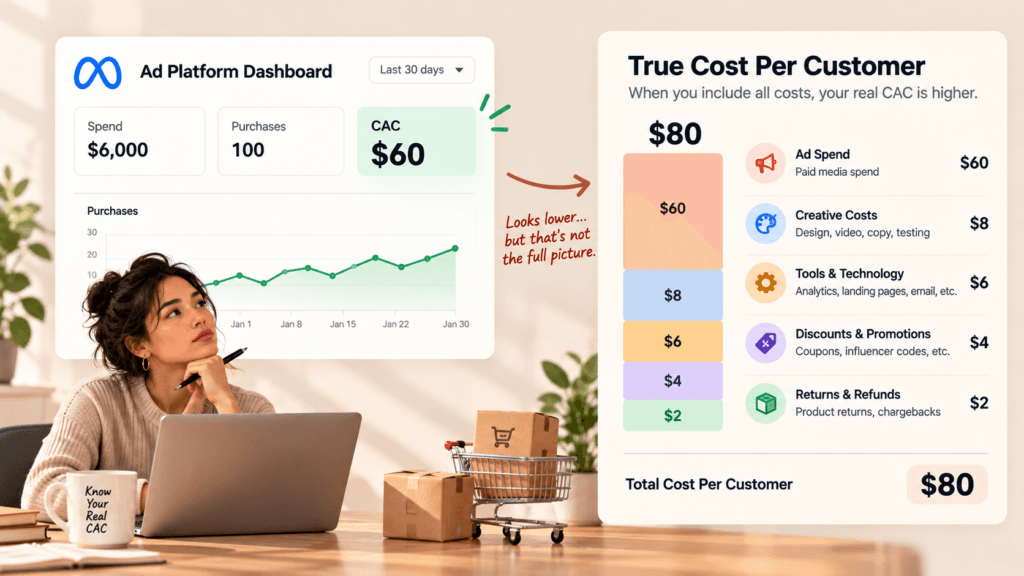
Picture a founder staring at the ad dashboard. It says $60 per new customer, and the mood in the room is bright and proud. Then the full bill arrives: creative, tools, agency fees, and scary discount codes.
The real cost is $80. Nobody lied. The dashboard simply cannot see the whole bill, and that blind spot is costly. A CAC calculator exists to close that painful gap.
Fear of the number is normal, and facing it is the smart, brave move.
What is a CAC calculator?
A CAC calculator divides everything you spent on winning new customers by the number of first-time buyers you won. It answers a blunt, important question: what does one new customer really cost? Shopify gives the formula as total marketing spend divided by new customers, and the logic is simple and fair.
What is CAC? CAC (customer acquisition cost) is the full cost of winning one new customer. Spend $500 and win 10 new customers, and your CAC is $50, a number that is simple and fair.
CAC is not cost per purchase. Cost per purchase counts loyal repeat buyers too, which flatters the number, and flattery is dangerous. A true CAC counts only people who bought from you for the first time, and that is the honest view.
How do you use this CAC calculator?
Enter your ad spend, your other marketing costs, and the new customers you won in the same period. This CAC calculator adds the costs, divides, and shows your blended CAC. Then add average order value and margin to see profit per order and the orders needed to pay back. It is quick, clear, and fair.
Here is what each input really means:
- Ad spend: the money paid to Meta, Google, and other platforms, usually the biggest and scariest bill.
- Creative and production: the real cost of photos, video, and edits.
- Tools and fees: software, agency retainers, and freelancers, which quietly pile up.
- Discount value: the codes and offers used to win first orders, which sting more than most teams admit.
- New customers: first-time buyers only, never loyal repeat buyers, because they flatter the math.
The answer appears on screen first, with no form in the way and no tricks. Press Email me the report for a clean copy of your inputs and a short, plain read. It makes a great page to share with a nervous finance team, because clear numbers build trust. Pair the result with your break-even ROAS before you bid.
How do you calculate CAC by hand?
CAC equals total acquisition cost divided by new customers. Add every cost in one period, then divide by first-time buyers in that same period. Do it once by hand, so the number feels real and you trust it. Then the CAC calculator repeats it for every month, fast.
Shopify’s own example is $500 spent on 10 new customers, or a simple $50 each.
Now try a real store. It spends $18,000 on ads, $3,000 on creative, $2,000 on tools and fees, and $1,000 on first-order discounts. The total is a hefty $24,000. The store wins 300 new customers, so CAC is a painful $80.
The ad dashboard alone says $18,000 divided by 300, or $60. That $20 gap is money that quietly leaks out of the bottom line, and nobody notices until the bank balance shrinks.
Which costs belong in your CAC calculator?
Every cost of winning a first-time buyer belongs in your CAC calculator total. Shopify’s guide lists software, marketing staff pay, ads, discount value, content, and sales costs, and it counts only first-time customers. Leave a cost out, and your CAC looks brave but wrong.
Split the number in two. Blended CAC uses all costs and all new customers. Paid CAC uses only ad spend and customers won from ads. Blended CAC is the safer view for money decisions, because it is hard to game and hard to fake.
Discounts deserve a special warning. A 20% welcome offer is a real cost, even though no invoice arrives. Count it, or your CAC calculator will lie to you in sale season, right when the stakes are highest.
What is a good CAC for an ecommerce brand?
A good CAC is one your profit per order can repay within a window you can survive. Benchmarks vary wildly, so treat them with caution and a healthy dose of doubt. Shopify’s 2021 data on brands with fewer than four employees shows average CAC of $127 in health and beauty, $129 in fashion, and $377 in electronics.
Roundups disagree wildly, and Shopify itself calls its figures rough ballpark numbers. Ringly’s 2026 roundup cites a $68 to $84 average, yet sources count different costs. Do not copy a benchmark and hope. Compare your CAC calculator result with your own margin and repeat rate, because that is the only fair test.
The classic check is LTV to CAC. Shopify says a good ratio sits around 3 to 1, and its example turns a $200 CAC into a ratio of 3 on a $600 lifetime value. That rule fails when margin is thin or repeat purchases are rare.
How does CAC connect to ROAS?
For first orders, CAC equals average order value divided by ROAS. An order value of $60 and a ROAS of 2.5 means $24 per order. If only half of those orders come from new buyers, CAC is $48. This link shows why a pretty ROAS can hide a costly, painful CAC.
The two numbers answer different, equally vital questions. ROAS asks whether ad dollars bring revenue back. CAC asks the harder question: is a new customer worth what you paid? Use the ROAS calculator for the first and this CAC calculator for the second.
A sale makes the gap worse. A deep discount lifts revenue, then drags profit per order down and hurts payback. The Black Friday marketing strategy guide shows how to plan that squeeze before it bites. Ignore the link between them, and a lovely ROAS can hide a bleeding business.
When does a CAC calculator mislead you?
A CAC calculator misleads when the customer count is wrong, the cost list is incomplete, or the time window is off. Ads run today may win buyers next week. Brand effects, organic buzz, and email all blur the picture. Treat the CAC calculator number as a strong clue, never a verdict.
Watch for four sneaky traps:
- Counting repeat buyers: this makes CAC look far too low, and far too happy.
- Leaving out discounts: the cost is real, and it is easy to forget.
- A short window: one weak week can mislead you badly.
- Blended averages: a healthy blend can hide one channel that burns cash.
Read marketing efficiency ratio explained for the blended view of spend and revenue, a strong second opinion. Then see how omnichannel measurement helps when platforms fight over credit for the same sale.
Imagine the sinking feeling. A campaign looks like a win, and the team celebrates. Then month-end arrives, and the loss is real. The shock hurts, the fear is fair, and the fix is simple: count every cost and trust the honest number.
What should you do with your CAC calculator result?
Turn the number into three firm choices: a payback limit, a creative budget, and a weekly check. Set the limit first, while you feel calm and clear. Decide how many orders a new customer may take to repay CAC, and hold the line when a flashy, exciting campaign tempts you.
Creative is where most CAC gets won or lost. A stale ad drives costs up quietly. See how ad creative testing keeps fresh ads flowing, and why ShopOS pairs Monica, its creative agent, with Gavin, its performance agent.
The agents work from your approval and never act alone. They warn you early, and you stay in charge, which feels safe.
Want a second pair of eyes on your CAC? Book a call and bring the last three months of spend and new customers. Honest CAC calculator numbers make the best conversations, and the toughest questions get easier.
Relief comes from clarity. When you know your payback window, a slow week stops feeling like a crisis. You can stay calm, test a bold idea, and sleep better.
FAQ
How do you calculate CAC?
Add every cost of winning new customers in a period, including ads, creative, tools, fees, and discounts. Divide that total by the number of first-time buyers in the same period. Spend $24,000 and win 300 new customers, and your CAC is a clear, honest $80.
What is CAC and how is it calculated?
CAC, or customer acquisition cost, is what it costs to win one new customer. Divide total acquisition spend by new customers. Shopify’s guide shows $500 spent on 10 new customers gives a CAC of $50, a simple, honest number that counts only first-time buyers.
What is a good CAC rate?
A good CAC is one your profit can repay quickly and safely, and a wise rule beats a lucky guess. Shopify calls an LTV to CAC ratio near 3 to 1 healthy. Averages vary by industry and source, so compare CAC with your own margin and repeat rate, never a headline number.
Should discounts count in CAC?
Yes. Shopify’s guide includes the value of discount codes, coupons, and promotional offers used to win new customers. A welcome offer is a real cost, even without an invoice. Leave it out, and your CAC looks lower and riskier than it truly is.
What is the difference between CAC and cost per purchase?
Cost per purchase divides spend by all orders, including repeat buyers. CAC divides total acquisition cost by first-time customers only. Cost per purchase usually looks lower, which can feel comforting and still be dangerously wrong. CAC is the stricter and more honest number.
What is the difference between blended CAC and paid CAC?
Blended CAC divides all acquisition costs by all new customers, including organic ones. Paid CAC divides ad spend by customers won from ads. Paid CAC shows channel strengths and weaknesses, while blended CAC gives the safer, honest, harder-to-game view of your whole business.
How often should I recalculate CAC?
Recalculate monthly, and before every sale or big budget change. Prices, ad costs, and discounts shift fast, so stale numbers can hurt. A quarterly check is enough only for calm, stable stores. An early check beats a costly surprise.


