

 ChatGPT
 Perplexity
 Claude
 Gemini
 Grok
Grok
Key takeaways
- Black Friday keeps growing, so the stakes are huge. Adobe counted a record $11.8 billion of US online spend on Black Friday 2025, up 9.1% (Adobe).
- The peak is brutally fast. Shopify merchants sold $5.1 million per minute at 12:01 p.m. EST on Black Friday (Shopify).
- Every Black Friday marketing strategy must respect margin, or it loses money. In the example below, 30% off cuts the allowed cost per order in half.
- Late November is risky. GeistM reported Meta CPMs up 11% in the second half of November 2025 (GeistM).
- Feed errors quietly waste the peak. Meta hides out-of-stock items from ads, and Google can disapprove products with mismatched prices.
At 12:01 p.m. on Black Friday 2025, Shopify merchants sold $5.1 million every minute (Shopify). Picture one brand inside that minute. Its best-selling hoodie just sold out, and nobody noticed. The ad is still running, still burning cash, still sending hopeful shoppers to a dead page.
A smart Black Friday marketing strategy stops that quiet, painful leak before it starts. This guide builds one for consumer brands that run paid ads. It uses real 2026 dates and simple math, plus honest advice about what to skip.
What is a Black Friday marketing strategy?
A Black Friday marketing strategy is a dated plan for winning demand during the biggest, most crowded sales weekend of the year. It covers your offer, audience, ad creative, product data, and budget. A strong plan also names the profit you need before the first ad runs, which saves you from painful surprises.
The prize is huge, and so is the pressure. Adobe measured a record $11.8 billion of US online spend on Black Friday 2025 and $14.25 billion on Cyber Monday, its biggest online shopping day ever. The five days from Thanksgiving to Cyber Monday reached a strong $44.2 billion, up 7.7% (Adobe).
Here’s the surprise, and it’s a relief. Adobe counted $257.8 billion of online spend from November 1 to December 31 (Talk Business). Those five days are only about 17% of it. So most holiday revenue lands outside the peak, and your plan has to stretch across weeks, steady and patient.
What is BFCM? BFCM stands for Black Friday Cyber Monday. It’s the whole sales weekend, from Black Friday through Cyber Monday, and it’s a real rush for shoppers. For dates, history, and the five-day split, read what BFCM means.
Most ranking guides on Black Friday marketing cover email, social posts, loyalty perks, and flash sales. Few explain the paid side, where money quietly leaks: ROAS, CPM, feeds, and creative testing. Ignore that gap and the leak stays hidden until the invoice arrives. That’s the gap this guide fills.
How early should a Black Friday marketing strategy start?
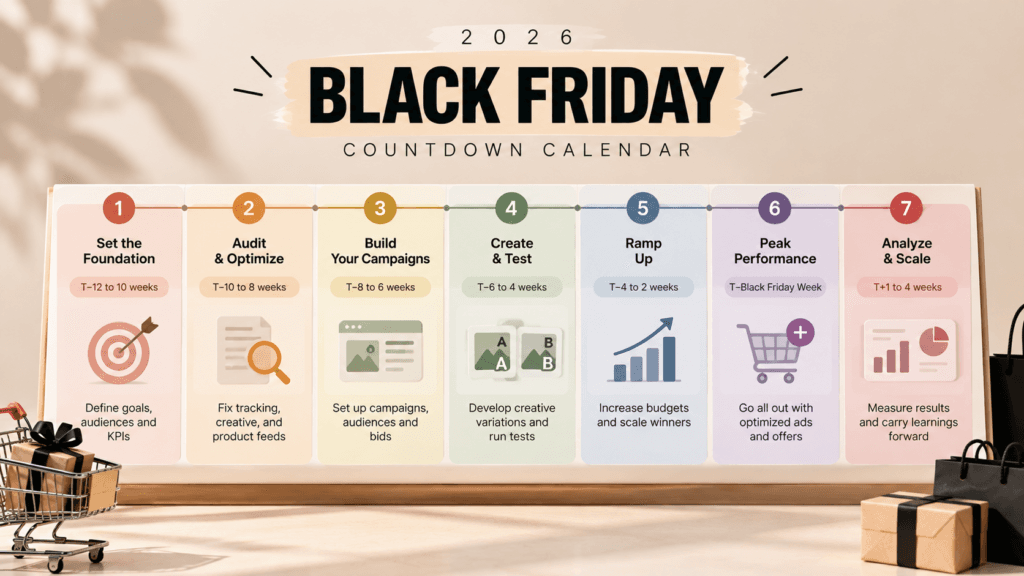
Start your Black Friday marketing strategy about six weeks before the sale, because ad costs rise late and good audiences take time to build. Black Friday 2026 lands on November 27, and Cyber Monday follows on November 30. If you’re reading this in mid-October, the clock is already ticking, loud and urgent.
Waiting is costly for any Black Friday marketing strategy. GeistM reported Meta CPMs up 3% in early November 2025 and 11% in the second half of the month (GeistM). Its page doesn’t describe its sample, so treat the numbers as a warning, not a law.
What is CPM? CPM is the cost of 1,000 ad impressions. When CPM rises, every click and every sale gets pricier unless your ads get better.
Klaviyo says many brands launched Black Friday promotions as early as November 7 in 2024 (Klaviyo). Early starters collect cheap attention and fill their retargeting pools. Late starters pay peak prices for cold, skeptical traffic, and the budget burns fast.
Here’s the 2026 countdown, a steady, simple plan worked back from Black Friday. The Black Friday checklist turns each phase into calm tick boxes:
| Dates | Phase | What to do |
|---|---|---|
| Oct 14 to Oct 25 | Audit | Fix tracking, feed errors, stock data, and your offer math. |
| Oct 26 to Nov 8 | Build and test | Run prospecting to fill retargeting pools. Test creative angles. |
| Nov 9 to Nov 15 | Lock | Pick winners and build sale versions. Freeze new concepts on Nov 13. |
| Nov 16 to Nov 22 | Early access | Launch sale ads early. Open early access for your list. |
| Nov 23 to Nov 25 | Final checks | Sync stock and prices. Test pages. Set budget caps. |
| Nov 26 to Nov 30 | Peak | Thanksgiving, Black Friday, the weekend, and Cyber Monday. Watch pacing. |
| Dec 1 to Dec 11 | Review | Shift to gifting messages. Log what worked. |
Running late? Be honest about it, and don’t panic. Skip the testing phase, and protect the basics of your Black Friday marketing strategy first: a clean feed and solid tracking, then rebuilt retargeting audiences. A calm, honest fix beats a panicked scramble.
Which Black Friday marketing ideas protect your margin?
The best Black Friday promotion ideas give shoppers a clear, urgent reason to buy without gutting your margin. Bundles, gifts with purchase, early access, and limited drops often beat a deep site-wide discount. In any Black Friday marketing strategy, discount depth is a profit decision first and a creative decision second.
Know what the market does, and respect its pressure. On Cyber Monday 2025, Adobe measured peak discounts of 31% in electronics, 28% in toys, 25% in apparel, and 19% in furniture (Adobe). Match your category’s pain threshold, but don’t race to a painful bottom.
Scarcity can beat price, and shoppers love it. Klaviyo’s case study says Jones Road Beauty ran a limited-edition drop instead of a discount. Its first 30 minutes on Black Friday matched the prior year’s whole BFCM weekend (Klaviyo). That’s a vendor-reported win, but the lesson is real.
Smart Black Friday promotion ideas that fit tight paid budgets:
- Early access. Reward your loyal list with first pick.
- Bundles. Lift order value without cheapening every item.
- Gift with purchase. Protect the list price and still feel generous.
- Limited drops. Give shoppers a real reason to act today.
- Tiered offers. Spend more, save more. Small baskets stay safe and profitable.
Pick one headline offer. A crowded, confusing message weakens any Black Friday marketing strategy and gets ignored in a fast feed. Shoppers are tired of noise, and a clear offer feels like relief.
What ROAS should a Black Friday marketing strategy target?
Your Black Friday marketing strategy should target a ROAS above break-even, and break-even climbs with every point of discount, which hurts. ROAS is revenue divided by ad spend. Break-even ROAS is your sale price divided by the margin left after product cost. Deeper discounts demand far more from every ad dollar, so the risk is real.
What is ROAS? ROAS means return on ad spend. A ROAS of 3 means $3 of revenue for every $1 of ad spend, a simple, honest score.
Take a simple product. It sells for $100 and costs $40 to make and ship, leaving a healthy $60 margin. Real life is harsh, since fees and returns eat into that margin.
| Discount | Sale price | Margin per order (your break-even CPA) | Break-even ROAS |
|---|---|---|---|
| 0% | $100 | $60 | 1.67 |
| 20% | $80 | $40 | 2.00 |
| 30% | $70 | $30 | 2.33 |
| 40% | $60 | $20 | 3.00 |
Read that table slowly. At 30% off, you can pay only $30 to win an order, half of the $60 you had at full price. And that’s exactly when CPMs climb. It’s a nasty, costly squeeze that catches careful brands off guard every year.
Don’t hunt for a magic “good Black Friday ROAS.” Darkroom, a performance agency, notes that Meta doesn’t publish a week-by-week CPM breakdown, so any single benchmark deserves suspicion (Darkroom). Your own November 2025 account is the most honest benchmark you have.
One fair exception exists. If repeat purchase data proves new customers return, you may accept a thin first order. Do it only when your numbers prove it, not because it feels brave or lucky. Hope isn’t a plan, and luck isn’t a margin.
How much ad spend does a Black Friday marketing strategy need?
Set Black Friday ad spend by working backward from the orders you need and the cost per order you can afford. Divide your revenue goal by average order value to get your order count. Multiply by your allowed CPA, and that’s your ceiling. Guessing is a risky gamble, and overspending is painful.
Cost per order isn’t magic. It’s easy to calculate with a simple formula: CPA = CPM ÷ (1,000 × click-through rate × conversion rate). Take a $20 CPM, a 1% click-through rate, and a 3% conversion rate. CPA lands at $66.67.
Now let CPM rise 11%, as GeistM saw late in November 2025 (GeistM). CPM becomes $22.20, and CPA jumps to $74.00. Nothing about your ads got worse, yet every order got more expensive.
A few rules keep the spend honest:
- Ramp in steps. Keep budget growth steady from early access onward, not a risky jump on Thursday.
- Protect prospecting. Keep some spend on new people so December doesn’t go quiet and empty.
- Watch the clock. Shopify’s peak hit at 12:01 p.m. on Black Friday, so budget caps running dry by lunch would be a costly mistake (Shopify).
- Set a stop line. Decide in advance when you’ll pause a losing campaign, before emotion decides for you.
For any Black Friday marketing strategy, the strongest lever is often conversion rate. A faster page, a clearer offer, or fresher creative cuts CPA more safely than a bigger budget. That’s a quick, clear win, and it feels great.
Which Black Friday ad creative works, and how do you test it?
Black Friday ad creative works when the offer is crystal clear in the first second and the product feels easy to want. Test the big idea before the small details. Creative carries real weight, and Nielsen found that creative quality matches every other success factor put together.
That’s why a tired, flat image costs more than most teams admit, and why it hurts. Every Black Friday marketing strategy needs fresh creative for each phase of the sale. Brave, clear ideas win, while timid ones vanish in the scroll.
Build one fresh, honest concept for each phase:
- Teaser. Make shoppers eager. Tell them what’s coming and when.
- Early access. Reward your list with first pick.
- Live. Lead with a bold, clear offer and the product together.
- Last chance. Add a real, honest deadline.
- Extended. Catch late shoppers on Cyber Monday and any bonus day.
Then multiply, and brace yourself. Four concepts across four phases and three formats (9:16, 1:1, and 4:5) means 48 assets per platform. That’s a painful grind, and it’s where small, tired teams drown.
Test fairly, because a muddy test is worse than none. Meta’s own guidance on split testing is firm: change a single variable at a time (Meta for Developers). Skip that rule, and you’ll chase false winners. Darkroom suggests freezing new concepts about two weeks before Black Friday, which is November 13 this year (Darkroom).
After the freeze, make sale versions of your October winners fast, so nobody scrambles at midnight. Swap the hook, then add the offer and the dates. The full method sits in this guide to ad creative testing. For sample ads and hooks, see these Black Friday ad examples.
How does product feed readiness affect a Black Friday marketing strategy?
Product feed readiness decides whether your Black Friday ads can even run, and the risk is real. Meta won’t show out-of-stock items in ads, and Google may disapprove products whose feed price differs from the landing page. In any Black Friday marketing strategy, one costly feed error at the peak hurts more than a weak headline.
Meta’s catalog documentation is blunt about stock, so a sold-out hero can silently vanish from your ads. A sale price must also be lower than the full price, and you should remove it once the sale ends to avoid confusion (Meta for Developers).
Google is just as strict, and the penalty is scary. If the price in your data doesn’t match the page, the product may be disapproved, and the help page warns this may lead to account suspension. Prices in the HTML must match exactly, because prices injected by JavaScript after load can trigger painful errors (Google Merchant Center Help).
Run this careful checklist before November 23, so nothing breaks:
- Sale prices. Set clear start and end dates, and check the time zone.
- Availability. Match the feed to the landing page and the checkout page, or risk painful mismatches (Google Merchant Center Help).
- Sold-out rules. Decide what happens when a hero SKU runs out, before panic hits.
- Update schedule. Refresh the feed right after every site change, so nothing goes stale.
- Titles and images. Fix your weak, tired bestsellers first.
ShopOS’s Gavin agent can pull sold-out SKUs from ads and shows the likely impact before a bulk catalog change goes live, which removes nasty surprises and saves you from panic. It also flags stale data fast, and fixing it early feels like relief, not firefighting. The deeper method sits in this guide to product feed optimization. Store owners on that platform should also read the Shopify Black Friday guide, because feed sync takes hours.
How should retargeting work in a Black Friday marketing strategy?
Retargeting wins Black Friday when audiences are built early, split by intent, and cleaned of recent buyers. You can’t retarget visitors you never earned. So October prospecting decides how much November retargeting you get. Plenty of brands discover that far too late, and it hurts.
Start with these groups, ranked by real intent:
- Cart abandoners. They’re closest to buying, so give them the biggest, most urgent share.
- Product viewers. Show the exact items they loved, with the clear sale price.
- Your early-access list. Remind your loyal fans before everyone else gets the offer.
- Past buyers. Thank happy customers with gifts or refills they’ll love.
Exclude people who just bought. Nothing feels worse, or more annoying, than an ad for the thing you bought an hour ago, and trust is fragile. The window lengths are yours to choose, and 7 days for abandoners and 30 days for viewers are fair starting points.
Be careful with praise for retargeting in any Black Friday marketing strategy. It often looks brilliant in reports because it harvests demand other channels created. Darkroom suggests proving it with a geo holdout run before early access, not through the peak (Darkroom).
Dynamic product ads put your catalog to work here, and they fail fast when the feed is messy. This explains Meta catalog ads in plain language. Each ad should land on a page that repeats its promise, and the Black Friday landing page guide shows how.
What are the best Black Friday marketing campaigns to learn from?
The best Black Friday marketing campaigns share three habits: they test early, they limit time or supply, and they rehearse the peak. Treat these Black Friday campaign ideas as patterns, not scripts. All three examples come from Klaviyo’s customer case studies, so be careful: the results are vendor-reported, not independent proof.
- Jones Road Beauty ran a bold limited-edition drop, and its first 30 minutes matched the prior year’s whole BFCM weekend.
- Little Sleepies nailed its timing, and the result was stunning: first-day revenue beat the projection for the whole BFCM stretch.
- KURU Footwear tested early. It reported 51.3% year-over-year growth in BFCM email revenue.
You can read the full, honest details in Klaviyo’s Black Friday playbook.
Notice what’s missing. None of these wins came from a bigger budget on the day. They came from preparation, and a sharp reason to buy and fast reactions did the rest. Panic doesn’t win Black Friday, but calm preparation does.
Now borrow the pattern for your own Black Friday marketing strategy. Pick a limited offer and test your message before the peak. Then time everything around real shopper behavior. The best Black Friday marketing campaigns are usually won in October.
Does AI search belong in your Black Friday marketing strategy?
Yes, because shoppers now ask AI what to buy, and that traffic is growing fast. Adobe reported AI-referred traffic to US retail sites up 670% on Cyber Monday 2025. Your Black Friday marketing strategy should make product pages easy and clear for AI engines to read and cite.
You can find that number in Adobe’s Cyber Monday release. Treat it as a signal, not a rescue plan. AI search is a slow, steady build next to paid ads, so don’t expect it to save a weak sale.
What helps is basic and honest. Keep product details accurate and clear, and answer buyer worries in plain text. Make sure prices and stock match across your store and your retailers, because mismatches destroy trust. Don’t panic, and start simple.
That’s the work of generative engine optimization, and it’s easier than it sounds. The ShopOS guide to GEO for ecommerce brands shows how to check what AI says about you, good or bad.
How can a small team run a Black Friday marketing strategy at scale?
A small team can run a big Black Friday marketing strategy by automating production and keeping humans in charge of approvals. The bottleneck is rarely ideas. It’s the exhausting, painful pile of ad versions, feed fixes, page changes, and approvals that stack up in November, and that’s where stress hits. ShopOS is a technical product built to scale that production.
Here’s how it works in practice. Monica, the creative agent, makes product images and video up to 4K, and shows the credit cost before you commit, so there are no nasty surprises. A published engagement with Derby Jeans delivered 30 videos and over 2,000 images (published case studies). That’s real volume, and a relief for lean teams.
Gavin watches the catalog and the numbers. Scheduled routines like the ROAS Performance Digest and Fatigue Detection flag tired ads early, and they come with the $99 Growth plan. Richard, the Shopify store manager agent, ships store updates that usually wait in a developer queue. That’s real peace of mind when everything feels urgent.
Brand Memory keeps every asset true to your voice, and you approve outputs before they ship. So speed never costs you control or trust, and approvals keep the process calm. ShopOS works for any consumer category, because the production grind looks the same everywhere.
Here’s an honest limit. ShopOS doesn’t run Meta’s statistical test or choose your offer, and you should be wary of any tool that promises to. With a small catalog and a handful of ads, a spreadsheet and Ads Manager will do the job. Software pays off when production becomes the painful bottleneck.
What should a Black Friday marketing strategy do after Cyber Monday?
After Cyber Monday, don’t go quiet. Shift to gifting messages, thank your happy new customers, and record what worked. About 83% of the season’s online spend lands outside the five peak days, based on Adobe’s totals above (Talk Business). December is still strong, so protect the momentum.
Three jobs matter most:
- Shipping honesty. Share cutoff dates clearly so gift buyers feel safe.
- Welcome new buyers. Send a useful, friendly follow-up before the first purchase fades.
- Save the numbers. Log CPM, CPA, conversion rate, and stock-outs by day, even the ugly ones.
That log is next year’s most honest benchmark. Public peak data is thin and often unreliable, so your own record becomes your best, most trusted guide in 2027. Future you will feel calm and ready. Monday deserves its own plan, so read how to run Cyber Monday ads.
Ready to check your feed and creative before the rush? The free tier includes 500 credits to try it on a few products. Running a large catalog into the peak? Book a call: Book a call.
FAQ
What is the best Black Friday marketing strategy?
A winning Black Friday marketing strategy starts early and protects margin, then fixes the basics first. Work out your break-even ROAS, ready your feed, and build retargeting pools in October. Then launch sale creative a week ahead and watch pacing during the peak. Calm, early preparation beats a bigger, riskier budget on the day.
How early should you start Black Friday marketing?
Start your Black Friday marketing strategy about six weeks before the sale. For 2026, that means mid-October, with Black Friday on November 27 and Cyber Monday on November 30. Early weeks are for calm audits and testing, plus filling retargeting audiences. Waiting is costly, because CPMs rose late in November 2025.
Is Black Friday really a dying trend?
No, it’s healthy and still growing, so don’t fear it. Adobe measured a record $11.8 billion of US online spend on Black Friday 2025, up 9.1% from a year earlier. Cyber Monday set a new single-day record at $14.25 billion, a strong sign. The sales are spreading out, though, so stretch your plan across several weeks.
How much should you safely spend on Black Friday ads?
Your Black Friday marketing strategy should work backward from profit. Divide your revenue goal by average order value to get the orders you need, then multiply by the cost per order you can afford. That total is your safe ceiling, so you never gamble blindly. Raise budgets in steady steps, and keep prospecting alive.
What is a good ROAS on Black Friday?
It depends on your margin, not a public benchmark, so be wary of anyone quoting one. Divide the sale price by the margin left after product cost to find break-even ROAS, then aim above it. Deeper discounts raise the bar sharply. Compare against your own honest November 2025 account.
What are some creative Black Friday marketing ideas?
Try early access for your list, bundles, a gift with purchase, a limited-edition drop, or tiered offers. Scarcity often works better than a deep site-wide discount, and shoppers love a real reason to act now. Pick one headline offer and test the message before the peak so buyers understand it instantly.
Should small brands really discount on Black Friday?
Only if the math works. Check your margin at each discount first, because your allowed cost per order shrinks as the price drops. Small brands often do better with bundles, early access, limited drops, or gifts that protect the list price and still give shoppers a reason to buy.