

 ChatGPT
 Perplexity
 Claude
 Gemini
 Grok
Grok
Key takeaways
- BFCM means Black Friday Cyber Monday. Some reports add Thanksgiving and call it a five-day stretch, so check the window before you trust a total, or you’ll be misled.
- The crowd is huge. NRF counted a record 202.9 million shoppers across the five days in 2025 (NRF).
- Every day plays a different role. Cyber Monday set the biggest online total, and even quiet Sunday drew 38.7 million online shoppers.
- Ads cost more, and each sale pays less, so honest margin math must come before creative, or you’ll lose money.
It’s a tense Tuesday in mid-October. A new ads manager reads a message from the boss: “Is BFCM sorted?” and Everyone nods. Nobody wants to admit they’re quietly searching for what the letters mean.
If that feels familiar, don’t worry. The meaning is simple, and the plan is easy once you see how each day works. This guide covers the meaning, the 2026 dates, the history, and the part most guides skip: what it really does to your ad account.
What does BFCM mean?
BFCM means Black Friday Cyber Monday. It’s the wild shopping stretch that starts on Black Friday and ends on Cyber Monday, and smart brands use the label to plan sales, ads, and stock. In 2026, BFCM runs from Friday, November 27 to Monday, November 30. Simple words, real money.
Different reports draw the lines differently, and that’s frustrating. Shopify measures the Black Friday Cyber Monday weekend. Adobe and NRF count five days, starting on Thanksgiving. So a “BFCM total” in one report never matches another, and the mismatch can mislead you.
What is Cyber Week? Cyber Week is the five-day stretch from Thanksgiving to Cyber Monday. Some reports use it as a stand-in, so always check which days a number really covers, and avoid a costly mistake.
In marketing, it’s the moment when consumer brands push their biggest offers and their hardest ad spend. It’s also when weak data, thin stock, and tired creative hurt the most. The good news is that fear shrinks when you plan early. The ShopOS pillar guide to a Black Friday marketing strategy shows how to plan for all of it.
When is BFCM in 2026?
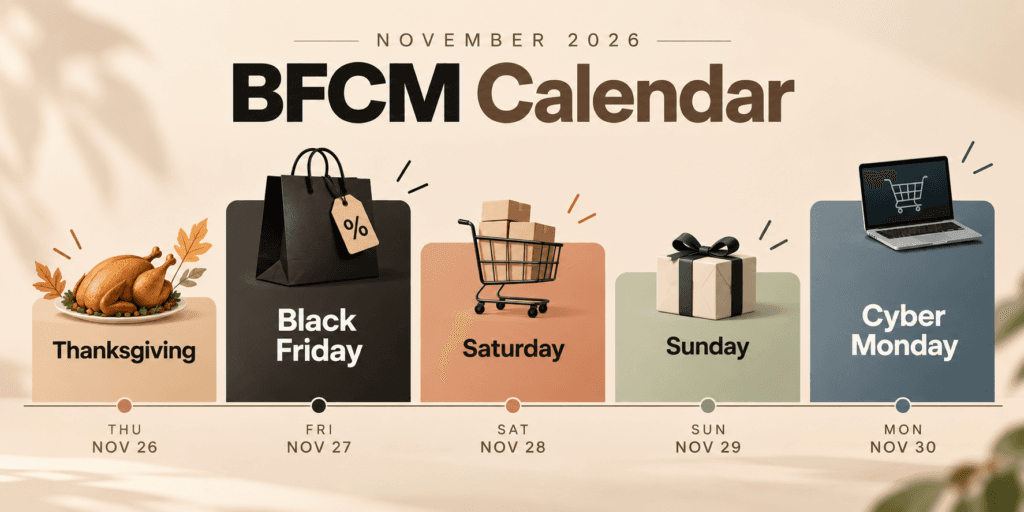
BFCM 2026 starts on Black Friday, November 27, and ends on Cyber Monday, November 30. Thanksgiving falls the day before, on November 26, so many shoppers and brands treat Thursday as the early opening act. Plan your ads, stock, and support around all five days, not just the two famous ones. Early planning cuts stress and saves money.
Here’s the 2026 calendar, with what each day delivered in 2025:
| Day | Date | What it’s known for |
|---|---|---|
| Thanksgiving | Thu, Nov 26 | $6.4 billion of US online spend in 2025, up 5.3% |
| Black Friday | Fri, Nov 27 | $11.8 billion online, a record for the day |
| Small Business Saturday | Sat, Nov 28 | A weekend deal day, with fewer headlines |
| Sunday | Sun, Nov 29 | 38.7 million online shoppers and 32.6 million in-store shoppers |
| Cyber Monday | Mon, Nov 30 | $14.25 billion online, the biggest online day ever |
| Giving Tuesday | Tue, Dec 1 | A giving day, not a sales day |
The solid numbers come from Adobe’s Cyber Monday release and NRF’s survey. Look hard at Sunday. Plenty of teams cut ads that day because it feels quiet, and that’s a costly mistake.
Imagine a founder who pauses ads on Sunday to save money. On Monday she returns to a thin pool of fresh data and a worried team. The savings were tiny, but the loss felt huge.
Adobe also found a wild late-night rush on Cyber Monday. From 8 p.m. to 10 p.m., $16 million poured in every minute. So your Monday budget has to survive until bedtime, or you’ll miss the best hours.
Where do the names Black Friday and Cyber Monday come from?
The two halves of BFCM have very different stories. Black Friday came from Philadelphia police, who used the name in the early 1960s for the traffic nightmare after Thanksgiving. Cyber Monday is newer: Ellen Davis of the National Retail Federation coined it in a press release on November 28, 2005.
The story of Black Friday is a fun, grim one. Former Philadelphia Bulletin reporter Joseph Barrett wrote that the name came from the old police traffic squad (The Philadelphia Inquirer). Merchants hated it and pushed for “Big Friday” instead, but the ugly name won anyway. It’s a strange, grim origin for the most exciting shopping weekend of the year.
Now compare the early days of Cyber Monday with today. From a quiet start to a roaring habit: Wikipedia lists $608 million of US Cyber Monday sales in 2006, citing comScore (Wikipedia). Adobe counted $14.25 billion in 2025. The two sources measure differently, so treat the jump as a rough but stunning picture, not a precise multiple.
How huge is BFCM today?
BFCM is huge, and that’s both thrilling and scary. NRF counted a record 202.9 million shoppers over the five-day Thanksgiving weekend in 2025, and Shopify merchants alone sold $14.6 billion over the Black Friday Cyber Monday weekend. Those two numbers show how huge the crowd and the cash have become, and how eager shoppers are.
NRF’s survey found 134.9 million of those shoppers bought online, a strong signal. Black Friday drew 85.7 million online shoppers, and Cyber Monday drew 75.9 million (NRF). The survey covered 3,099 adults between November 26 and 30. That’s a real flood of eager buyers.
Shopify’s side of the story is sharper, and a little scary. Its merchants reached 81 million customers, and its busiest minute, just after noon Eastern on Black Friday, hit $5.1 million (Shopify). Blink, and a record minute is gone.
Picture a small shop owner watching a live sales map at 12:01 p.m. The dots flash faster than her heart. Orders pour in, the site holds, and she finally exhales. A moment later, she sees a sold-out hero product still advertised, and the joy turns sour.
Fulfillment data shows the same wave. ShipBob saw a huge jump: Black Friday orders ran 236% above a typical October Friday, and 212% above an average October Monday on Cyber Monday (ShipBob). The average November order was $69.86, which is modest, so every sale has to earn its keep. The wave is fast, and it won’t wait for a late team.
What does BFCM feel like from inside an ad account?
From inside an ad account, BFCM feels like a fast, noisy storm. Spend climbs, alerts buzz, and every decision feels urgent. The calm teams win because they decided early. Their offers, feeds, and budgets were set before the first notification, so panic never gets a vote.
Picture two teams on Black Friday morning. The first team still argues about the offer at 7 a.m. Its feed shows last week’s prices, and nobody trusts the numbers. Coffee goes cold, tempers rise, and the best hours slip away.
The second team checked everything three days earlier, using a simple Black Friday checklist. Prices matched, stock was clean, and the budget caps were safe. At 7 a.m. they simply watch, fix small problems, and breathe.
One team feels dread. The other feels calm. Same market, same ads, very different day, and the gap came from early, honest preparation.
What does BFCM mean for ad costs and margin?
BFCM raises ad costs and squeezes margin at the same time, and that hurts. The risk is real. Meta CPMs ran 11% higher in late November 2025, per GeistM, while Cyber Monday discounts peaked at 31% for electronics and 25% for apparel, per Adobe. Fierce competition meets lower prices, so your math must change.
Take a simple $100 product that costs $40 to make and ship. At full price, each order earns $60. At 25% off, the sale price is $75 and each order earns only $35. Your allowed cost per order drops by 42%, just as ad auctions get pricier, a brutal squeeze.
That’s the painful truth behind every BFCM strategy. A good one starts with break-even ROAS, not a loud headline discount. Gut feelings lose money. The pillar guide includes a table that sets each discount level against its break-even ROAS.
Many brands only discover the squeeze after the sale, when it’s too late to fix. GeistM shares no sample details, so read the 11% as a warning sign, not a promise. Darkroom adds that Meta releases no weekly CPM breakdown (Darkroom). Your own 2025 account is the most honest guide you have.
How do you plan BFCM marketing without burning out?
Plan BFCM marketing in three moves: lock your offer early, build your audiences in October, and freeze new creative about two weeks before Black Friday. Calm preparation beats a late, panicked scramble every time. The pillar guide’s 2026 countdown gives the exact dates for each step.
Darkroom suggests the creative freeze, which lands on November 13 this year (Darkroom). After that date, you only make sale versions of ads that already win. It keeps the team calm and the learning clean.
Three other guides turn that worry into confident action. This full task checklist covers every step. This guide to Cyber Monday ads covers the final day. And the product feed guide covers the data your ads depend on.

What mistakes hurt brands most during BFCM?
The costly BFCM mistakes are the quiet ones: late feed fixes, panic discounts, and ads paused on the wrong day. Nothing here looks dramatic on a dashboard. Each slip drains profit slowly, and the pain only shows after the sale ends.
- Panic discounts. A rival cuts prices at midnight, so you slash yours, and your margin vanishes.
- Stale feeds. Old prices and sold-out items keep running, and shoppers lose trust.
- Tired creative. The same ad runs for ten days, and the audience stops caring.
- Silent Sundays. Teams switch off just when 38.7 million people are still shopping online.
Every one of these is fixable, and every one is much easier to fix in October than in November. The product feed optimization guide covers the data side, which is where most of the quiet damage starts. Don’t panic, because small, early fixes win.
Should every brand take part in BFCM?
No. Some brands do better by sitting out the discount race, and that’s a valid, brave call. If your margin is thin or your customers don’t hunt for deals, a deep sale can cost more than it earns. Choose a limited drop, a gift, or a quiet stance on purpose.
REI chose that bold path in 2015, which felt risky. It shut its doors on Black Friday and paid staff to spend the day outdoors. Retail Dive saw a strong response: over 1.4 million social hits, 175 partner groups, and a 26% rise in online traffic (Retail Dive).
Not every brand has REI’s loyal fans. But the lesson is honest and useful. It’s a choice, not an obligation, and a clear stance beats a weak, desperate discount. Fear of missing out is a poor reason to discount.
How does ShopOS fit into BFCM?
ShopOS was built as a technical product that scales marketing production, and the peak is where that matters most. Its agents make ad creative, keep the catalog clean, and run scheduled checks, and nothing ships without your approval. It’s most useful when volume, not ideas, is the painful bottleneck.
Monica, the creative agent, produces product images and video in bulk, so tired creative gets a fresh start. Gavin, the performance marketing agent, drops sold-out items from ads and keeps scheduled routines like Catalog Health running. Scheduled routines begin with the $99 Growth plan.
Here’s the honest limit. ShopOS doesn’t pick your offer or set your budget. With a small catalog and a few ads, a spreadsheet and a calm Monday morning will do. It pays off when the grind of production starts to hurt.
Nobody should spend a November weekend fixing stale prices by hand. That’s tired, painful, avoidable work, and it steals the calm you need on the biggest days.
Curious how it copes with your products? The free tier gives you 500 credits for a calm test run before the rush. Running a catalog with thousands of items? Book a call: Book a call.
FAQ
What does BFCM stand for?
BFCM stands for Black Friday Cyber Monday, a simple label that’s easy to mix up, so don’t worry. It names the wild stretch that begins on Black Friday and ends on Cyber Monday. Many reports also add Thanksgiving, which makes it five days. In 2026, the core dates are Friday, November 27 to Monday, November 30.
What is BFCM in marketing?
In marketing, BFCM is the planning window for the year’s biggest sales weekend. Brands set offers, lock ad budgets, prepare product feeds, and refresh creative around it. The stakes are high because ad costs climb and margins shrink, so smart teams plan their math before their discounts, since guessing is risky and costly.
When is BFCM in 2026?
Black Friday is November 27, 2026, and Cyber Monday is November 30, 2026. Thanksgiving is November 26, so mark all three early. Adobe and NRF count five days, while Shopify counts the weekend, so check the days behind any total, or it will mislead you.
Is BFCM the same as Cyber Week?
Not quite, and the confusion is common and easy to fall into. Cyber Week usually means a five-day run from Thanksgiving to Cyber Monday, while BFCM often means the weekend from Black Friday to Cyber Monday. Reports use both labels loosely, so it gets messy fast. Always check the dates behind a figure before you compare it.
Why is it called Black Friday?
The name came from Philadelphia police, who used it in the early 1960s for the awful traffic after Thanksgiving. Merchants disliked it and promoted “Big Friday” instead, but Black Friday stuck. Cyber Monday is newer, coined by the National Retail Federation in a 2005 press release.
Is it actually cheaper to shop during BFCM?
Often, but not always, and the best deals are rare. Adobe saw Cyber Monday 2025 discounts peak at 31% for electronics and 25% for apparel, with furniture topping out at 19%. Savings depend on the category and the retailer, so be careful, compare prices before you buy, and beware of fake, inflated “original” prices.