
 ChatGPT
 Perplexity
 Claude
 Gemini
 Grok

Key takeaways
- An ecommerce marketing agency usually charges 10 to 20% of ad spend or a flat retainer, billed apart from the ad budget, which surprises many founders.
- You must own your ad accounts. A good agency is a trusted partner with access, never the owner.
- Creative volume decides results more than strategy decks, so ask how many new ads you get each month, and push for a clear number.
- A retainer wins when you need direction. AI agents win when output is the painful bottleneck.
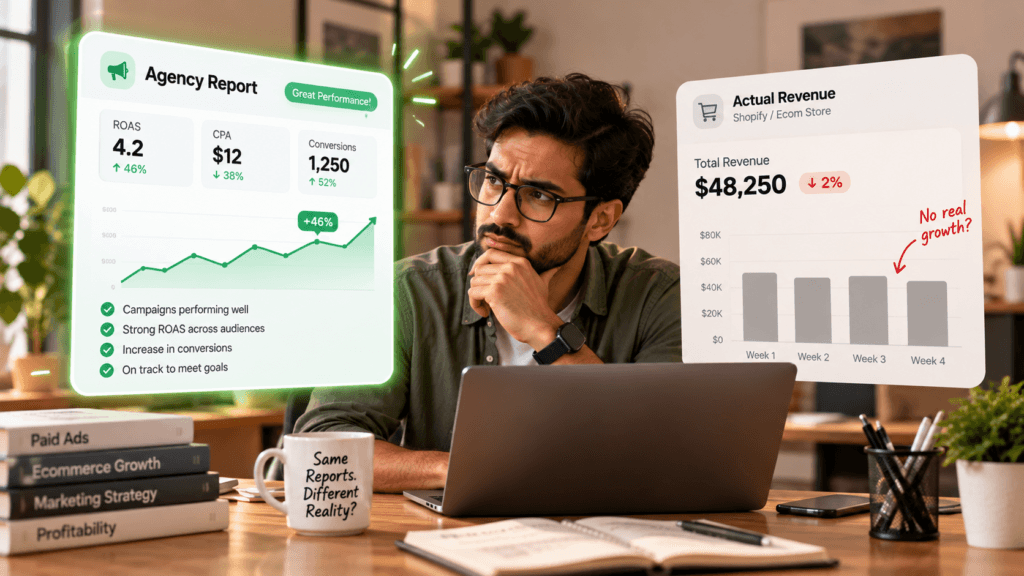
Picture a founder who signs a retainer in January. By March the reports glow green, the calls feel warm, and revenue is flat. Nobody did anything wrong. Nobody did anything measurable either.
Nobody enjoys that sinking feeling, and you can dodge it. A smart choice starts with the truth about what an ecommerce marketing agency should do, what it should cost, and what to ask before the contract lands. Fear is a fair guide here. So is hope.
What does an ecommerce marketing agency actually do?
An ecommerce marketing agency plans and runs the work that wins shoppers and keeps them loyal. That means paid ads, fresh creative, email and SMS, conversion fixes, and honest reporting. The best ones also watch AI search. The weak ones sell you a pretty deck and a happy dashboard.
A strong ecommerce marketing agency does six jobs well:
- Paid media: Meta, Google, TikTok, and Pinterest campaigns tied to your real margin.
- Creative: fresh images, video, and copy, because stale ads quietly drain the budget.
- Retention: email and SMS flows that win loyal second orders.
- Conversion: product page fixes that stop sales from leaking away.
- Measurement: clear, honest reports on ROAS, CAC, and blended efficiency.
- AI visibility: whether ChatGPT and Gemini name or ignore your brand, as the generative engine optimization agency guide explains.
Few agencies do all six well. Ask which two they truly own and love, and which they quietly hand to a stranger.
A gap you find on call one is cheap. A gap you find in month four is painful. Quiet failure is the costly kind.
Monday morning, you open the report, hoping for good news. A great agency tells you the hard truth, even when it hurts, and then shows a clear fix. A weak one hides the pain behind pretty charts.
How much does an ecommerce marketing agency cost?
Most agencies charge a percentage of ad spend, a flat monthly retainer, or both. Hawksem’s pricing guide says the percentage model typically runs 10 to 20% of ad spend, while retainers run from about $1,500 to $10,000 a month, averaging near $3,500. Ad budget is billed on top, and that surprise stings.
Cheap fees can still be expensive when results stall. Run the math on a real budget. A brand spending $50,000 a month on ads pays $7,500 at a 15% fee, before a single ad dollar goes to work.
That hurts when sales are slow. Hawksem’s figures cover general marketing agency pricing, not ecommerce alone, so treat them as a rough, honest map.
Now compare an in-house hire. The Bureau of Labor Statistics lists a median of $165,780 a year for advertising, promotions, and marketing managers. That is about $13,800 a month in pay alone, a heavy load, and one tired person cannot shoot, edit, buy media, and fix the catalog.
ShopOS posts its prices in the open on the pricing page: monthly Growth is $99 and Business is $199. Those buy agent capacity, not strategy hours, so the two are never a like-for-like swap.
Fees are never the scary part. The scary part is paying a retainer for months of silence, then learning the budget leaked while everyone smiled on calls.
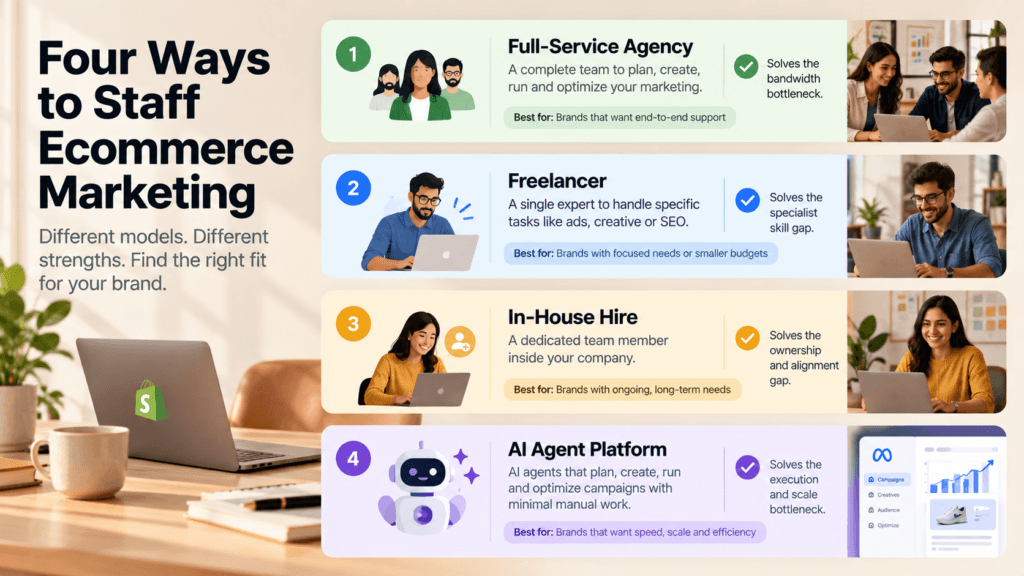
Which ecommerce marketing agency model fits your brand?
Pick by bottleneck, not by brand name. A strategist-led retainer fixes missing direction, while a freelancer or an AI agent platform fixes missing hands. Heavy monthly spend may justify a strong in-house lead. Name your bottleneck first, then shop for the model that fixes the pain.
| Model | Best when | Watch out for |
|---|---|---|
| Full-service agency | You need strategy and a team | Retainer lock-in, slow creative, account ownership |
| Freelancer | You need one skill, fast | Single point of failure, no backup |
| In-house hire | Ad spend is large and steady | High salary, one person’s limits |
| AI agent platform | Output is the bottleneck | Needs your direction and approvals |
Most brands mix two. A strategist sets the direction while agents handle the heavy, repetitive production. That blend keeps taste and judgment where they belong, in human hands, and it feels calm.
Relief often comes from a simple split: people for taste, agents for speed. The Shopify marketing agency guide shows what that looks like on a real store.
What should you ask an ecommerce marketing agency before you sign?
Ask who owns the ad accounts, how many new ads you get each month, what the report shows, and how you leave. These four answers expose a weak ecommerce marketing agency fast. Meta’s help center says only someone with full control of your business portfolio can add a partner, so ownership should always stay with you, for safety.
Use this checklist on the first call:
- Account ownership: you create the business portfolio and give the agency partner access to assets, then remove it when the contract ends. Never hand over the keys. Bad news is a gift when it arrives early.
- Creative volume: a real number of new ads per month, never a vague, hopeful promise.
- Reporting: honest results against your own break-even, so run your numbers through the ROAS calculator and the CAC calculator first.
- Exit terms: what happens to your data, pixels, and creative the day after you leave. A messy breakup is costly.
- Proof with context: time frames, spend levels, and baselines beside every win.
Trust is earned in the boring details. A partner who welcomes tough questions feels safe and honest. A partner who dodges them is waving a loud warning. Brave founders ask hard questions early.
Fear of lock-in is fair. Read how brands avoid it in the guide to scaling a DTC brand without getting trapped by agencies.
Why is buying ecommerce marketing getting harder?
Costs are climbing, the field is crowded, and the pressure is real. US retail e-commerce reached $340.2 billion in the second quarter of 2026, or 17.1% of all retail sales, according to the Census Bureau. Meanwhile Meta’s average price per ad rose 12% year over year in the same quarter.
More shoppers online means more brands fighting for the same eyes. The IAB says US social media ad revenue reached $117.7 billion in 2025, up 32.6%. Bigger auctions punish stale creative and loose budgets without mercy.
Hope is cheap. Data is worth more.
That is why a good ecommerce marketing agency must show creative speed and margin discipline, not only a polished pitch. Slow teams lose the auction, and the loss is quiet. You cannot control the auction. You can control how fast your creative improves, how clean your numbers are, and how calm you stay when a week goes badly.
How does ShopOS work as an ecommerce marketing agency alternative?
ShopOS pairs smart AI agents with a trusted human squad. Gavin watches paid performance, Monica builds creative, Richard runs the Shopify store, and Big Head tracks AI search visibility. Nothing publishes without your approval, which feels safe. You get agency-style output at published software prices, and you keep full control of the strategy.
ShopOS also tested the model in the open, with real money at stake. In a one-week experiment in March 2026, Gavin ran Meta and Google accounts for three partner brands on $4,200 in total budget. CAC fell a striking 44% against one brand’s 30-day baseline and 31% for another, and Gavin shipped more than 60 creative variants.
The test was small and short, and the brands were partners. Read it as a bright signal, never as proof. Small tests are safe, bold, and honest.
One moment shows the idea. When a winning Stryd ad hit a frequency of 4.1, Gavin wrote down the fatigue risk and queued three fresh variants before the drop could hurt. The ShopOS ad monitoring guide shows how scheduled checks catch leaks early, day after day.
Want to see how it fits your store? Book a call and share three months of ad data. Honest numbers make the best first conversation, and a good agency loves them.
When is an ecommerce marketing agency the wrong choice?
An ecommerce marketing agency is the wrong choice when the real problem sits outside marketing. A weak offer, a thin margin, or a product shoppers do not want cannot be fixed with ads. No retainer and no agent will rescue it, and a good agency will say so early. An honest no beats an expensive maybe.
Picture the hardest call of all: the product is wrong, and everyone hoped it was the ads. That truth stings, yet it saves a year of wasted spend.
The reverse is also true. A traditional ecommerce marketing agency still beats software when you need direction more than output. Positioning, pricing, and brand taste need a human with scars and strong opinions. A strong human voice is priceless when the stakes are high.
ShopOS is a poor fit for brands whose whole look depends on one gifted photographer’s eye. Keep that photographer, and use agents for the fast volume formats around the hero work. The Shopify agency guide explains the four agency types and when each one wins.
FAQ
How much does an ecommerce marketing agency cost?
Agencies usually charge 10 to 20% of ad spend or a monthly retainer of roughly $1,500 to $10,000, according to Hawksem’s general agency pricing guide. Ad budget is billed on top, a costly surprise for many. A brand spending $50,000 a month at 15% pays $7,500 in fees alone, which can hurt.
What does an ecommerce marketing agency do?
It runs paid ads, fresh creative, email and SMS, conversion fixes, and honest reporting for an online store. Stronger agencies also cover AI search visibility. Ask which services they handle in-house and which they secretly outsource, because quality drops fast at a weak hand-off.
How do I choose an ecommerce marketing agency?
Start with your bottleneck, whether that is direction, creative volume, or hands. Then ask about account ownership, new ads per month, reporting against your break-even, and exit terms. Honest answers to those four hard questions beat any polished case study.
Should I own my ad accounts?
Yes, always. Meta’s help center says you create the business portfolio, share assets with a partner, and choose full or partial access. Keep ownership, give the agency partner access, and remove it when the contract ends. Never let an agency hold your account hostage, because getting it back is a painful fight.
Is an agency better than hiring in-house?
It depends on spend and stage. The Bureau of Labor Statistics lists a $165,780 median for marketing managers, and one hire cannot cover every job. Agencies add breadth, while an in-house lead adds focus and loyalty. Many smart brands blend both, plus agents.
Can AI agents replace an ecommerce marketing agency?
AI agents can replace much of the execution, such as creative production, monitoring, and reporting. They cannot replace direction, taste, or a hard strategic call. The safest, calmest setup keeps a trusted human in charge and uses agents for speed.


