
AI for Ecommerce·Sep 16, 2026
TL;DR: Answer engine optimization shapes your pages so AI tools ...

TL;DR: Answer engine optimization shapes your pages so AI tools trust them and quote them when shoppers ask questions. It rewards clear, honest, specific answers. For stores, the biggest wins often hide on product and comparison pages, not blog posts. You can measure it, and you’ll feel better when you do.
Key takeaways
Picture a tired shopper at 11pm. She asks an AI engine for the best carry-on bag that fits under a plane seat. The answer confidently names three brands and explains why each one works. She taps one and happily buys it.
She never saw a results page.
If your bag was better but your page was vague, you lost that sale and never knew it existed. That silent loss is the painful problem answer engine optimization tries to fix. The good news is that most fixes are simple and mostly within your control.
Answer engine optimization is the work of making your content easy for AI tools to trust and quote. ChatGPT, Perplexity, and Google’s AI Overviews answer questions directly now. AEO helps your page become the trusted source behind that answer. Think of it as SEO aimed at being quoted, not just ranked.
The shift is real, and it happened shockingly fast. Capgemini surveyed 12,000 consumers across 12 countries in late 2024. It found 58% had replaced traditional search engines with gen AI tools for product and service recommendations, up from 25% in 2023 (Capgemini).
That’s a huge jump in one year. Your next loyal customer might meet your brand inside a chat, not on your homepage. Answer engine optimization decides whether that first meeting happens at all, or whether a rival quietly takes your place.
What is an answer engine? An answer engine is an AI tool that replies to a question with a written answer instead of a list of links. It pulls facts from sources it trusts and often cites them.
Answer engines favor sources that are easy to read and trusted elsewhere. They scan pages for direct answers, and they reward hard facts over fluffy claims. Then they blend a few sources into one reply. Brands they can quote confidently get named first, which makes answer engine optimization a race for trust.
Here’s the painful truth for brands. Once the answer appears, few people click anything. In Pew’s study of Google users, people clicked a link inside the AI summary on just 1% of visits (Pew Research Center).
It gets worse. People ended their browsing session on 26% of pages with a summary, versus 16% without one. So being named inside the answer is the real prize, and the click is a lucky bonus.
Engines tend to trust these signals most:
Answer engine optimization builds on SEO rather than replacing it. The same crawlable, useful pages power both, but the real goal differs. SEO fights for a position on a results page, while AEO fights to become the trusted sentence an AI reads back to a shopper. Both reward honest, helpful work.
Google is refreshingly blunt here. Its guidance says, “There are no additional requirements to appear in AI Overviews or AI Mode, nor other special optimizations necessary” (Google Search Central). On Google, strong SEO is your answer engine optimization foundation.
Other engines can feel less predictable. They lean harder on outside mentions and clear, quotable facts. That’s why a brand can rank well on Google and still feel invisible in ChatGPT, which is a frustrating spot to be in.
Short on time and worried about wasting it? The GEO vs SEO breakdown shows where effort pays best. ShopOS also has a deeper comparison of SEO, AEO, and GEO for D2C brands.
Lead with the answer, then prove it. Put a direct, honest reply right under each heading, using the words shoppers actually type. Add hard specifics like sizes and materials, and say clearly who the product is wrong for. Keep key facts in plain text, because engines struggle to read words trapped inside images.
Google’s own best practices back this up. It asks sites to keep content in textual form and to make sure structured data matches the visible text (Google Search Central). Good answer engine optimization starts with that simple discipline.
Here’s a quick before and after for a product page. The before is sadly common.
Before: “Our premium carry-on is crafted for the modern traveler who refuses to compromise on style or function.”
After: “This carry-on measures 21 x 14 x 9 inches and weighs 6.8 pounds. It has one padded laptop sleeve. It’s great for weekend trips, but too small for two-week holidays.”
The first version sounds pretty and says nothing useful. The second one honestly answers three questions an engine might get, and it even admits a weakness. Shoppers trust that, and engines reward it.
A few habits make every page easier to quote:
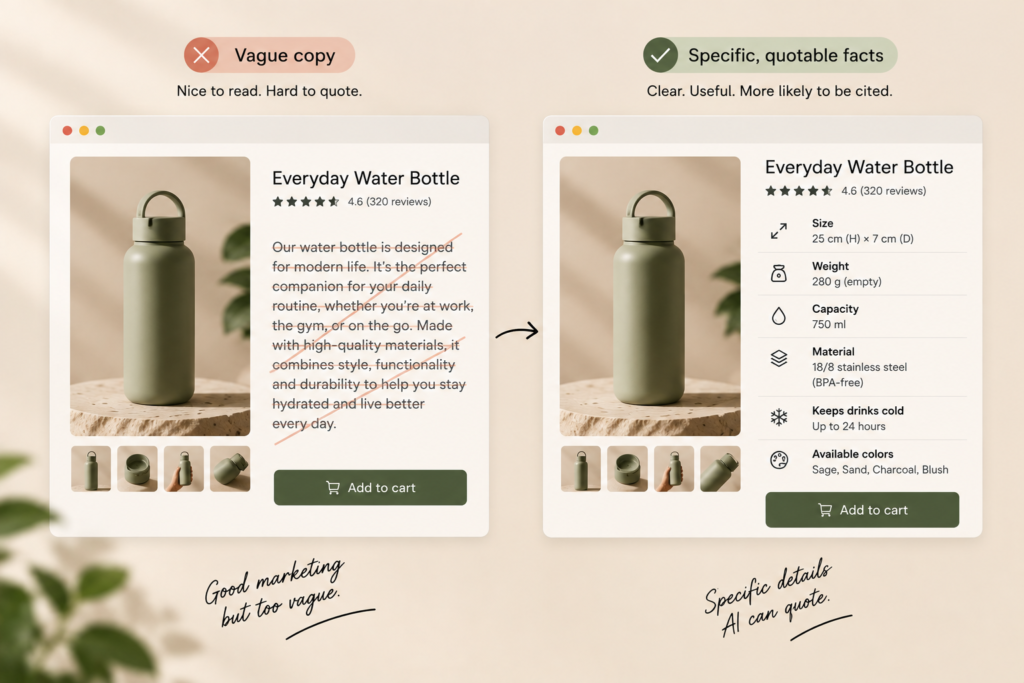
Answer engine optimization pays off most on the pages that hold hard facts: product pages, category pages, comparisons, and FAQs. Blog posts help, but an engine recommending a product needs real product details. A thin product page is often the hidden, costly reason a good brand never gets named.
Product data is becoming a direct input. OpenAI says product feeds let merchants “share structured product data with OpenAI so ChatGPT can accurately surface their products in search and shopping experiences.” It adds that extras like reviews and performance signals “improve ranking, relevance, and user trust” (OpenAI Developers).
Here’s where to focus first:
Comparison pages feel scary, and that’s exactly why they work. Shoppers ask engines “X vs Y” constantly. If you won’t answer fairly, a competitor happily will.
Measure it by prompts, not page views. Pick 20 to 50 real buyer questions and test them on each engine every month. Count how often engines name you versus a rival, and note which pages they cite. Then watch AI referral traffic and sales, because wins that never reach revenue are hollow.
Watch the gaps as closely as the wins. In one published ShopOS engagement, a sneaker brand cut its open prompt gaps from 87 to 52 in 90 days while reaching 19 of 20 buyer prompts (ShopOS case study). The gap count told the team exactly what to write next, which beats guessing.
Manual testing works fine when you’re small. It gets tedious and messy fast once you track dozens of prompts across four engines. That’s usually the moment teams feel stuck.
ShopOS built this tracking into Big Head, its GEO and SEO agent. It scores your brand prompt by prompt across ChatGPT, Perplexity, Gemini, and Claude, then writes and publishes pages to close the gaps. You approve before anything ships. The goal isn’t a prettier dashboard; it’s steady answer engine optimization output instead of a stressful quarterly scramble.
What is a prompt gap? A prompt gap is a buyer question where engines have no good answer from your brand yet. Each gap is a page you still need to write or fix.
Answer engine optimization is weak when shoppers don’t research before buying. Cheap impulse products and pure commodity items see smaller gains. If your product honestly sells on price alone, fix your ads and feed first. AEO rewards categories where anxious buyers compare options and crave reassurance.
That honesty matters. Plenty of guides treat AEO like a must-do for everyone, and that hype wastes budgets. It isn’t right for every brand yet.
Signs it should wait:
Fix the foundation first, then come back confident. If answer engine optimization clearly fits, the next step is choosing who does the work. The generative engine optimization agency guide covers what a good partner should deliver, and LLM SEO explains how models learn about brands in the first place.
Curious, or a little nervous, about how engines see your store today? The free tier shows how four AI engines describe your store, starting from one URL. If you run a large catalog, Book a call instead: Book a call.
They overlap heavily, and many people use the terms interchangeably. AEO usually focuses on direct answers. GEO covers the wider job of being cited across generative AI tools. In practice the work is nearly identical, built on clear pages and genuine outside trust, so don’t let confusing labels slow you down.
It helps when it honestly matches what’s visible on the page. Google says structured data should match the visible text, and markup won’t rescue a weak page. Add Product and FAQ markup where it’s accurate. Treat schema as a useful label, not a secret trick.
Small fixes on existing pages can show up within weeks, especially on engines that search the live web. Bigger wins take a few months of steady publishing. In published ShopOS case studies, brands saw clear movement after month one and strong results by month three. Crowded categories may feel slower.
No, and it usually backfires badly. Engines quote pages that genuinely help people. Write for a real shopper with a real worry, and keep it specific and honest. If a page would bore a human, it probably won’t earn a citation either.
Yes, and sometimes more easily than in search. Engines care about specific, trustworthy answers, not just big domain authority. A small brand with detailed product pages and fair comparisons can beat a giant with vague copy. The hard part is staying consistent, not being big.
Start with your ten best-selling product pages. Add plain specs, a clear “who it’s for” line, and a short FAQ. Then test five real buyer prompts to see what engines say today. Those quick, satisfying wins usually reveal the next pages worth writing.

