
 ChatGPT
 Perplexity
 Claude
 Gemini
 Grok

Key takeaways
- A good performance creative agency sells a weekly count of new concepts and cuts, because one big film cannot keep an account alive.
- Vendor benchmarks list performance video ads at $100 to $500 each and 15 to 40 variations a month, so test every quote against that and trust the math.
- Creative fatigue is real, so set aside a fixed share of ad spend for new ideas instead of waiting for results to drop.
- AI makes variants quick and cheap, but people must still approve every ad before launch. Moving fast without care is risky, and mistakes sting.
Picture a tense Tuesday morning. Your best ad has run for six weeks, the cost per purchase is creeping up, and the folder of replacements is empty. Nobody planned for this day, and it always arrives. That quiet dread is familiar.
That slow, quiet slide is what a performance creative agency exists to stop. It feeds your paid channels fresh ads before the old ones tire and results fall. This guide covers the work, the price, and the paperwork, so you never feel stuck.
What does a performance creative agency do?
A performance creative agency makes the ads that paid channels run, and it builds them to win a measurable result, not an award. It writes bold concepts, shoots or generates footage, cuts every size, and swaps in fresh versions each week. The best ones read the numbers, learn fast, and brief a sharper next batch.
That hard loop is the whole job: launch, learn, remake, repeat. An agency that hands over one tidy film and disappears leaves you stuck with a tired ad and a hard question.
ShopOS makes its own promise plainly: new ad concepts every week, cut for each placement, and replaced before they wear out. Derby Jeans shows the big payoff, with ROAS climbing 114% after moving creative production to ShopOS. Ask any agency for the same honest promise, in hard numbers. Stale ads drain budgets, and fresh ads win clicks back.
How does a performance creative agency differ from a brand agency?
Performance creative moves a number you can see, such as cost per purchase or return on ad spend, and it is judged fast. Brand creative quietly builds memory over months. Both matter, but they need different briefs, different speeds, and different reports, or the work gets messy. Mixing them up is a costly mistake that wastes budget and trust.
Brand work can take weeks and still pay off, slowly and quietly. Performance work gets judged within days, and a weak hook shows up fast in the data. That is why a performance creative agency places many small bets instead of one big one.
Creative still carries huge weight, and weak creative is a costly gamble. Runneth, citing a 2017 Nielsen analysis of about 500 campaigns, says creative quality explains 47% of sales lift from advertising. It is an older study, so treat it as a clue, not a law.
How many ads should a performance creative agency make each week?
Ask for a hard number, in writing, and refuse vague promises. Sovran’s agency comparison puts performance agencies at 15 to 40 variations a month and full-service brand agencies at 2 to 5. The numbers are vendor estimates. The gap is real, and it shows how the two models think.
Count concepts and variants separately. A concept is a bold new idea, while a variant is the same idea cut a new way. Ten variants of one weak idea is still one weak idea, and great briefs make great ads. Quantity without ideas is just noise.
Runneth also warns about Meta ads fatigue and suggests setting aside 5% to 15% of ad spend for testing new ideas. Treat that as a safe starting range and size the batch to your budget. Starving the test is a painful, wasteful guess.
How much does a performance creative agency cost?
Sovran’s 2026 benchmark lists performance video ads at $100 to $500 each, against $1,000 to $16,000 for polished brand films. Performance ads also arrive fast, in 1 to 5 days, against a slow 3 to 6 weeks. Treat these March 2026 vendor figures as a rough, honest map, never a promise. Surprises hurt.
Divide any retainer by the ads you really get. A $6,000 month that delivers 12 ads costs $500 an ad. The same fee for 40 costs a fair $150, and that is a very different deal. A low retainer can hide thin scope, and hidden gaps hurt.
ShopOS sets scope after the first call and offers three ways in: a yearly plan, a single campaign, or one service at a time. Hidden fees sting, so ask any performance creative agency to quote in ads, not hours, and push back on vague answers.
What does the weekly workflow at a performance creative agency look like?
A good week has five beats: brief, concepts, cuts, launch, and read. Monday sets the brief from last week’s data. Midweek brings fresh, bold concepts and first cuts; Thursday launches, and Friday reads the results. Simple beats clever when the clock is running.
Rushed weeks produce sloppy ads, and speed is where most teams slip. Before ShopOS, Derby Jeans booked two studio shoots a month across two vendors, and slow two-week cycles left creative stale before launch. After the move to ShopOS, brief-to-publish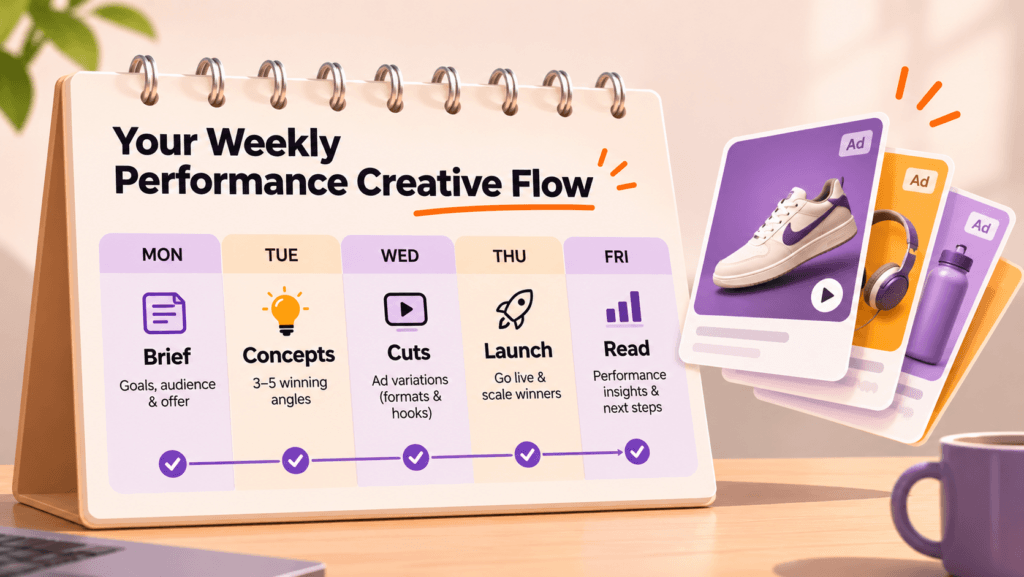 dropped to about 10 days, as its Derby results show. Slow feedback kills good ads.
Ask your performance creative agency for dates, not hope. Late work is costly work, and calm teams win. Agree on a first-cut date, one round of notes, and a final date, and the rhythm keeps both sides calm.
How do you know a performance creative agency is working?
Judge creative by what it truly changes: cost per purchase, ROAS, and how long an ad lives before it fades. Likes feel good but pay no bills, and vanity numbers lie. At Derby Jeans, ROAS climbed 114% while production costs dropped 40%, per the Derby case study.
Track four honest numbers every week:
- Cost per purchase: what one sale truly costs.
- ROAS: revenue per dollar of ad spend, the clearest test.
- Fatigue: days until an ad stops working and goes stale.
- Winners per batch: how many new ads beat your best control.
Fresh winners feel great, and stale losers feel awful.
If your agency cannot show these, you are paying for hope. Stale ads cost real money. Ask to see last month’s report for another client, with names removed, and read it with care.
Who owns the work from a performance creative agency?
You should own the finished ads, the editable files, and the testing notes, and the contract must say so in clear words. Never trust a handshake, because silence is risky. 17 U.S.C. § 101 lists the few categories where commissioned work can count as work made for hire. It also demands a written agreement signed by both sides.
This is not legal advice, only a general guide. Write four clear lines into the agreement: ownership of the final ads, access to source files, rights for talent and music, and ownership of the ad account. An unwritten line becomes the first thing you fight about.
Learning’s are worth as much as files, and losing them hurts badly. Ask for a living log of every test, so a new team never starts from zero and repeats an old, costly mistake. Smart teams test early and win often.
How does AI change a performance creative agency?
AI makes variants fast and cheap, so more of your budget can go to testing bold ideas. Van Heusen Inner-wear is the clearest example. At Van Heusen Inner-wear, three shoot days fed a massive 50,000 unique assets. Each of 10,000 retailers received a festive ad set in their own shop’s name, per the Van Heusen case study.
Speed has a nasty catch. AI can drift on product details. One small error copied across a whole campaign gets expensive fast. Have a person approve every ad before it goes live, because trust is slow to earn and quick to lose.
For creator-led clips, the guide to UGC video for ecommerce is a good start. Creator-led clips often win on trust.
When is a performance creative agency the wrong choice?
A performance creative agency is the wrong choice when your offer is weak, your product page is slow, or your tracking is broken. A great ad on a broken page still loses. Skip it, too, if one strong in-house designer already ships every ad you can test. Fix those weak spots first, because a smart skip saves money.
If you also need brand films, bold stills, and social posts, see the content creation agency guide. For short-form video, read the video ad agency guide and dodge a costly mistake.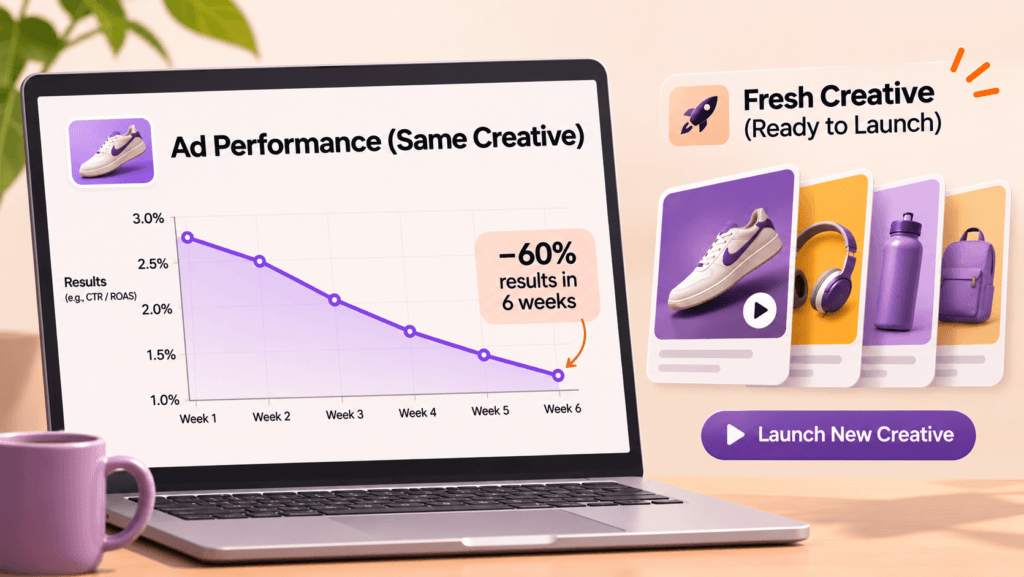
Want a second opinion on your ads? Book a call. Bring your best ad and your worst one, the honest pair, and ShopOS will talk through what to make next.
FAQ
What is a performance creative agency?
A performance creative agency makes the ads that paid channels run and tunes them to a measurable result, such as cost per purchase. It ships new concepts every week, cuts them for each placement, and swaps out tired ads. Ask which parts it builds itself and which it hands to freelancers, and expect an honest answer.
How much does a performance creative agency cost?
Vendor data puts performance video ads at $100 to $500 each, per Sovran’s 2026 benchmark, and retainers vary with volume. Divide any monthly fee by the ads delivered. Scope differs wildly, so a low price may buy painfully little. Get a price per ad in writing.
How is a performance creative agency different from a performance marketing agency?
A performance creative agency makes the ads. A performance marketing agency buys the media and tunes bids and budgets, a hard job of its own. Good creative and good media must talk every week, so ask who owns what and where a hand-off could fail.
How many ad variations should I test?
Match the batch to your budget, because each variant needs enough spend for a clear read. Vendor data suggests performance agencies ship 15 to 40 variations a month. Test one change at a time so the read stays clean, and set aside a fixed share of spend for new ideas.
Who owns the ads a performance creative agency makes?
Ownership comes from the contract, not from payment, and silence is risky. Work made for hire needs both a listed category and a signed writing; outside that, get an assignment on paper, since gaps get expensive. Confirm talent, music, and source files before launch, because hidden gaps hurt.
Can AI replace a performance creative agency?
AI can take over much of the production work, not the direction. Fast but wrong is a disaster, so someone must set the brief, read the results, and check each ad. The safest model keeps a person on the brief and the final check. AI does the repetitive cuts, which saves time and builds trust.


