

 ChatGPT
 Perplexity
 Claude
 Gemini
 Grok

Key takeaways
- Sources quote PPC fees at about 15% to 30% of spend or $500 to $5,000 a month flat, so check every quote against both models and trust the math.
- Percentage fees suit mid-sized budgets, and flat fees suit steady, larger ones. Small budgets rarely justify either, and weak math hurts.
- Give it about three to six months to optimize, and judge it on real profit, not clicks.
- You should own every ad account, and never trust a handshake: the agency should hold only managed access.
Picture a tense Monday report. Spend is up, clicks are up, and sales are flat. Somebody says the account needs more time, and nobody can say how much, or how you will know it is working. The doubt is awful.
That slow, quiet leak is why smart brands vet a PPC agency before they hire one. The right partner turns spend into sales and earns your trust. The wrong one turns it into a monthly invoice and a vague story.
What does a PPC agency do?
A PPC agency plans, builds, and runs your paid search, shopping, and social ads, then tunes bids, budgets, and creative to win a profit target. It sets up tracking, writes the ads, manages the feed, watches the numbers daily, and reports what worked. The weak ones set up campaigns, hide the real work, and send a pretty chart.
Four clear jobs sit inside the hard work:
- Setup: accounts, tracking, and a clean product feed.
- Campaigns: search, shopping, and social, built to one clear goal.
- Tuning: bids, budgets, and ads, adjusted fast, every week.
- Reporting: honest results tied to revenue and profit.
Pretty charts can hide a sinking account, and that hurts. Fixing what fails fast is the job. Honest reports win trust, and weak ones lose it.
ShopOS runs paid media through its performance marketing service, where media buyers report on revenue, not reach. It is built for consumer brands, so Amazon-only advertisers need a different specialist. Google’s retailer guide strongly recommends fresh assets, and tired ads fall flat.
How much does a PPC agency cost?
Metadata’s PPC agency guide says percentage-of-spend fees typically run 15% to 30% of ad spend, and flat retainers run $500 to $5,000 a month. Directive’s pricing guide says you are not going to get an agency charging less than $3,000 for quality PPC management. The two disagree, and the gap is huge, so test every quote and stay careful.
On-boarding costs extra at many agencies, and the warning is fair. Directive notes that an initial research fee can be much higher than the monthly one, and hidden fees sting. Cheap quotes often leave out the hard parts.
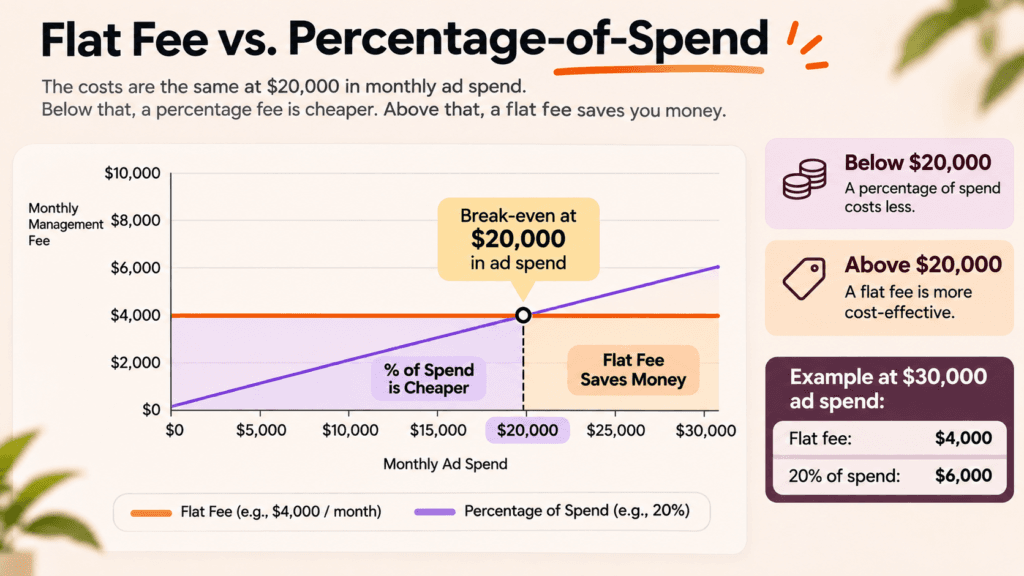
Run the break-even before you sign: a $3,000 flat fee equals 15% of $20,000 in spend, so above that a flat fee is cheaper and below it the percentage wins. Surprises hurt.
Which PPC agency pricing model fits your budget?
Percentage of spend suits mid-sized budgets, flat retainers suit steady, larger ones, and hybrids split the risk, which feels fair. Directive offers a clear example: 15% of spend can make sense at $50,000 a month, but the model loses its appeal as spending creeps toward $250,000 and up, where a cap helps.
Small budgets are the tough case. Directive says a management fee twice the size of a $1,500 ad budget is hard to justify. If you spend that little, a good self-serve setup may beat any agency.
Directive’s guide dates from 2019, so use its logic and not its stale prices. ShopOS scopes paid media after a first call, then prices the plan you choose. Clear scope feels calm, and no hidden fees sting later.
Which channels should an ecommerce PPC agency run?
Start where buyers already search, then widen. Google Search catches people who know what they want, while great Shopping ads show the product, the price, and the photo. Meta and TikTok reach people before they search. A good agency builds all four to one plan, not four risky bets.
Google says shifting from Standard Shopping to Performance Max drove a 25% increase in conversion value on average at a similar ROAS. That is Google’s own average, so treat it as direction, not a promise.
Amazon ads are a different job. If someone asks “What is an Amazon PPC agency?”, the honest answer is a specialist for Amazon’s own ad products. Ask any agency which channels it truly runs, and be careful with big claims. Wrong channel, wasted money.
How long does a PPC agency take to show results?
Plan on three to six months for an agency to optimize an account, according to Metadata’s guide. Early weeks gather data, test ads, and fix broken tracking, so slow starts are normal. Real gains usually come after the account learns what sells. Anyone who promises a miracle in a week is selling hope.
Patience is hard, but rushed changes waste data.
Judge progress in stages, and stay patient. Month one should show clean tracking and a testing plan, and months two and three should show winners and painful cuts. By month six, the report should show real profit, not just activity. Rushed judgment is risky.
Ask for a plan with dates, not hope. A first review at 30 days, a deeper one at 90, and a clear stop rule keep both sides calm and safe.
How should a PPC agency report results?
Report on revenue and profit, not clicks. Google’s retailer guide says to set a ROAS target based on what will yield the highest profit, and to weigh cost of goods and customer lifetime value. An agency that cannot talk about margin is tuning the wrong number. Stale reports hide real trouble.
Track four honest numbers every month:
- Revenue and ROAS: what the spend earned.
- Profit after ad cost: the true test.
- Cost per new customer: what each buyer costs.
- Share of spend on winners: where the budget really goes.
Without these four numbers, you are flying blind. Vanity numbers lie, and profit tells the truth. Request a redacted report from a current client.
Why does creative matter to a PPC agency?
Ads win or lose on creative, and most agencies do not make it. Google says advertisers who add at least one video to Performance Max saw an average 12% increase in total conversions. An agency that waits on you for assets can stall for weeks, and waiting is costly.
The best setups put creative and media on one team. At Derby Jeans, ROAS climbed 114% after creative production moved to ShopOS, per the Derby case study. Fresh ads feed the media buyers, and the media data briefs the next ads, a strong loop. Stale ads drain budgets.
To fix weak creative, read the performance creative agency guide. For bold short-form video, see the video ad agency guide and skip the guesswork.
Who owns the ad accounts and data at a PPC agency?
You should own every ad account, pixel, and data feed, and the agency should hold only managed access. Never let an agency open the account in its own name, because leaving can mean starting from zero, a painful reset. A short clause now beats a long dispute later, because leaving should be easy, never a nightmare. Strong contracts feel safe.
A Partner badge in Google’s program confirms an agency cleared the performance, spend, and certification bars, per Google’s partner help page. It does not prove the agency will treat you fairly. Only your contract does, so never trust a badge alone.
Put four clear lines in writing: account ownership, access for you at all times, a 30-day notice period, and the return of all data on exit. Unwritten terms are where the risk hides.
When is a PPC agency the wrong choice?
A PPC agency is the wrong choice when your ad budget is tiny, your tracking is broken, or your product page cannot convert. Great ads on a weak page still lose, and a slow site wastes every click. Skip it, too, if one in-house marketer already runs every campaign well. Smart brands fix the basics first.
For Google-specific work, read the Google Ads agency guide and avoid a costly mismatch, because a bad fit wastes time. For the social side, see the social media management agency guide.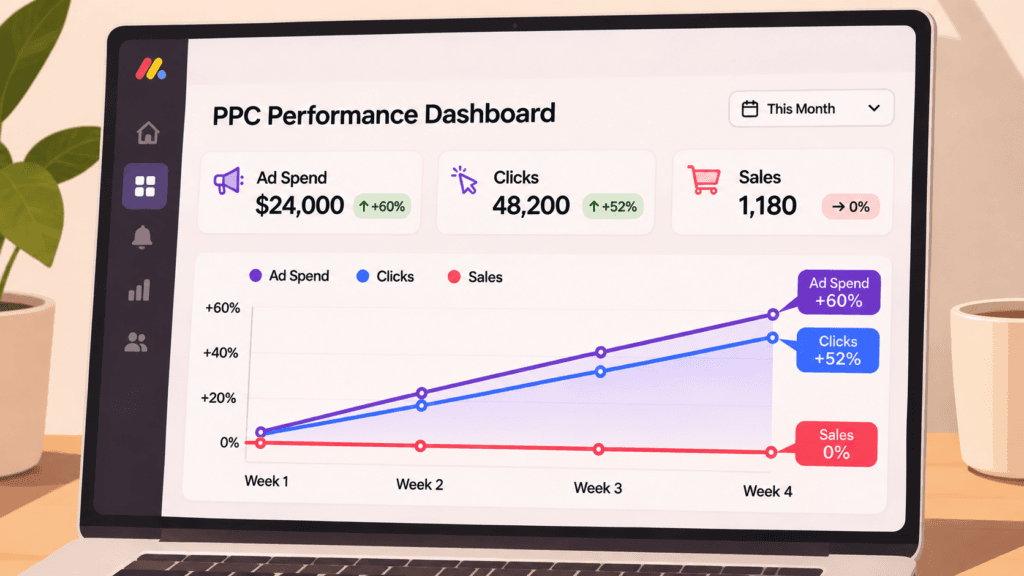
Feeling stuck on your ad account? Book a call for an honest second opinion. Bring your last three months of spend, and ShopOS will talk through what to fix first, with no fluff.
FAQ
What does a PPC agency do?
A PPC agency builds, runs, and tunes paid ads on search, shopping, and social channels, then reports what they earn. It handles tracking, writes the ads, manages the feed, and adjusts bids and budgets fast, every week. Ask which parts its own team handles and which go to freelancers.
How much does a PPC agency cost?
Sources quote percentage fees at about 15% to 30% of ad spend and flat retainers at $500 to $5,000 a month, though one guide says quality management rarely costs under $3,000. On-boarding can cost extra. Get every fee in writing, because hidden costs sting and surprises hurt.
Is PPC legitimate?
Yes, PPC is a real, standard way to buy visits on search engines and social platforms, and you pay for the ads you run. The risk is a bad agency, not the channel. Check account ownership, reporting, and contract terms before you trust anyone with spend, because a costly mistake is hard to undo.
What is an Amazon PPC agency?
An Amazon PPC agency runs ads inside Amazon’s own advertising products, such as sponsored product ads. It is a separate, hard specialty from Google and Meta work. If Amazon is your main channel, hire a specialist and ask for real Amazon case results, not a generic pitch.
Should I pay a PPC agency a percentage or a flat fee?
Percentage fees fit mid-sized budgets, and flat fees fit steady, larger ones. A $3,000 flat fee equals 15% of $20,000 in spend, the break-even point. Small budgets often cannot justify either, so run the math and trust it.
Can AI replace a PPC agency?
AI can speed up reports, drafts, and variants, not the judgment. A fast mistake is still a mistake, so someone must set the profit target, guard the budget, and check every ad. Keep a person on targets and budget, and let AI do the reporting grunt work, which saves time and builds trust.


