

 ChatGPT
 Perplexity
 Claude
 Gemini
 Grok
Grok
Key takeaways
- LLM SEO has two tough fronts: what a model remembers, and what it finds live when a shopper asks.
- Blocking the wrong crawler can make you invisible. OpenAI says sites opted out of OAI-SearchBot won’t be shown in ChatGPT search answers (OpenAI).
- Genuine brand mentions beat links. Web mentions correlated at 0.664 with AI Overview visibility, versus 0.218 for backlinks (Ahrefs).
- A good LLM SEO tool tracks real prompts by engine and helps you act, not just stare at charts.
Try something slightly scary. Open ChatGPT and ask it about your own brand. Be honest with yourself about how nervous you feel.
Some founders get a pleasant surprise. Many get an awkward, painful answer instead. Maybe it’s an old price or a discontinued product. Worst of all, it’s a rival praised for the exact thing you do best.
That moment feels personal, and it stings. The good news is that it’s fixable. LLM SEO is how you correct the story a model tells about you, and how you earn a spot when shoppers ask for recommendations.
What is LLM SEO?
LLM SEO is the practice of shaping how large language models describe and recommend your brand. It covers two jobs. You influence what models learn from the public web over time, and you make sure they can find and trust your pages when they search live. Winning at LLM SEO means getting both right.
It’s closely related to GEO and answer engine optimization for stores. The labels can feel confusing, but the goal is the same: be the brand an AI names with real confidence.
Why does this matter so much for stores? Because models don’t just answer trivia. They compare products and build shortlists for eager buyers. If a model misunderstands you, it can quietly steer those ready buyers toward a competitor, and you’ll never see the lost sale in any report.
What is retrieval? Retrieval is when an AI tool searches the web in real time before answering. It lets the model use fresh pages instead of relying only on what it learned during training.
How do large language models learn about your brand?
Large language models learn about brands in two ways. Training data shapes what a model already believes before anyone asks. Live retrieval adds fresh pages at answer time, which is your faster, easier win. Strong LLM SEO feeds both, because old training memories can be stubborn while retrieval rewards whoever has the clearest, most current page.
OpenAI makes this split easy to see, and honestly helpful, in its crawler docs. GPTBot crawls content “that may be used in training our generative AI foundation models.” OAI-SearchBot is “used to surface websites in search results in ChatGPT’s search features” (OpenAI).
Here’s what that means in plain, honest terms:
- Training memory is slow to change. It builds from repeated, consistent facts across many sites.
- Live retrieval moves fast. It rewards pages that clearly answer the exact question asked.
The frustrating truth is that you can’t edit a model’s memory directly. You can only change the web it learns from. That’s why steady, honest consistency across your site and third-party sites is your best long-term LLM SEO lever.
Which crawlers should you allow for LLM SEO?
Allow the search crawlers, and decide carefully about training crawlers. Blocking an AI search crawler can make your pages invisible in that engine’s answers, which hurts sales. Blocking training crawlers is a business choice about your content, not an SEO trick. Check your robots.txt before you assume anything, because mistakes here are painfully common.
OpenAI is clear about the risk. “Sites that are opted out of OAI-SearchBot will not be shown in ChatGPT search answers,” its crawler documentation says (OpenAI).
That single line should worry anyone who copied a blanket “block all AI bots” rule. Some brands did that in a panic, then felt confused and hurt when ChatGPT ignored them.
A quick, safe checklist to avoid a costly mistake:
- Open your robots.txt file and hunt for AI crawler names.
- Make sure search crawlers like OAI-SearchBot aren’t blocked by accident.
- Decide on training crawlers like GPTBot with your legal team, not by fearful guesswork.
- Recheck after every site migration, because silent mistakes creep back in.
Honest take: most stores should allow search crawlers without hesitation. The fear of AI “stealing” product pages rarely outweighs the cost of being absent when buyers ask.
Why do mentions matter more than links in LLM SEO?
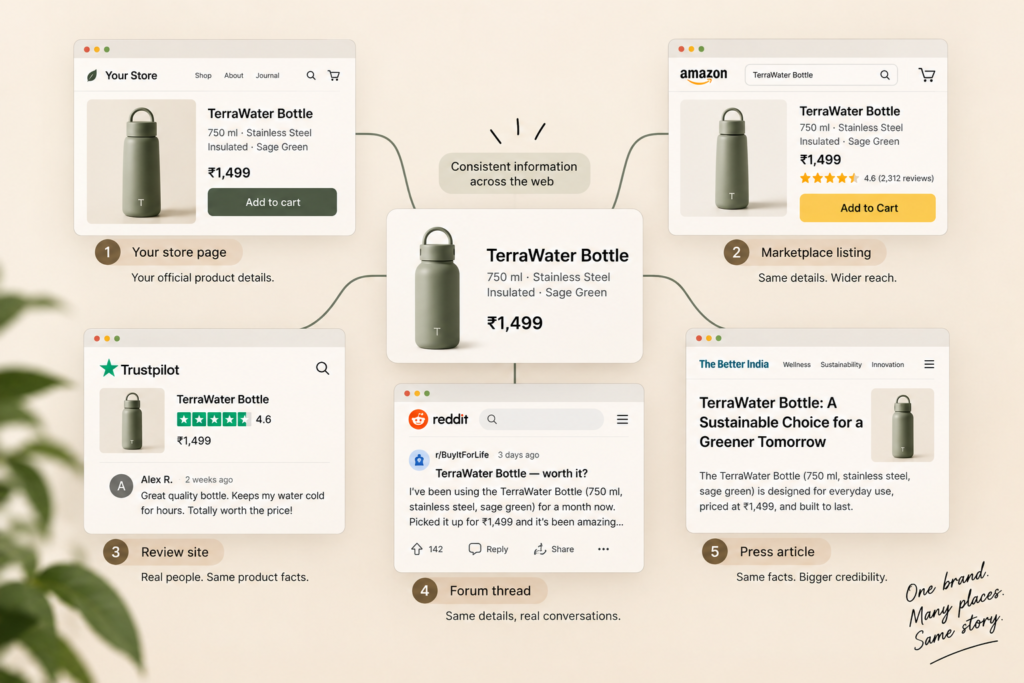
Because models learn from how often and how warmly the web talks about you. A backlink is one weak signal. A glowing mention in a trusted review or forum thread is language the model can actually absorb. For LLM SEO, being discussed beats being linked, which shocks many teams raised on link building.
The data is surprisingly strong. Ahrefs studied 75,000 brands and found branded web mentions had the strongest correlation with AI Overview brand visibility, at 0.664. Branded anchors came next at 0.527, while the number of backlinks sat far lower at 0.218 (Ahrefs).
Correlation isn’t proof of cause, and Ahrefs looked at Google’s AI Overviews specifically. So don’t treat it as gospel. Still, the pattern matches what brands honestly report across engines: real conversations about you seem to count.
That doesn’t mean buying fake reviews or spamming forums. That backfires fast and badly damages trust. It means earning genuine, happy mentions where your buyers already gather, one real conversation at a time.
What should you fix first for LLM SEO?
Fix your facts before you chase shiny new content. Prices, product names, sizes, and key claims should match on your site, marketplaces, social profiles, and press pages. Inconsistent facts confuse models, and a confused model rarely recommends anyone confidently. That boring, honest cleanup is the real heart of LLM SEO.
After that, add clear product details as text and build pages that answer real buying questions. Fair product comparisons and honest buying guides give models something useful to quote with confidence.
Different engines reward this work at frustratingly different speeds, so patience matters. In a published ShopOS engagement, a Mumbai sneaker brand published 72 articles and seeded sneaker communities over 90 days (ShopOS case study). Its citations grew unevenly:
- Perplexity jumped fastest, from 0 to 16 of 20 buyer prompts.
- Claude climbed steadily, from 1 to 13 of 20.
- Gemini grew from 0 to 11 of 20.
- ChatGPT lagged, rising slowly from 0 to 9 of 20.
Notice ChatGPT moved slowest. If you only test one engine, you might panic too early or celebrate too soon. Good LLM SEO work tracks all four, and it stays calm through the slow weeks.
Does LLM.txt help LLM SEO?
Probably not much, at least today. An LLM.txt file is a proposed text file that points AI tools to your key content. It’s harmless to add, but no major engine has promised to use it. Treat it as a tiny experiment, never as a replacement for clear pages and earned mentions.
Google is refreshingly honest about its own AI features. “You don’t need to create new machine-readable files, AI text files, or markup to appear in these features” (Google Search Central).
So be wary of anyone selling LLM.txt as the secret to LLM SEO. That’s a cheap promise dressed up as expertise, and it wastes precious time. Fix a weak product page instead. It’s less exciting, and far more likely to win.
How do you choose an LLM SEO tool?
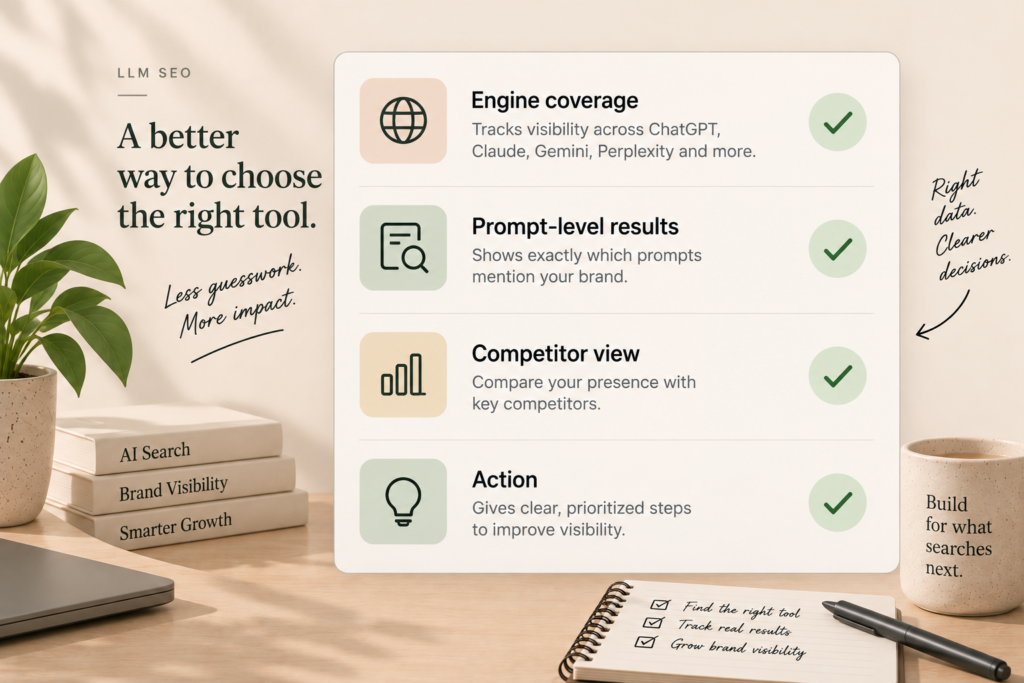
Choose an LLM SEO tool that tracks real buyer prompts by engine over time, then helps you act. Pretty visibility scores feel reassuring but hide the painful detail you need. The best tools show which prompts you win or lose, who beats you, and which pages would close each gap.
Here’s what to look for:
- Engine coverage. ChatGPT, Perplexity, Gemini, and Claude, because missing one hides real risk.
- Prompt-level results. Cited or not cited for each question, not one vague blended number.
- Competitor view. Who wins the prompts you lose, and how often.
- Action, not just alerts. Content suggestions or publishing, so tracking leads to real wins.
Tracking alone can become a sad weekly ritual of watching red numbers and feeling stuck. The useful tools connect the problem to a clear fix.
That simple idea shaped Big Head, the ShopOS GEO and SEO agent. It finds prompts and scores your brand across four engines. Then it publishes useful content to close painful gaps, with your approval first, so production scales without extra headcount.
Pro starts with 5 tracked prompts, and Business covers 100 (ShopOS pricing). If you’re comparing options, ShopOS has a longer guide to AI visibility tools for brand tracking.
Want to go deeper on the page-level craft? Read the guide to answer engine optimization. Prefer handing the work to a partner? Here’s how to judge a generative engine optimization agency before you sign.
Brave enough to see what models honestly say about you right now? Start on the free tier, enter your store URL, and see which prompts name you and which name a rival. Managing a bigger catalog? Book a call for a walk through: Book a call.
FAQ
Is LLM SEO different from regular SEO?
It builds on the same strong foundation, but the finish line moves. Regular SEO fights for rankings and clicks. LLM SEO aims to be described accurately and recommended in AI answers. Good technical health still matters, but off-site mentions and consistent facts carry extra weight with models.
Can I fix what ChatGPT gets wrong about my brand?
Not directly, which feels frustrating. You can’t edit the model. You can publish clear, correct facts on your site and make sure trusted third-party pages match. Over time, live search picks up the fixes faster than training memory does, so start with pages ChatGPT can retrieve today.
Should I block AI crawlers to protect my content?
Think carefully before you do. Blocking AI search crawlers can remove you from answers where buyers are actively shopping. Blocking training crawlers is a separate business decision. Many stores allow search crawlers and review training access with legal advice, rather than blocking everything in a panic.
How long does LLM SEO take?
Live retrieval can reflect good changes within weeks. Training memory shifts much slower, often across model updates. In published ShopOS case studies, brands saw real movement within the first month and strong results by month three. Consistency matters more than any single clever tactic.
Do I need an LLM SEO tool, or can I test manually?
Manual testing works fine for 10 to 20 prompts. It gets tedious and unreliable beyond that, because answers vary between runs and engines. A tool saves hours and shows trends honestly. Pick one that helps you act on gaps, not just report them.
Does Reddit really matter for LLM SEO?
It can, because models learn from real conversations. Both published ShopOS GEO case studies included community seeding alongside content. The key word is genuine. Helpful answers from real people build trust, while spammy posts get removed and can damage your reputation fast.